
TL;DR:
- 90% of consumers use coupons, saving households an average of $1,465 annually.
- Coupon codes include percentage off, dollars off, BOGO, and special deal types; redeem easily online or in-store.
- Smart coupon use boosts local spending, encourages loyalty, and saves money when selecting deals with minimal restrictions.
Most people picture coupon clippers as extreme bargain hunters with binders full of paper cutouts. That image is outdated. 90% of consumers use coupons, and the average household saves $1,465 per year through them. That means your neighbor, your coworker, and the person ahead of you at the restaurant counter are all quietly pocketing real money. This guide breaks down exactly what coupon codes are, how they work across local dining, entertainment, and services, and how you can use them strategically to keep more cash where it belongs: in your wallet.
Table of Contents
- What are coupon codes and how do they work?
- How coupon codes benefit local consumers
- Not all coupon codes are created equal: Choosing the best deals
- Digital coupon trends and smart usage for local savings
- Why smart shoppers go beyond the code: A fresh perspective on saving
- Start saving more with easy-to-use coupon codes nearby
- Frequently asked questions
Key Takeaways
| Point | Details |
|---|---|
| Nearly everyone uses coupons | 90% of consumers use coupons, with average households saving over $1,400 each year. |
| BOGO deals drive the most use | Buy One Get One offers have a 78% redemption rate and give the highest chance at big savings. |
| Digital coupon adoption is skyrocketing | The digital restaurant coupon market is forecasted to surpass $10 billion in 2025. |
| Choose wisely for maximum value | Opt for high-value codes with fewer restrictions and track code expirations for best results. |
| Responsible couponing supports local | Smart use of codes can boost loyalty and spend, benefiting both consumers and neighborhood businesses. |
What are coupon codes and how do they work?
A coupon code is a short sequence of letters, numbers, or symbols that triggers a discount when entered at checkout or shown to a cashier. They started as printed slips in newspapers and mailers, but today most codes live on your phone or in your email inbox. Understanding the basic types helps you recognize which ones are worth your time.
The four main types of coupon codes you'll encounter:
- Percentage off: A set percentage removed from your total, like 20% off your entire order.
- Dollars off: A flat dollar amount subtracted, such as $5 off any purchase over $25.
- BOGO (Buy One Get One): You buy one item and receive another free or at a reduced price.
- Special deal codes: Bundled offers like a free appetizer with an entree, or a discounted service add-on.
Redeeming them is straightforward. Online, you paste the code into a promo field at checkout. In-store, you show the code on your phone or hand over a printed version. Most local restaurants, salons, gyms, and entertainment venues accept both formats. Learning how voucher codes work can help you avoid confusion at the register and make every redemption smooth.
The scale of coupon use is striking. 1.1 billion restaurant coupons were redeemed globally in 2023, saving consumers $2.4 billion. That is not a niche behavior. It is a mainstream habit that spans every income level and neighborhood.
| Coupon type | Average savings | Best used for |
|---|---|---|
| Percentage off | 15-25% per visit | Larger orders or group dining |
| Dollars off | $3-$10 flat | Everyday quick-service meals |
| BOGO | Up to 50% per item | Sharing meals or repeat visits |
| Special deal | Varies widely | Trying new local spots |
Exploring the range of restaurant coupon types available near you is one of the fastest ways to start seeing real savings on your regular spending.
How coupon codes benefit local consumers
Coupon codes are not just about saving a few dollars on a random Tuesday. For local shoppers and diners, they change how often you go out, how much you spend, and even how loyal you become to your favorite spots.
Consider the numbers. Restaurants see a 15% digital sales boost, and diners who use coupons spend 18 to 24% more per visit than those who don't. That sounds counterintuitive until you realize that a discount lowers the mental barrier to ordering that extra dish or trying a new menu item you'd otherwise skip.
"Diners using coupons spend 18 to 24% more per visit, and restaurants gain measurable loyalty from coupon-driven customers."
Here is how coupon usage fits naturally into a typical local routine:
- Search before you go: Before heading to a restaurant or booking a service, spend two minutes checking for active codes on a platform like Clipp.
- Save the code: Screenshot it or copy it to your notes app so it's ready when you need it.
- Apply at checkout: Show or enter the code before you pay. Do not wait until after.
- Track your savings: Note what you saved each month. Most people are surprised how quickly it adds up.
- Repeat at your favorites: The more consistently you use codes at the same spots, the more you benefit from both discounts and loyalty rewards.
Pro Tip: Stack your coupon use with loyalty programs at your go-to local restaurants or service providers. Many businesses let you earn points on a discounted purchase, which means you save twice: once on the bill and once through future rewards.
If you want to get restaurant coupons for your neighborhood, starting with a curated platform saves you the time of hunting across a dozen different websites. Real dining coupon examples show just how much families can trim from their monthly food budgets without changing where they eat.
Not all coupon codes are created equal: Choosing the best deals
Not every coupon code deserves your attention. Some look impressive but come loaded with restrictions that make them nearly impossible to use. Others are genuinely valuable and easy to redeem. Knowing the difference saves you frustration and maximizes your actual savings.

BOGO deals are consistently the most popular format. The 78% BOGO redemption rate tells you that consumers recognize their value. When you get a second item free, you are effectively cutting your per-item cost in half. Percentage-off codes are close behind, especially for larger orders where the savings compound. Flat dollar-off codes work best for smaller, predictable purchases.
| Coupon format | Max savings potential | Common restrictions |
|---|---|---|
| BOGO | Up to 50% per item | Equal or lesser value item only |
| 25% off | High on large orders | Minimum spend often required |
| $5 off | Moderate, predictable | Specific days or hours |
| Free item with purchase | Varies | Limited menu items |
Before you use any code, run through this quick checklist:
- Does the code apply to the specific item or service you want?
- Is there a minimum spend requirement you can realistically meet?
- Are there day or time restrictions that conflict with your plans?
- Does it exclude popular or high-value menu items?
- When does it expire?
Pro Tip: Prioritize coupon codes with high redemption rates and minimal restrictions. A 10% off code with no minimums and no exclusions often beats a 30% off code that only applies on weekday lunches with a $50 minimum.
For deeper guidance, best-value coupon tips walk you through how to evaluate deals quickly. If you want to build a consistent savings habit, proven coupon strategies give you a repeatable framework that works across dining, entertainment, and local services.
Digital coupon trends and smart usage for local savings
The shift to digital coupons is not coming. It is already here. The digital restaurant coupon market is projected to hit $10.57 billion in 2025, reflecting how completely mobile and app-based deals have taken over from paper circulars and mailers. If you are still relying on printed coupons alone, you are missing the majority of available deals.
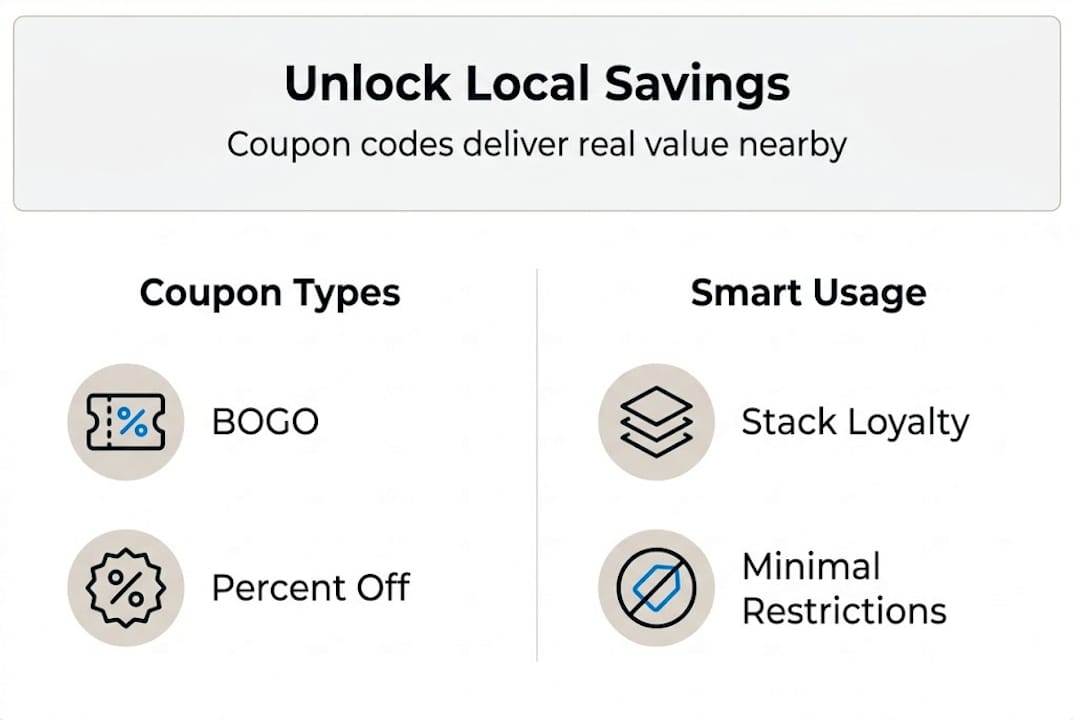
$10.57 billion: The size of the digital coupon market in 2025, driven by mobile adoption and local business promotions.
Redeeming digital coupon codes is a simple process once you know the steps:
- Find your code: Search a local deals platform, check your email, or browse a business's app.
- Verify the details: Confirm the expiration date, applicable locations, and any restrictions before you commit.
- Save it accessibly: Add it to your phone's wallet app, screenshot it, or copy it to a notes file.
- Present at the right moment: Show the code before the transaction is processed, not after.
- Confirm the discount applied: Check your receipt or order summary to make sure the savings registered.
To stay organized when managing multiple codes, keep these habits in mind:
- Create a simple folder in your phone's notes app labeled by category: dining, services, entertainment.
- Set a calendar reminder one day before a code expires so you don't lose it.
- Check stacking rules first. Many businesses allow only one code per transaction.
- Delete expired codes immediately to avoid confusion at checkout.
Understanding digital coupon tips helps you avoid the most common pitfalls, like applying a code to an ineligible item or missing a deal because you didn't check the fine print. For in-person visits, knowing how redeeming coupons in-store actually works prevents awkward moments at the register. And always pay attention to coupon expiration policies, since many digital codes have shorter windows than their printed counterparts.
Why smart shoppers go beyond the code: A fresh perspective on saving
Here is something most coupon guides won't tell you: chasing every available discount is not the same as saving smartly. Real coupon mastery means understanding timing, exclusivity, and knowing when skipping a deal actually serves you better.
The businesses offering you local coupons are your neighbors. Over-discounting or exploiting every loophole can quietly strain the small restaurants and service providers that make your neighborhood worth living in. Consumers spend 18 to 24% more when coupons are used responsibly, and businesses gain genuine loyalty in return. That is a relationship worth protecting.
"Responsible couponing creates a cycle where consumers save more and local businesses grow stronger together."
The smartest savers we see use coupons to try new local spots, reward businesses they already love, and time their deals around genuine need rather than impulse. They treat coupons as a tool, not a game. That mindset shift is what separates someone who saves $200 a year from someone who saves $1,400. If you want to understand the full picture, the local coupon marketing guide shows how businesses and consumers both win when deals are used with intention.
Start saving more with easy-to-use coupon codes nearby
You now have a clear picture of how coupon codes work, which types deliver the most value, and how to use them without falling into common traps. The next step is putting that knowledge to work in your own neighborhood.
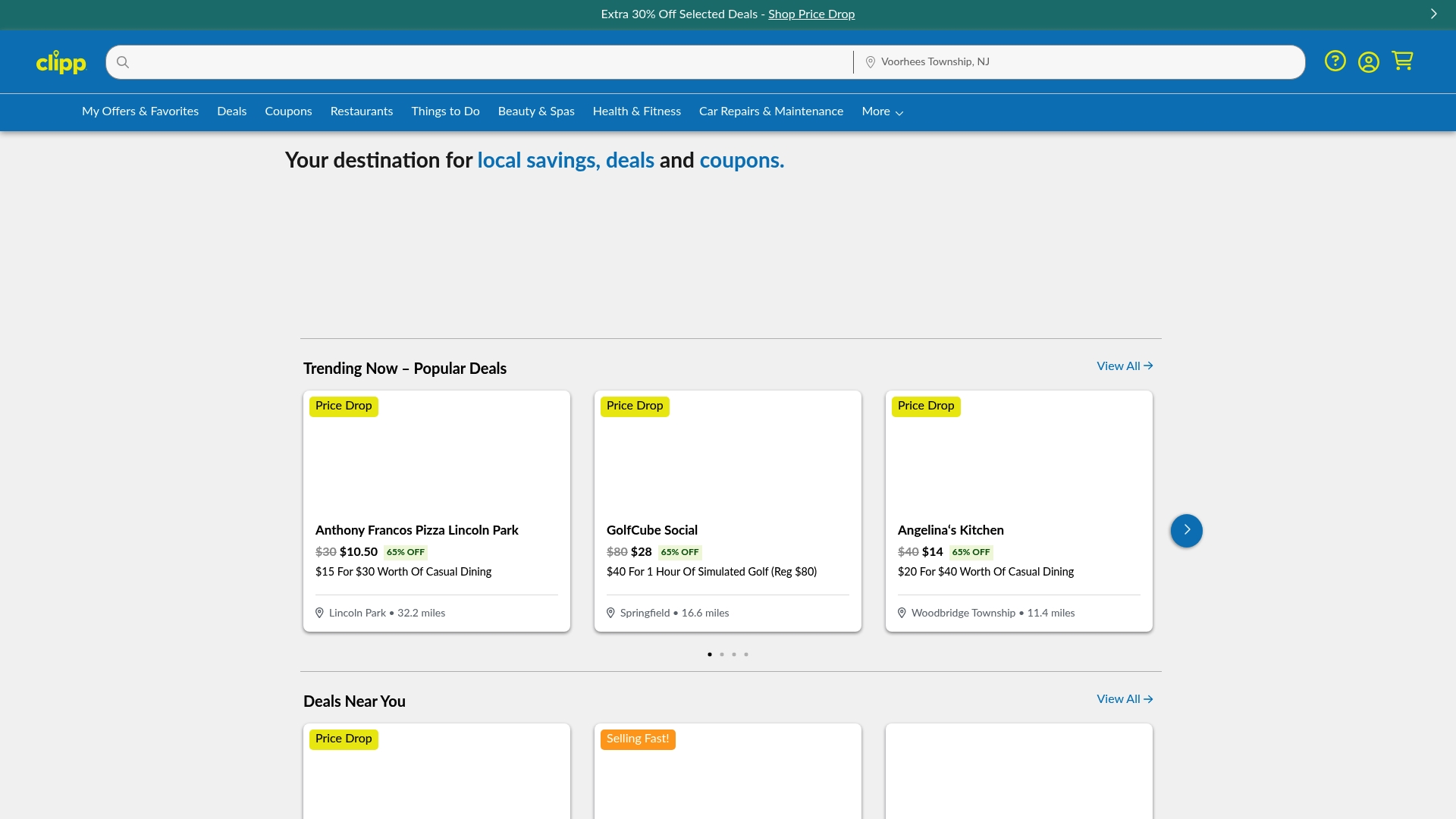
Clipp makes it easy to find the best local deals in Ashburn without the hassle of searching across multiple sites. Browse fresh Ashburn coupons for dining, entertainment, wellness, and more, all in one place. Whether you're planning a night out or booking a routine service, Clipp local savings connects you to verified offers that are ready to use today. No binders required.
Frequently asked questions
How do I redeem a coupon code at local businesses?
Show or enter your code at checkout. Most restaurants, stores, and services accept both printed and digital coupons, and simple coupon redemption takes less than 30 seconds.
Are digital coupon codes better than printed ones?
Digital coupons are often easier to find, organize, and track. With the digital coupon market projected to reach $10.57 billion in 2025, mobile savings have become the standard for most local deals.
Which coupon codes save the most money?
BOGO and percentage-off codes typically deliver the highest savings. BOGO deals carry a 78% redemption rate, making them the most popular and often the most valuable format available.
Do coupon codes affect loyalty points or rewards?
Using coupon codes generally adds to your savings without canceling loyalty points. Data shows that coupons drive loyalty and repeat visits, meaning you often benefit on both fronts at once.
What should I check before using a coupon code?
Always review the expiration date, location restrictions, and minimum spend requirements. Checking coupon expiration policies before you head out prevents surprises at the register.