

TL;DR:
- Promo codes are alphanumeric strings used online to unlock discounts and special offers.
- They can be public or private, with various restrictions and validation checks.
- Finding and using codes strategically enhances savings while saving time and effort.
You've filled your cart, you're ready to pay, and then you see it: a small box labeled "promo code." You either scramble to Google one or skip it entirely and wonder if you just left money on the table. You probably did. Promo codes show up in 38% of online purchases, yet millions of shoppers still aren't sure what they actually do or how to use them effectively. This guide breaks down exactly what promo codes are, how they work at checkout, why they sometimes fail, and where to find the best ones for dining, entertainment, and everyday local services.
Table of Contents
- What is a promo code and how does it work?
- Types of promo codes and how they differ from coupons
- Limits, exclusions, and common reasons promo codes fail
- Where to find promo codes for local savings
- The fine print: Tax rules, brand perception, and personal data
- A smarter approach: Why strategic promo code use unlocks more than savings
- Find the latest promo codes and deals near you
- Frequently asked questions
Key Takeaways
| Point | Details |
|---|---|
| Promo codes defined | Promo codes are short digital codes entered at checkout to unlock discounts on products or services. |
| Common discount types | They provide percentage off, fixed discounts, free shipping, BOGO, or special perks depending on the code. |
| Limits and tips | Watch out for expiration, usage limits, and product restrictions to make sure your code works. |
| Local savings strategies | Find codes through local deal platforms, daily deal sites, or business newsletters to save on dining and entertainment. |
| Beyond savings | Strategic use of promo codes can maximize value, avoid hassle, and support your favorite local businesses. |
What is a promo code and how does it work?
A promo code is exactly what it sounds like: a short string of letters and numbers you type into a box at checkout to get a discount. More precisely, a promo code is a short alphanumeric string entered at checkout to unlock discounts like percentage off, fixed amounts, free shipping, or other perks on products or services. Think of it as a digital handshake between you and the business, confirming you qualify for a special deal.
When you enter a code, the system doesn't just blindly apply a discount. The system validates the code against expiration dates, usage limits, minimum spend requirements, eligible items, and customer status before applying any discount. If everything checks out, the savings appear instantly. If not, you get an error message with little explanation.
Businesses offer promo codes for several smart reasons:
- Attract new customers who might not otherwise try a product or service
- Reward loyal shoppers with exclusive savings not available to the general public
- Clear inventory quickly without permanently lowering prices
- Drive traffic during slow periods, like weekday lunch specials at local restaurants
Here's a quick look at how promo codes function in practice:
| Feature | Details |
|---|---|
| Code format | Alphanumeric string (e.g., SAVE20, PIZZA10) |
| Common discount types | % off, fixed dollar amount, free shipping, BOGO |
| Validation checks | Expiration, usage limits, minimum spend, item eligibility |
| Application timing | Applied before final payment |
| Common risks | Expired codes, stacking restrictions, category exclusions |
For everyday savings like restaurant coupons or local deals on entertainment, promo codes are one of the fastest ways to reduce your bill without much effort.
Types of promo codes and how they differ from coupons
Not all promo codes are created equal, and they aren't the same thing as traditional coupons either. Understanding the difference saves you time and frustration.
Common promo code types include percentage discounts, fixed-amount savings, free shipping, and buy-one-get-one offers. Some are restricted by geography, product type, or customer category. Beyond the discount type, codes also fall into two broad categories:
- Public or shared codes: Posted openly on deal sites or social media. Anyone can use them, but they may expire fast or have high usage limits.
- Private or unique codes: Sent directly to specific customers via email or loyalty programs. These are personalized and often one-time use only.
Promo codes differ from traditional coupons in a key way: codes are alphanumeric strings designed for digital entry, while coupons are often visual images or printable pages with barcodes. Unique codes also track redemption better and prevent unauthorized sharing.

| Feature | Promo code | Traditional coupon |
|---|---|---|
| Format | Alphanumeric text string | Image, barcode, or printable |
| Redemption | Online checkout field | In-store or online upload |
| Tracking | Easy, tied to account or order | Harder to track digitally |
| Sharing risk | Low (unique codes) | Higher (anyone can copy) |
| Common use | E-commerce, apps, local platforms | Grocery stores, print ads |
For a deeper look at how different savings formats compare, check out the breakdown of restaurant coupon types to see which works best for dining deals.
Pro Tip: When you find a promo code on a deal site, copy it exactly as shown, including any capitalization. Many systems are case-sensitive, and even one wrong character will cause the code to fail.
Limits, exclusions, and common reasons promo codes fail
Few things are more annoying than an error message right before you check out. Here are the most common reasons promo codes don't work and what you can do about each one.
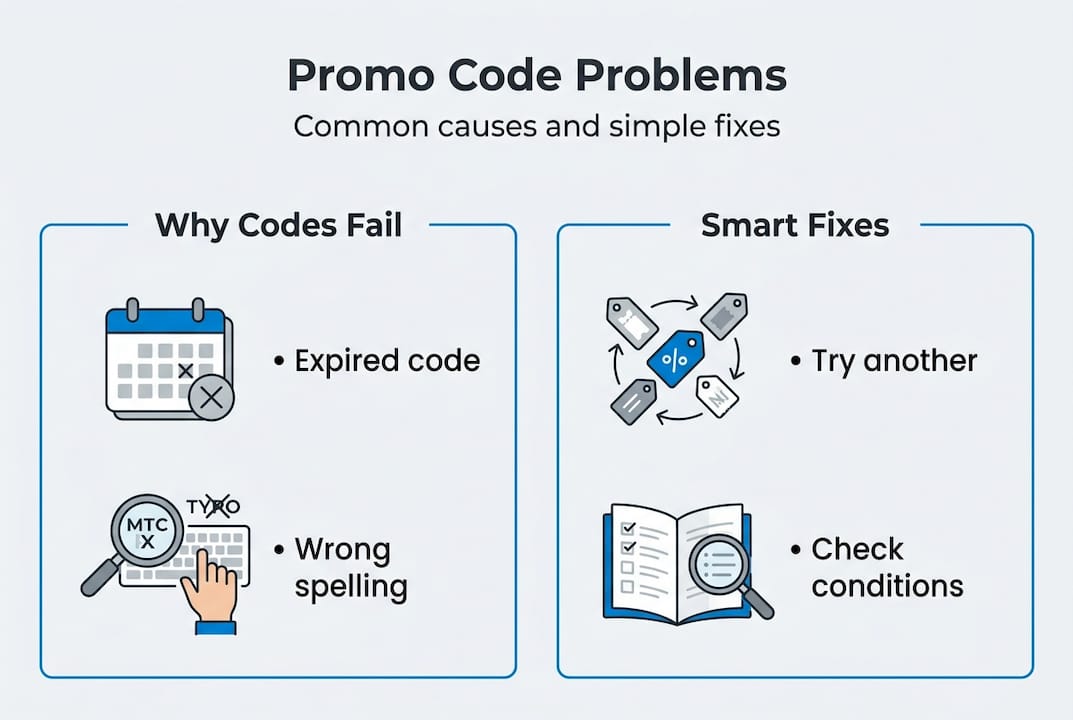
Common promo code limitations include expired codes, exceeded usage limits, minimum spend not met, excluded items or categories, new or existing customer restrictions, no stacking of multiple codes per order, and sale item exclusions. Most of these are intentional design choices, not glitches.
- Expired code: Every promo code has a lifespan. Weekend flash deals may expire in 48 hours.
- Already used: Single-use codes are tied to your account or email. Once redeemed, they're gone.
- Minimum spend not met: Many codes require a cart total of $25, $50, or more before they activate.
- Item exclusion: Certain categories like alcohol, gift cards, or already-discounted items are often excluded.
- New customer only: Some codes are specifically for first-time buyers. Existing accounts won't qualify.
- Code stacking not allowed: Most platforms only allow one promo code per order.
- Geographic restriction: Some local deals are only valid in specific cities or zip codes.
"Single-use codes significantly reduce fraud and unauthorized sharing. And with over 93% of coupon redemptions now happening on mobile devices, the shift to digital, trackable codes is accelerating fast."
If a code fails, don't give up immediately. Check the spelling, look for eligibility notes, and try an alternative platform. Browsing types of local deals can also surface newer, active codes you may have missed.
Pro Tip: Apply your promo code early in the checkout process, before entering payment info. This way, you confirm it works before committing to the purchase.
Where to find promo codes for local savings
Knowing how codes work is only half the battle. Finding reliable, active ones for local dining, entertainment, and services is where the real skill comes in.
For consumers focused on city-specific deals, the best strategy is to use platforms built for local discovery rather than generic national coupon sites. Daily deal platforms and local coupon sites function similarly to retailer coupons, so testing codes directly in your cart and checking exclusions before finalizing is always the smart move.
Here are the most reliable discovery channels for promo codes:
- Local deal platforms: Sites like Clipp.com curate codes and deals by city and category, making it easy to find savings near you.
- Retailer newsletters: Signing up for emails from your favorite restaurants or gyms often unlocks welcome discounts and member-only codes.
- Social media: Brands frequently post limited-time codes on Instagram and Facebook, especially around holidays or local events.
- Physical mailers: Old-school but effective. Many local businesses still mail promo codes to nearby households.
- University or community programs: Student and resident discount programs often include exclusive codes for local services.
- Loyalty apps: Many local chains have their own apps with rotating promo codes for frequent visitors.
For families and frequent diners, the best habit is to check your preferred local deal platform before every outing. New codes rotate regularly, and finding local deals becomes second nature once you build it into your routine. Set up email alerts or app notifications so you never miss a limited-time offer.
The fine print: Tax rules, brand perception, and personal data
Promo codes come with a few less obvious considerations that are worth knowing before you click "apply."
Tax implications can vary depending on the type of discount. Manufacturer coupons may be taxable if reimbursed by the manufacturer, while retailer coupons and standard promo codes are generally not taxed. Double discounts, where a promo code is applied on top of a sale price, can sometimes affect the taxable amount. It's a minor detail, but worth noting if you're budgeting carefully.
Brand strategy behind promo codes is more deliberate than most shoppers realize. Promo codes preserve full pricing perception better than permanent price cuts, and they drive trials effectively, with 58% of consumers trying a new brand after receiving a promo offer. Businesses use codes to attract new customers without signaling that their regular prices are inflated.
Privacy and data use is another angle worth considering:
- When you enter your email to receive a promo code, you're joining a marketing list.
- Single-use codes reduce fraud and sharing, and personalized codes see 20 to 30% higher redemption rates than generic ones.
- Businesses use this data to retarget you with future offers, which can be helpful or overwhelming depending on your preferences.
- You can always unsubscribe after claiming your discount, but expect a follow-up email or two.
Being aware of these details helps you use promo codes on your terms, saving money without handing over more personal data than you're comfortable with.
A smarter approach: Why strategic promo code use unlocks more than savings
Here's something most savings guides won't tell you: chasing every promo code you find can actually cost you more time and energy than the discount is worth. The real win comes from being selective.
Think about it this way. If you spend 20 minutes hunting for a code that saves you $2, that's not a great trade. But if you spend 2 minutes on a trusted local platform and save $15 on a family dinner, that's genuine value. The difference is having a system instead of scrambling.
Smart consumers build direct relationships with local businesses they love. Follow them on social media, join their loyalty programs, and ask staff about upcoming deals. These connections often surface verified, exclusive codes that never appear on public deal sites.
Timing also matters more than most people think. Combining a promo code with an off-peak visit, like a Tuesday lunch instead of Saturday dinner, often stacks savings in ways that compound. Restaurants and entertainment venues are more likely to honor flexible deals during slower periods.
View promo codes as one tool in a larger savings strategy, not the whole strategy. Use them to amplify value you were already going to get, not to drive decisions you wouldn't otherwise make. Platforms built for maximizing local savings make this approach much easier by surfacing deals that match your actual habits and location.
Find the latest promo codes and deals near you
Now that you know exactly how promo codes work, where to find them, and how to use them wisely, the next step is putting that knowledge to work. Clipp.com makes it easy to browse local deals and local coupons across dining, entertainment, wellness, and more, all organized by your city and neighborhood.
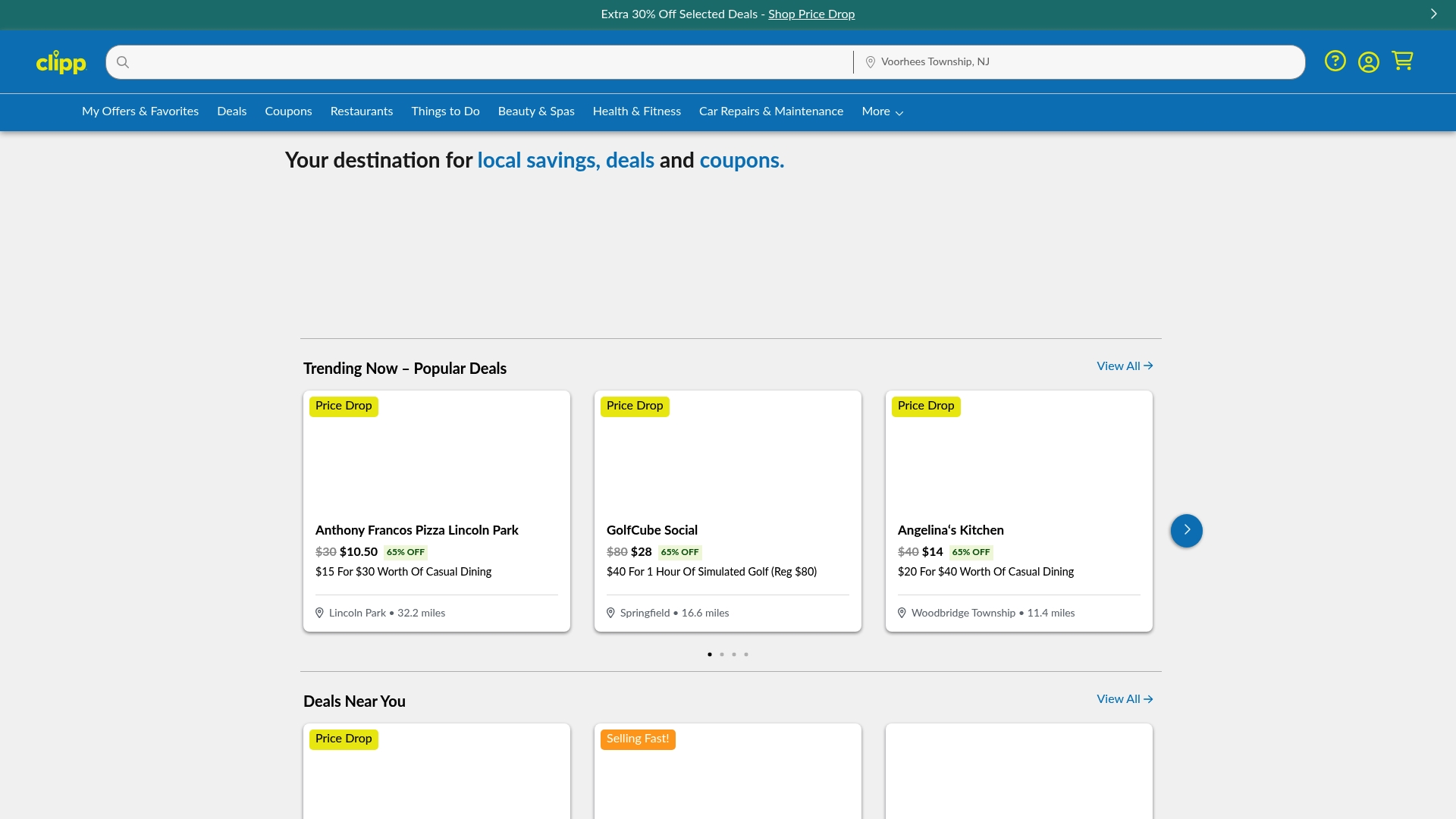
Whether you're planning a family night out, looking for a great restaurant deal, or searching for savings on everyday service coupons, Clipp.com connects you with trusted, verified offers from local businesses near you. No guessing, no expired codes, just real savings ready to use.
Frequently asked questions
What is the difference between a promo code and a coupon?
Promo codes are alphanumeric strings entered online for instant discounts, while coupons are often images or printable formats with barcodes that may be used in-store or uploaded digitally.
Why won't my promo code work?
Common reasons include expired codes, already used codes, not meeting the minimum spend, product exclusions, and not qualifying as a new or existing customer depending on the offer terms.
Are promo code discounts taxable?
Manufacturer coupons may be taxable if reimbursed by the manufacturer, while retailer coupons and standard promo codes are generally not taxed. Always check your local regulations for specifics.
Where can I find valid promo codes?
You can find active promo codes on daily deal and local platforms, retailer email newsletters, social media brand pages, and loyalty apps, especially for local dining and entertainment offers.