

One word in a coupon's fine print can cost you real money. The difference between "expires on" and "valid through" sounds minor, but it determines whether your deal goes through or gets rejected at the register. Coupon interpretation depends on phrasing, and most shoppers never realize this until they're standing at the checkout counter, embarrassed and empty-handed. Whether you're hunting for dining discounts, entertainment deals, or everyday service savings in your neighborhood, understanding how expiration language works is the single fastest way to stop leaving money on the table.
Table of Contents
- The basics: Why coupons have expiration dates
- Decoding expiration language: 'Expires on' vs. 'valid through'
- Where and when coupons are accepted: Policies from major local retailers
- Strategies to maximize your savings before coupons expire
- Discover and apply local deals before coupons expire
- Frequently asked questions
Key Takeaways
| Point | Details |
|---|---|
| Expiration phrasing matters | Always check if your coupon says 'expires on' or 'valid through' to know the exact redemption deadline. |
| Major retailers rarely accept expired coupons | Strict policies mean expired coupons almost never work; check before visiting local stores. |
| Fine print impacts savings | Coupon terms, exclusions, and limits restrict how and when deals can be used, so always read carefully. |
| Maximize local deals with tracking | Use reminders and digital platforms to monitor coupon expiration and redeem offers before they lapse. |
The basics: Why coupons have expiration dates
Coupons don't expire by accident. Businesses set expiration dates deliberately, and the reasons go deeper than you might expect. At the core, expiration dates help companies manage financial risk. Every unredeemed coupon sitting in someone's wallet is a liability on a business's books. Putting a firm end date closes that liability and keeps accounting clean.
For local restaurants and entertainment venues, the timing of a promotion matters just as much as the discount itself. Local dining promotions like those on Groupon or DoorDash carry firm expiration dates specifically to fill slow periods and control how many discounted visits happen at once. A pizza place running a Tuesday night special doesn't want that coupon redeemed on a packed Friday evening.
The fine print attached to any coupon is where the real rules live. Here's what you'll typically find buried in those small-font terms:
- Expiration date: The hard cutoff for redemption
- Eligibility requirements: Who qualifies (new customers only, loyalty members, etc.)
- Exclusions: Items or services the coupon cannot be applied to
- Stacking rules: Whether you can combine it with other offers
- Redemption limits: One per customer, one per visit, or one per household
"Clear expiration dates, eligibility rules, and redemption limits are found in 56% of campaigns as standard coupon terms designed to prevent abuse."
Skipping the fine print is the number one reason shoppers lose savings they thought they had locked in. Take two minutes to read it before you head out the door. And if you're looking for deals that already have clear terms spelled out, check out these restaurant coupon tips to start saving smarter on dining.
Decoding expiration language: 'Expires on' vs. 'valid through'
This is where most coupon confusion lives. Two phrases that look almost identical carry very different meanings, and getting them mixed up is a costly mistake.
"Expires on [date]" means the coupon becomes invalid at the very start of that date, specifically at midnight. So if your coupon says "expires on June 15," you cannot use it on June 15 at all. The last valid day was June 14.

"Valid through [date]" means you can use the coupon all the way through the end of that day. A coupon "valid through June 15" is good until 11:59 PM on June 15. You have the full day.
Here's a quick comparison to keep it straight:
| Phrasing | Last valid day | Can you use it on the printed date? |
|---|---|---|
| Expires on June 15 | June 14 | No |
| Valid through June 15 | June 15 | Yes, all day |
| Until June 15 | June 14 | No |
| Good through June 15 | June 15 | Yes, all day |
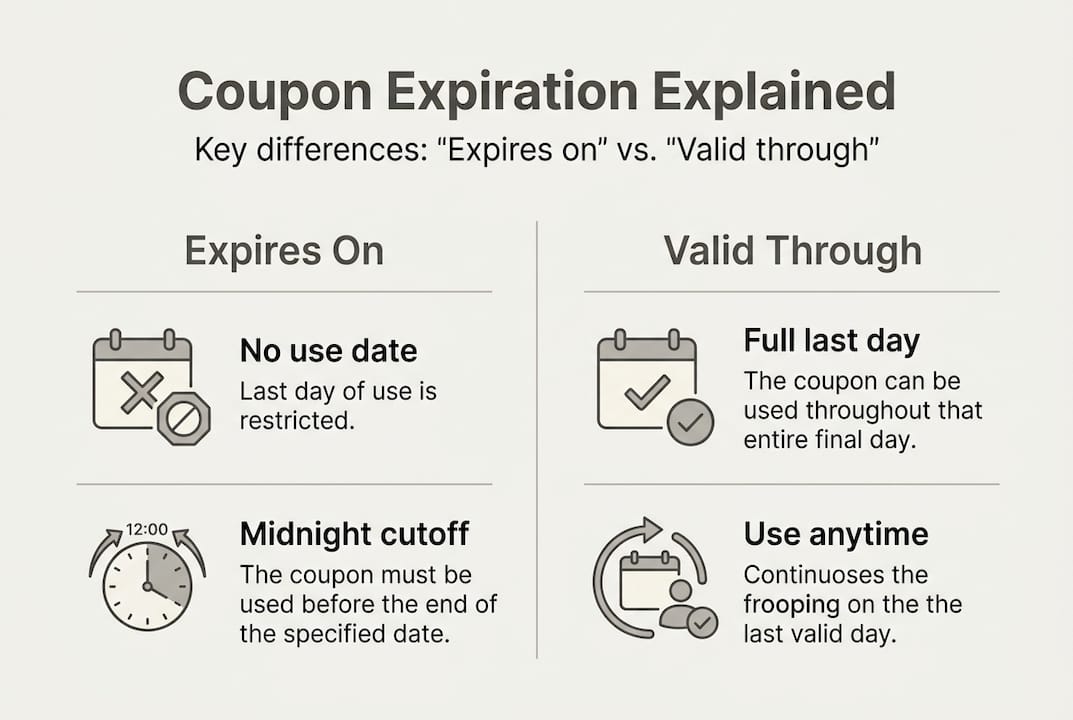
The words "until" and "expires on" both exclude the printed date. The words "through" and "valid through" include it. Semantics determine validity in every case, so reading carefully is non-negotiable.
Here's a simple framework to apply this in real life:
- Find the expiration phrase on your coupon before anything else.
- Identify whether it uses inclusive language ("through," "good through") or exclusive language ("expires on," "until").
- Count back one day if the language is exclusive.
- Set a reminder for the actual last valid day, not the printed date.
- Redeem early in the day to avoid any last-minute system or policy issues.
Pro Tip: When browsing local deals, look for platforms that display both the start and end dates clearly. Shoppers in states like Louisiana can browse Louisiana restaurant deals or check out Delaware entertainment savings to find offers with transparent redemption windows already built in.
Where and when coupons are accepted: Policies from major local retailers
Knowing what a coupon says is one thing. Knowing whether a store will actually honor it is another. The short answer: expired coupons almost never work, and hoping for an exception is a losing strategy.
Target's official policy is direct: expired coupons are not accepted, period. Shaw's Supermarket holds the same line. These aren't arbitrary decisions. Retailers who accept expired coupons cannot get reimbursed by manufacturers, which means the store eats the cost. That's a financial hit no business wants to absorb regularly.
Here's how acceptance policies typically break down across different venue types:
| Venue type | Expired coupon accepted? | Notes |
|---|---|---|
| Major grocery chains | No | Manufacturer reimbursement rules are strict |
| Big-box retailers | No | System-level rejection at POS |
| Local restaurants | Rarely | Discretionary, inconsistent |
| Local service providers | Sometimes | May honor within a short grace window |
| Entertainment venues | No | Ticketing systems enforce dates automatically |
A few things to keep in mind when planning your redemptions:
- Always check the store's coupon policy page before shopping
- Don't assume a cashier can override an expired coupon, most can't
- Digital coupons often auto-expire in the app, removing the guesswork
- Local service providers (salons, gyms, pet groomers) may have more flexibility, but never count on it
Pro Tip: Browse local savings in your state to find deals that are currently active and verified, so you never walk into a store with a coupon that's already dead.
Strategies to maximize your savings before coupons expire
Now that you understand the rules, let's talk about winning the game. The shoppers who consistently save the most aren't lucky. They're organized and strategic.
Here's a proven approach to getting full value from every coupon you collect:
- Set calendar reminders. The moment you save a coupon, add a reminder two days before it expires. This gives you time to plan a trip without scrambling.
- Use digital platforms with live tracking. Apps and websites that show real-time expiration windows eliminate the guesswork entirely.
- Stack eligible deals. Many local restaurants and retailers allow one manufacturer coupon plus one store coupon on the same purchase. Always check the stacking rules in the fine print.
- Redeem earlier in the day. Technical glitches, long lines, and system errors are real. Don't risk a last-minute redemption on the final day.
- Prioritize high-value, short-window deals. A 40% off coupon expiring in three days beats a 10% off coupon with two months left. Work the urgency.
The manufacturer reimbursement cutoff makes expired coupons genuinely risky for retailers, which is exactly why they enforce dates so strictly. Understanding this helps you respect the timeline and plan accordingly.
More ways to stretch your savings:
- Follow local deal platforms for flash sales and limited-time drops
- Sign up for email alerts from your favorite local restaurants and service providers
- Check for birthday or loyalty bonuses that extend your savings window
- Look for deals that allow multiple redemptions across a household
If you're in New York, for example, New York dining deals are updated regularly with current expiration windows. Pair that with solid restaurant coupon tips and you have a repeatable system for saving on every meal out.
Discover and apply local deals before coupons expire
You now know how to read expiration language, understand store policies, and build a savings strategy that actually works. The next step is finding deals worth using before they disappear.
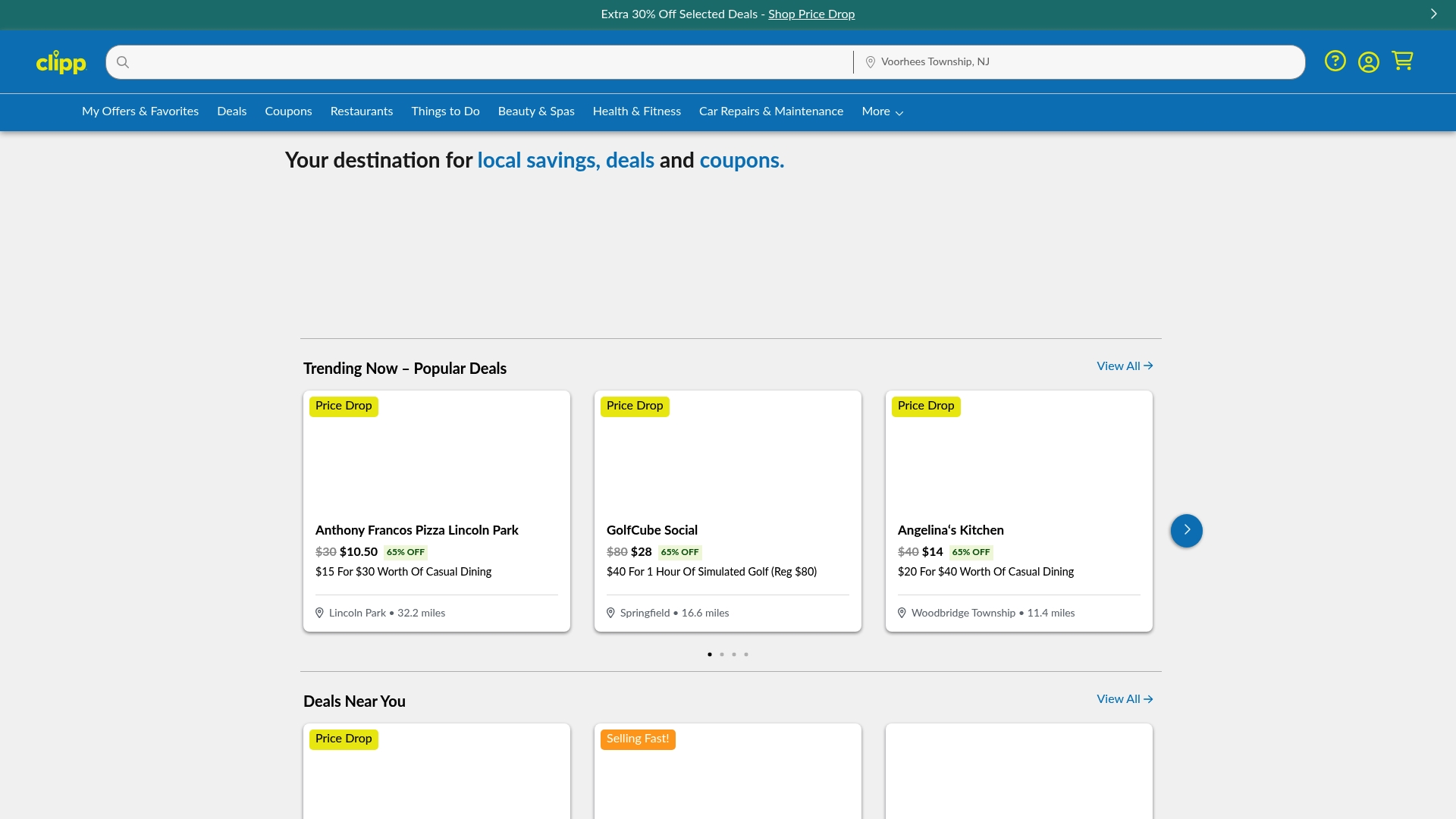
Clipp.com makes it easy to browse verified, up-to-date offers filtered by category, location, and expiration window. Whether you're looking for local deals in Ashburn, browsing Ashburn coupons for your next grocery run, or hunting for service deals in Ashburn like salon visits or home repairs, the platform keeps everything current so you're never working with outdated information. No more guessing whether a deal is still live. No more awkward moments at the register. Just real savings, ready to use, right in your neighborhood.
Frequently asked questions
Does 'expires on' mean I can still use my coupon on that date?
No. "Expires on" means invalid starting at midnight on that date, so the last day you can use it is the day before the printed date.
Are expired coupons ever accepted by local restaurants or stores?
Rarely. Major retailers like Target explicitly do not accept expired coupons, and most restaurants follow the same policy. Any exceptions are purely at the manager's discretion.
How can I avoid missing out on local deals due to expiration?
Set reminders two days before a coupon expires and use digital platforms that display live deal windows. 82% of consumers actively use coupons and deals, so competition for the best offers is real.
Is there a difference between 'valid through' and 'expires on' in coupon terms?
Yes, a significant one. "Valid through" includes the full last day for redemption, while "expires on" means the coupon is already invalid on the printed date.
Why do coupons have so many fine print terms and exclusions?
To control costs and prevent abuse. Clear terms appear in 56% of coupon campaigns as a standard practice to protect both businesses and consumers during promotions.