

TL;DR:
- Nearly 70% of online coupon codes fail at checkout, causing shoppers to waste time on ineffective discounts. Coupons define offer rules, while promo codes are the activation strings entered at checkout; many discounts apply automatically without codes. Focus on verified retailer coupons and understanding offer rules to maximize local savings effectively.
Nearly 7 in 10 online coupon codes don't actually work at checkout, which means most shoppers are wasting real time and energy chasing discounts that were never going to fire. The frustration usually comes down to one thing: not understanding the difference between a coupon and a promo code, and how each one actually works. These two terms get used interchangeably everywhere, but they are not the same thing, and that gap in understanding quietly kills savings for millions of local deal hunters every day. This guide breaks down exactly what each one is, how they're redeemed, why codes fail, and what strategies reliably put more money back in your pocket.
Table of Contents
- What are coupons and promo codes?
- How coupons and promo codes work: redemption and rules
- Key differences for deal hunters: practical impact
- When to use coupons, promo codes, or both: strategies for local savings
- A deal hunter's perspective: what most guides miss
- Unlock deeper local savings with Clipp
- Frequently asked questions
Key Takeaways
| Point | Details |
|---|---|
| Coupons define the rules | Coupons set the eligibility, timing, and scope for discounts, both online and in-store. |
| Promo codes trigger discounts | Promo codes are entered at checkout to activate specific coupon rules, mainly online. |
| Check fine print for savings | You save most by reviewing expiration dates, eligible items, and stacking policies. |
| Code reliability is low | Only about 32 percent of online promo codes actually work for shoppers. |
| Local deals often stack | Combining automatic coupons and promo codes can boost savings when allowed. |
What are coupons and promo codes?
Most people treat "coupon" and "promo code" as two ways to say the same thing. They're not. Understanding the actual difference is the first step toward saving more without the guesswork.
A coupon is essentially a set of rules. It defines the offer, who qualifies for it, when it's valid, what products or services it covers, and under what conditions it applies. Think of it as the contract behind a discount. When your local pizza shop runs a "buy one, get one free on Tuesdays" offer, the coupon is the entire structure governing that deal, including the day restriction, the product pairing, and the eligibility requirements. A good resource for explaining coupon codes can help you see exactly how these rules shape the savings you're able to access.
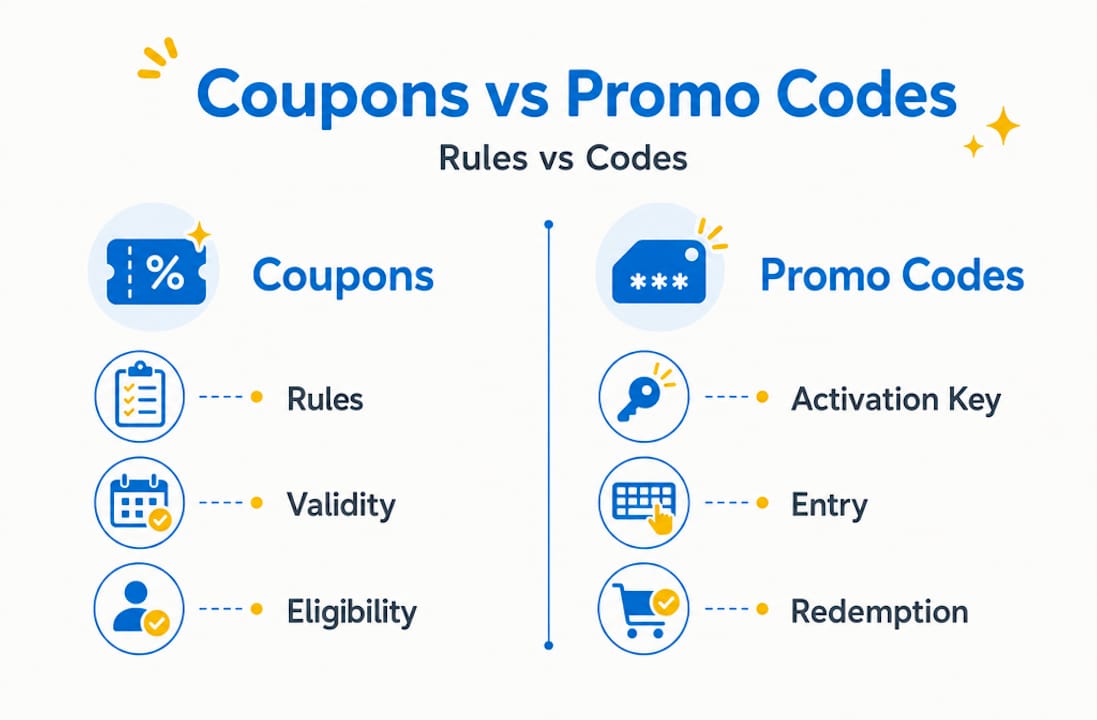
A promo code, on the other hand, is the customer-facing activation key. It's the string of letters and numbers you type into a checkout field to trigger the discount. As Stripe explains, a coupon is the set of rules or offer mechanism, while a promo code is the customer-entered string that redeems it. The promo code is how the system knows to apply the coupon's rules to your specific transaction.
Here's what surprises most shoppers: plenty of discounts don't require any code at all. Promo codes are triggers for coupons, but many discounts apply automatically without visible codes when the eligibility conditions are already met. If you're logged into a loyalty account, or your cart already meets the minimum spend, the coupon rules can fire without you typing anything. Understanding what is a promo code in this broader context helps you stop over-relying on code hunting and start recognizing automatic savings opportunities more readily.
Key traits of each:
- Coupons define eligibility, timing, product scope, usage limits, and discount type (percentage off, flat dollar amount, free item)
- Promo codes are strings entered at checkout that link your transaction to a specific coupon's rules
- Automatic discounts apply coupon rules without any code, triggered by account status, cart contents, or promotional periods
- Both can exist in digital or physical formats, and both can be time-limited or category-specific
"A coupon is the foundational offer structure; a promo code is simply one method customers use to claim it. Many shoppers never realize that the most reliable discounts often require no code at all." This distinction matters enormously when you're trying to build a repeatable savings strategy rather than relying on luck.
How coupons and promo codes work: redemption and rules
With definitions in place, let's examine how coupons and promo codes are redeemed, and why those mechanics matter for your wallet.
Coupons can be redeemed in-store via barcode or scan, or online through code entry or automatic application. Promo codes are mostly used for online checkout and require manual entry by the customer. That distinction shapes the entire experience of saving money, especially when you're shopping locally across both physical and digital channels.
Here's a direct comparison to make it clear:
| Feature | Coupons | Promo codes |
|---|---|---|
| Redemption location | In-store and online | Primarily online checkout |
| Entry method | Barcode, scan, or auto-apply | Manual entry at checkout |
| Typical use case | Broad promotional campaigns | Targeted, audience-specific offers |
| Visibility to shopper | Printed, digital, or automatic | Alphanumeric string (e.g., SAVE20) |
| Flexibility | High, multiple formats | Lower, requires exact code match |
When you're redeeming coupons in-store, the experience is usually smoother because the cashier or point-of-sale system handles the validation. Online, redemption depends entirely on whether you meet the rules embedded in the coupon before the code triggers anything. That's where most failures happen.
Common rule types that govern both coupons and promo codes:
- Expiration dates: The most obvious rule. Even a working code fails after the offer window closes.
- Minimum spend requirements: Many offers only activate once your cart total hits a threshold, such as $25 or $50.
- Product or category exclusions: A restaurant coupon might apply to entrees but exclude drinks, or a salon coupon might cover cuts but not color services. Knowing common restaurant coupon types helps you read these restrictions faster.
- Single-use restrictions: Some codes are one-time-use per customer or per account, and they silently fail if you've already claimed them.
- Stacking rules: Many offers explicitly prohibit combining with other active promotions, which is one of the leading causes of failed checkouts.
- Account-level requirements: Certain codes are locked to specific customer segments, like new users or loyalty members.
Pro Tip: Before entering any code at checkout, scan the offer's fine print for the three most common deal-killers: expiration date, minimum cart requirement, and stacking restrictions. This takes 30 seconds and saves you the frustration of a failed checkout. Staying current with digital coupon tips also helps you recognize red flags in unfamiliar offer structures.
Key differences for deal hunters: practical impact
Understanding redemption logic is one thing, but local deal hunters need actionable insights to avoid losing out on savings. Here's what actually matters.

The single most important data point every deal hunter should know: only 31.9% of codes work at redemption, and code effectiveness decays quickly after publication. That means roughly two out of every three promo codes you find on a general coupon-listing site are going to fail. This isn't bad luck. It's a structural problem with how codes circulate online.
Why does this happen so often?
| Failure reason | How common | What to do |
|---|---|---|
| Expired offer | Very common | Always check publication date |
| Cart ineligibility | Common | Verify product/category exclusions |
| Stacking conflict | Frequent | Check if other promos are active |
| Account restrictions | Moderate | Confirm code matches your account type |
| Already redeemed | Moderate | Single-use codes fail silently |
| Retailer discontinued | Less common | Use retailer-issued sources only |
Many codes fail due to cart ineligibility, expired offers, or stacking conflicts. What's worth noting is that none of these failures are random. Every one of them is a predictable outcome of not reading the coupon rules before attempting redemption. The code itself isn't broken. The conditions simply weren't met.
Steps to maximize your savings and avoid failed attempts:
- Read the fine print first. Before copying any code, find the offer's terms. Look specifically for expiration date, eligible items, and minimum spend.
- Prioritize retailer-issued codes. Official codes from a brand's own website, email newsletter, or app have dramatically higher success rates than codes scraped from third-party listing sites.
- Check for active stacking conflicts. If your cart already has an automatic discount applied, many promo codes will refuse to stack on top of it. Temporarily remove other offers and test.
- Use code-verification tools or verified coupons sources. Platforms that actively test and verify codes before listing them save you enormous time and prevent the dead-end checkout experience.
- Apply one offer type at a time. Test automatic discounts first, then see if a promo code can stack. Never assume stacking is allowed by default.
- Build your savings around coupon strategies rather than code hunting. Strategic rule-based savings consistently outperform the random approach of trying whatever codes you find.
Pro Tip: When a promo code fails at checkout, don't just abandon the cart. Check whether an automatic discount is already active, whether your cart meets all eligibility conditions, and whether the code was sourced directly from the retailer. These three checks resolve the majority of failed attempts.
When to use coupons, promo codes, or both: strategies for local savings
With primary differences covered, let's get practical: how do you choose and use coupons or promo codes for real-world savings?
The key insight is that promo codes activate targeted discounts, while coupons can apply automatically. Maximizing savings requires checking constraints more than chasing code deals. This reframes the entire game. Instead of spending 20 minutes hunting for a code that might not work, experienced deal hunters spend 5 minutes verifying that a reliable coupon's conditions are already met.
When to favor coupons over promo codes:
- You're shopping in-store and need a physical or scannable offer
- The retailer already offers automatic discounts tied to loyalty programs or minimum spend
- You want broad coverage across a category rather than a single targeted item
- You're using platforms like Clipp that curate verified local deals with clear eligibility rules
When promo codes work better:
- You're completing an online checkout and have a retailer-issued code from a newsletter or app
- The offer is targeted to your customer segment (new user, VIP member, returning buyer)
- You need a specific, one-time discount that isn't available as a public automatic offer
- You're booking local services like salons, gyms, or restaurants where promo codes are sent via email
A real-world stacking scenario worth understanding:
Imagine you're ordering from a local restaurant that offers an automatic 10% loyalty discount when you're logged into your account. The restaurant also sends a promo code for free delivery to email subscribers. If the restaurant's rules allow stacking, you enter the delivery code at checkout and both discounts apply. But if stacking isn't permitted, entering the code might cancel the automatic discount, netting you less savings overall. This is exactly why checking the restaurant coupon guide and reading rules before checkout beats guessing every time.
For local savings specifically, the headline percentage of a deal matters far less than whether you actually qualify for it. A 40% off code that fails at checkout is worth zero. A reliable coupon aggregator for local savings that surfaces verified, eligible offers beats any random code list. Focusing on best-value coupon tips aligned with your actual shopping habits builds consistent savings that code hunting never delivers.
A deal hunter's perspective: what most guides miss
Most coupon guides online are essentially code-hunting checklists. They point you to aggregator lists, tell you to try several codes, and treat failed checkouts as part of the process. That's a fundamentally broken approach, and it explains why so many shoppers feel like savings are harder to get than they should be.
The real skill in deal hunting isn't finding codes. It's reading rules. Expert advice consistently points to most people saving more by checking coupon rules than by chasing codes. This isn't a minor optimization. It's a complete strategy shift. When you understand the rule structure behind an offer, you know instantly whether it applies to you, whether it can stack, and whether it's worth your time.
Retail-issued coupons almost always outperform codes scraped from third-party sites. Retailers control the source, they honor their own offers reliably, and they often bundle automatic discounts that require no code at all. The habit of going directly to the retailer's app or email list for codes, rather than a generic code listing site, immediately lifts your success rate above the 32% industry average.
Focusing tightly on local category eligibility matters more than most shoppers realize. A coupon for 20% off dining within your neighborhood is worth far more than a 30% off code for a restaurant that doesn't serve your area. The digital coupon benefits and risks framework helps sharpen this kind of thinking by making you weigh not just the discount amount but the actual probability of successful redemption.
The smartest deal hunters we've observed don't spend time on code-scraping sites at all. They build a short list of trusted sources, understand the rule structures for their favorite categories, and let automatic discounts do most of the heavy lifting. That approach is less exciting than hunting for secret codes, but it's dramatically more effective.
Unlock deeper local savings with Clipp
You now have a clear picture of how coupons and promo codes actually work, why so many codes fail, and what strategies consistently produce real savings. The next step is putting that knowledge to work with offers you can actually trust.
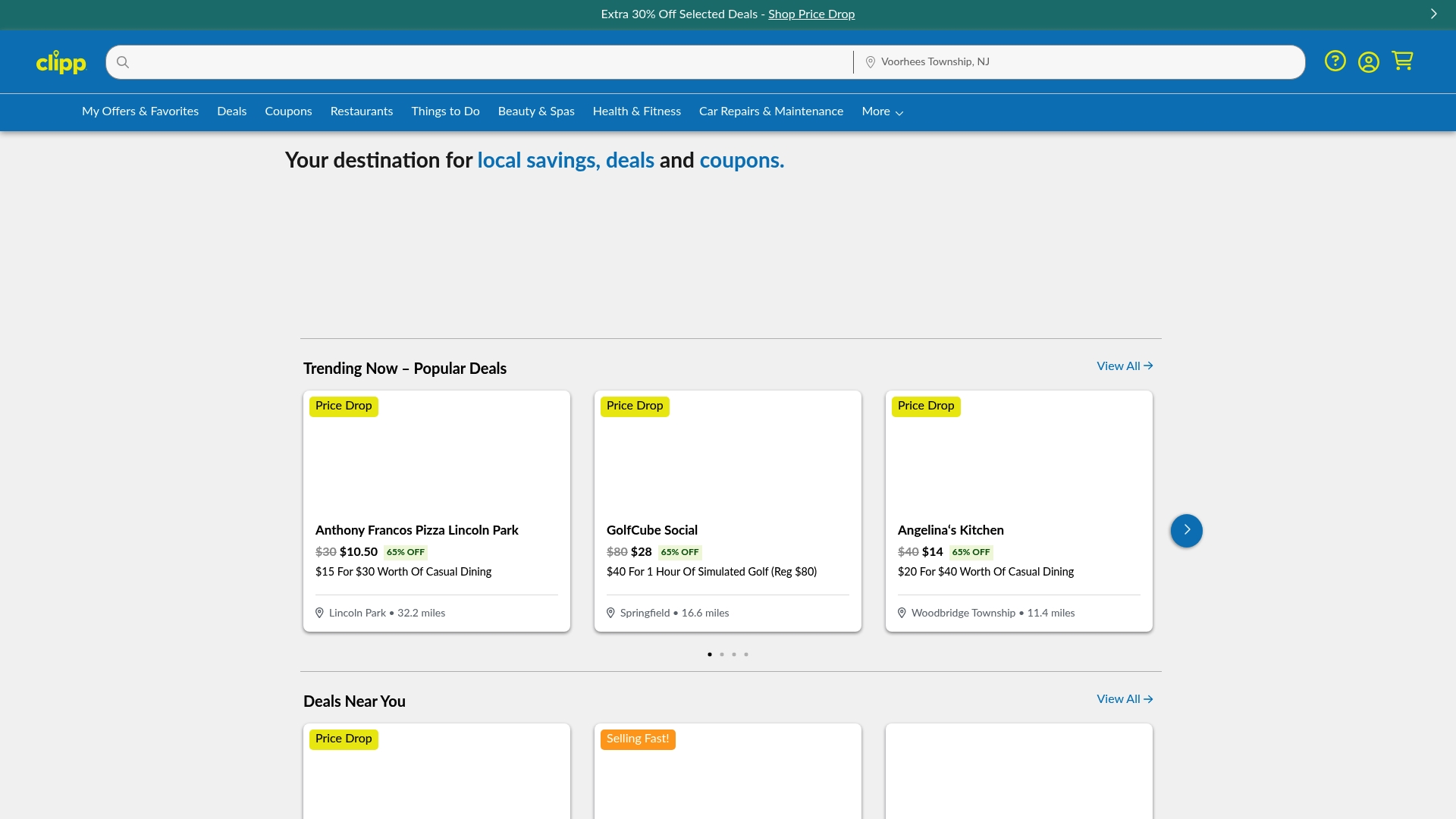
Clipp connects local deal hunters with verified coupons and promo codes across dining, wellness, home services, entertainment, pet care, and more in neighborhoods across the country. Every deal on the platform is curated so you're not wading through expired codes or offers that don't match your location. Browse trending deals near you, filter by category, and find automatic discounts alongside code-redeemable offers, all in one place. Whether you're looking for a reliable restaurant deal or a local salon promotion, Clipp's deals near you are built for the way real shoppers save.
Frequently asked questions
Can coupons be used both online and in-store, and how do promo codes fit in?
Yes, coupons commonly support both in-store and online redemption, while promo codes are typically entered manually at online checkout and don't apply in physical settings.
Why do so many promo codes fail when I try to use them?
Promo codes frequently fail due to expiration, ineligible cart items, minimum purchase requirements not being met, or conflicts with other active discounts already applied to your order.
How can I maximize savings: should I look for coupons or promo codes?
You'll save most consistently by reviewing coupon rules before attempting redemption, using verified retailer-issued codes, and stacking eligible offers where the merchant's terms explicitly allow it.
Are automatic discounts different from promo codes?
Yes, automatic discounts apply when eligibility conditions are already met without any customer action, while promo codes require manual entry at checkout to activate the underlying discount.
What's the average success rate for online promo codes?
Only about 31.9% of published codes work at checkout, meaning nearly seven in ten codes fail, most often due to expiration or cart eligibility mismatches.