

TL;DR:
- Reliable, verified codes and local focus are key features of top coupon sites.
- Combining cashback, stacking deals, and local vouchers maximizes savings effectively.
- Consistent routines and trusted platforms lead to greater overall deal success.
Finding the right place to score genuine local discounts is harder than it sounds. Hundreds of coupon sites compete for your attention, and not all of them deliver real value. Some show expired codes, others are loaded with pop-ups, and many simply skip local deals entirely in favor of big national retailers. If you've ever pasted a promo code at checkout only to see it fail, you know the frustration. This guide cuts through the noise, laying out exactly what separates a great coupon platform from a mediocre one, which sites lead the pack in 2026, and how to combine them for savings that actually add up.
Table of Contents
- What makes a great coupon site?
- The top coupon sites for local and online savings
- Head-to-head: How the best coupon sites compare
- How to maximize your savings: Stacking, tips, and mobile strategies
- Why real savings require more than just coupon clipping
- Find your next local deal with Clipp
- Frequently asked questions
Key Takeaways
| Point | Details |
|---|---|
| Success depends on strategy | Quality coupon sites and effective stacking can save an average household over $1,400 per year. |
| Top sites offer different strengths | Platforms like RetailMeNot, Rakuten, and Groupon each excel in specific ways—compare features for your needs. |
| Efficiency matters | Browser extensions and mobile apps can automate savings and boost code success rates above 90%. |
| Local deals are surging | Community-focused and geo-targeted coupon platforms are a fast-growing source of discounts for dining and entertainment. |
What makes a great coupon site?
Having introduced the challenge of choosing the best options, it's important to know what sets the top coupon sites apart. Not every platform is built the same way, and the difference between a useful site and a waste of time often comes down to a handful of specific features.
Reliability and code verification sit at the top of the list. A coupon site is only as good as its current offers. Platforms that show you a code's success rate, flag recently verified deals, or automatically test codes before surfacing them save you the pain of failed checkout attempts. Look for timestamps on every deal.
Local versus national reach is a major dividing line. Some sites focus entirely on big box retailers and e-commerce giants. Others zero in on neighborhood restaurants, local salons, gyms, and entertainment venues. For most everyday shoppers, the mix of both matters. Digital coupon tips can help you navigate this split effectively.
User experience affects how quickly you can find and use a deal. Search filters, category browsing, map-based local deal discovery, and a clean mobile interface all reduce friction. If you're hunting for a last-minute restaurant deal before dinner, a cluttered site with no filters costs you time and money.
Community-driven content adds a layer of trust that editorial teams alone can't provide. Sites that let users vote on deals, report expired codes, or submit new finds tend to surface better opportunities. Think of it as a crowd-sourced quality check.
Cashback and stacking options separate good platforms from great ones. Some sites offer flat cashback on purchases, while others let you combine cashback with promo codes or in-store deals. This is where serious savers make the biggest gains.
Privacy and spam protection matter more than most people realize. Sites that require extensive sign-up information or bombard you with marketing emails can cost more in frustration than they save in dollars.
Here's a quick checklist of what to look for before trusting any coupon site:
- Code verification timestamps and success rate indicators
- Coverage of local businesses, not just national chains
- Mobile-friendly design with location-based filtering
- User-submitted deals with community voting
- Cashback programs with stacking capability
- Clear privacy policy and minimal required sign-up data
Pro Tip: Always check a coupon site's "last verified" date on a code before copying it. If it hasn't been verified in more than 30 days, skip it and find a fresher source.
The scale of digital coupon use is staggering. 90% of U.S. consumers are projected to use digital coupons in 2026, with average household savings reaching $1,465 per year or roughly $12.85 per transaction. That kind of money adds up fast when you use the right platforms consistently.
The top coupon sites for local and online savings
Now that you know what to look for, let's break down the leading coupon platforms tailored to both local and national needs. Each of these sites has carved out a specific niche, and knowing those niches helps you pick the right tool for the right situation.
RetailMeNot is one of the most recognized names in online couponing. RetailMeNot aggregates promo codes and cashback deals for more than 20,000 stores, with success rates displayed alongside each code. That transparency is a standout feature. Its focus skews toward online retail, making it excellent for e-commerce purchases but less useful for finding a deal at your local pizza spot.
Rakuten takes a different angle. It combines cashback up to 40% at more than 3,500 stores with a browser extension called "Coupon Magic" that automatically tests and applies codes at checkout. You just shop, and the extension does the work. For online shopping, this automation is hard to beat. The cashback gets deposited into your account and paid out quarterly.
Slickdeals runs on community power. Users post and vote on deals across all categories, including local dining and entertainment, and the front page highlights whatever the community rates as the best current finds. It's particularly strong for limited-time flash deals and product discounts, though local service deals require more digging.
Groupon dominates the local deals space. Whether you're looking for a discounted massage, a half-price dinner for two, or tickets to a local event, Groupon has built its entire model around this kind of savings. Local deals are prominent in dining at 64% usage, and Groupon often delivers entertainment discounts up to 70% off. It's the first stop for local service savings.
Restaurant.com specializes in dining certificates and promotions for independently owned restaurants. If your goal is to explore local food spots without overpaying, this platform fills a gap that larger national sites often miss. Pairing it with smart grocery coupon tips for home meals rounds out a solid food savings strategy.
A few key highlights across these platforms:
- RetailMeNot: Best for online retail, transparent success rates
- Rakuten: Best for cashback on national brands, automated code testing
- Slickdeals: Best for community-vetted flash deals and tech discounts
- Groupon: Best for local dining, entertainment, and services
- Restaurant.com: Best for independent restaurant dining certificates
"The most effective couponers don't rely on a single platform. They pick two or three that match their lifestyle and use them consistently for every purchase decision."
Pro Tip: Install the Rakuten browser extension before your next online shopping session. It activates automatically on supported retailer pages and applies the best available code without any extra steps on your part.
Head-to-head: How the best coupon sites compare
With the key players covered, a direct comparison helps clarify which platforms excel for particular scenarios. Raw features tell part of the story, but understanding strengths and limitations in context makes all the difference.
The digital coupon market reached $19.8 billion in 2025, with 142 billion digital coupon redemptions. Yet online promo codes still fail at high rates, with success rates often falling below 50%. This gap explains why automation and verification matter so much.
Here's how the major platforms stack up:
| Platform | Code Success Rate | Cashback | Local Deals | Community | Ease of Use |
|---|---|---|---|---|---|
| RetailMeNot | Moderate (shown) | Yes | Limited | No | High |
| Rakuten | High (auto-tested) | Yes (1-40%) | Limited | No | Very High |
| Slickdeals | Varies | No | Some | Yes (voting) | Moderate |
| Groupon | High (curated) | No | Excellent | No | High |
| Restaurant.com | High (curated) | No | Dining only | No | High |
| Clipp | High (verified) | No | Excellent | No | Very High |
Best for online retail shopping: Rakuten wins here because its browser extension eliminates guesswork. You don't need to search for codes manually; they're tested and applied automatically.
Best for local dining and services: Groupon and Clipp lead this category. Groupon's scale gives it breadth, while platforms like Clipp focus tightly on neighborhood-level deals with verified offers you can trust.
Best for community deal discovery: Slickdeals stands alone. If you enjoy the hunt and want to see what deals others are raving about, the community voting system surfaces gems that editorial teams might miss.
Best for maximizing code reliability: Any platform using automated code testing or curated local deals will outperform a simple code aggregator. The local deal strategies you use matter as much as which platform you choose.
Digital redemption rates average 13.4% across the industry, but curated local platforms consistently beat that average because every offer is tied to a specific, active merchant promotion. When using coupon platforms built around local verification, your success rate climbs significantly.
The bottom line: no single platform wins across every category. Savvy shoppers maintain accounts on two or three platforms, each chosen for a specific purpose.
How to maximize your savings: Stacking, tips, and mobile strategies
Once you know how the top sites compare, here's how to get the most out of every deal opportunity. The real power of coupon sites comes not from using one perfectly, but from combining several strategically.
Stacking is the technique of layering multiple discount types on a single purchase. Stacking codes, cashback, and sales consistently delivers the highest savings, and browser extensions can boost your automation efficiency to a 92% success rate on supported sites. Here's a simple step-by-step process:
- Find the best available sale or promotion on the item or service you want. Check the retailer's website first.
- Search for a promo code on RetailMeNot or the retailer's dedicated coupon page.
- Activate cashback through Rakuten or a similar cashback portal before you click through to the retailer.
- Apply any in-store or mobile coupon if you're buying locally, such as a Groupon voucher or Clipp deal.
- Pay with a rewards credit card to earn points on top of your existing savings.
A real-world example: you want dinner for two at a local restaurant. You find a Groupon voucher worth $30 for $15. You pay with a rewards card that earns 3% back on dining. Your actual cost for a $30 dinner drops to around $14.55 after the card reward. That's more than 50% off without doing anything complicated.
Mobile coupons and in-store deals are growing fast. Mobile and in-store redemption sits at 68% usage and climbing. Most platforms now offer app-based deal browsing with location filtering, which means you can pull up deals on your phone the moment you're standing outside a restaurant or salon.
Timing matters more than most people admit. Restaurants and local services often push their best promotions on slower business days, typically Monday through Wednesday. Setting deal alerts for your favorite categories means you see those offers before they sell out.
Here's a quick comparison of savings strategies by approach:
| Strategy | Effort Level | Avg. Savings Boost | Best Platform |
|---|---|---|---|
| Single promo code | Low | 5-15% | RetailMeNot |
| Cashback only | Very Low | 1-40% | Rakuten |
| Stacking codes + cashback | Medium | 20-50%+ | Rakuten + any code site |
| Local voucher (Groupon/Clipp) | Low | 30-70% | Groupon, Clipp |
| Full stack (voucher + card rewards) | Medium | 50%+ | All combined |
Restaurant coupon strategies deserve special attention because dining is where most local shoppers leave money on the table. Many restaurants also send exclusive offers through restaurant promo emails, so signing up for your favorite spots' newsletters adds another savings layer.
Pro Tip: Before any significant local purchase, spend 90 seconds checking Groupon and Clipp for that specific business or category. This habit alone can recover several hundred dollars per year in savings you would have otherwise missed.
Why real savings require more than just coupon clipping
Here's something that years of observing deal hunters has made clear: the shoppers who save the most are not the ones with the most codes. They're the ones with the best process.
Most people approach couponing as a quantity game. They open five browser tabs, grab every code they can find, and then spend 10 minutes at checkout testing codes that fail one after another. That approach is exhausting and produces inconsistent results. The average online promo code fails more than half the time without proper vetting.
The smarter move is to treat your coupon toolkit like a small set of trusted tools rather than a bottomless junk drawer. Pick one cashback platform. Pick one local deal platform. Install one browser extension. Then use them every time, for every purchase, without exception. The habit is what compounds.
Community platforms like Slickdeals are genuinely valuable, but they require active engagement to get the most out of them. If you don't have time to browse community posts and vet deals yourself, automation and curated local platforms will serve you better.
Local deal platforms also have an edge that national coupon aggregators can't replicate. When a deal is tied to a specific neighborhood merchant and verified by the platform, the reliability is fundamentally higher than a generic promo code pulled from a web scraper. Saving on local deals consistently beats chasing national codes for the everyday shopper.
The uncomfortable truth is that the best coupon strategy is also the most boring one: build a short, repeatable routine and stick with it. Real savings come from consistency, not heroic one-time coupon hunts.
Find your next local deal with Clipp
Ready to put all of this into practice? Clipp makes local savings straightforward by gathering verified deals from restaurants, salons, gyms, entertainment venues, and service providers right in your neighborhood. Every offer on the platform is curated and active, so you skip the frustration of expired codes and failed checkouts.
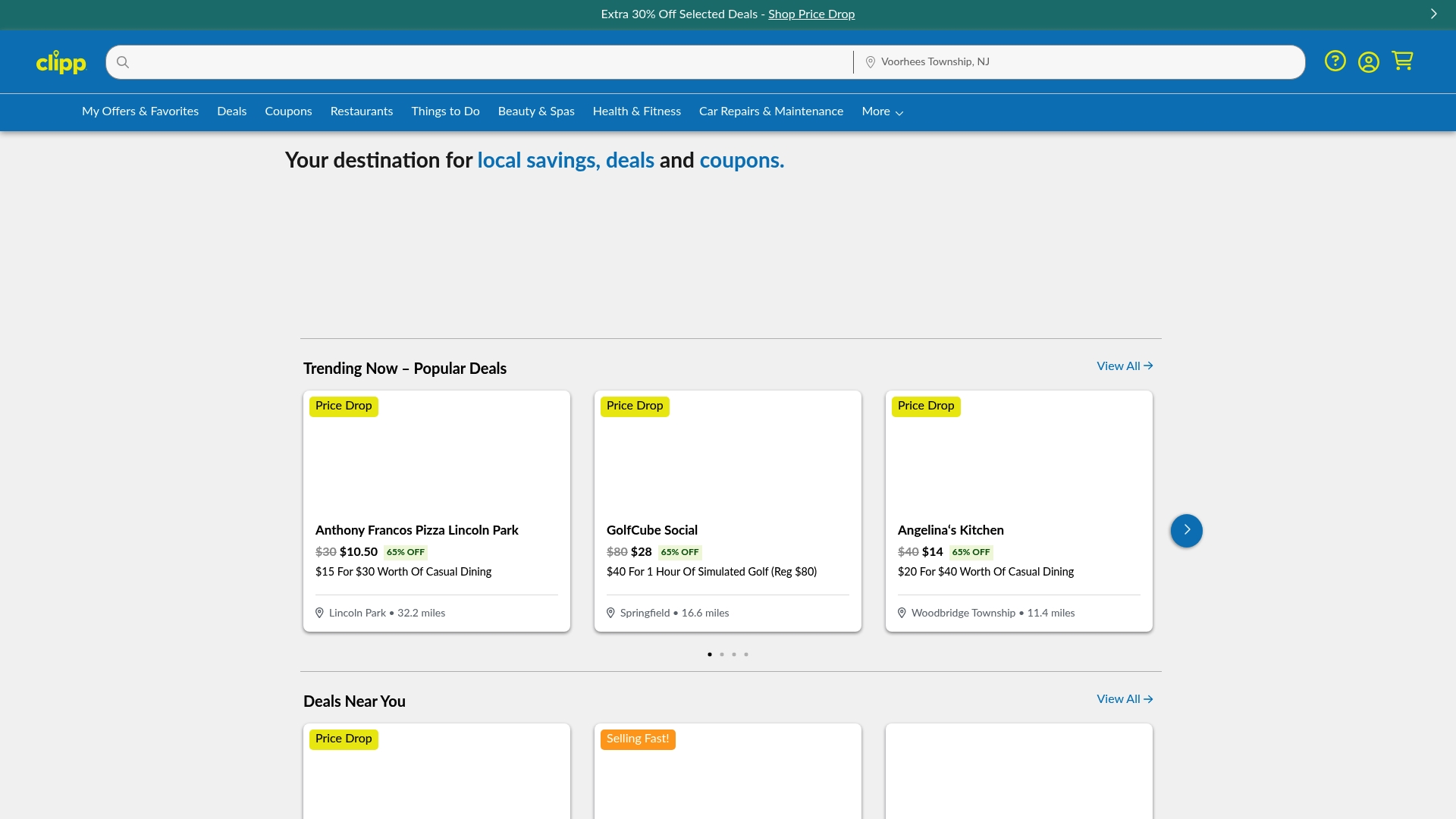
Browse local coupons by category or search deals near you to find what's available in your city right now. The mobile-friendly layout means you can check for savings on the go, whether you're planning a dinner out or booking a local service. New deals update regularly, so checking back often keeps you ahead of the best limited-time offers in your area.
Frequently asked questions
Why do some online coupon codes fail to work?
Online coupon codes can fail due to expiration, usage limits, or retailer restrictions. Online codes often work less than 50% of the time, which is why verified platforms and browser extensions that auto-test codes are worth using.
Which coupon site is best for dining and local entertainment?
Groupon and Restaurant.com are top choices for local dining and entertainment savings. Local dining deals account for 64% of local coupon usage, with some Groupon offers reaching up to 70% off.
Is it possible to stack coupons and cashback offers for better savings?
Yes, and it's one of the most effective strategies available to everyday shoppers. Stacking codes with cashback and sales layers multiple discounts on a single purchase for significantly higher total savings.
Do browser extensions really help with coupon success?
Browser extensions can dramatically improve your results by automatically testing and applying the best available code at checkout. Extensions boost savings efficiency to a 92% auto-success rate on supported sites.
Are digital and mobile coupons replacing paper ones?
Absolutely. Mobile and in-store redemption now accounts for 68% of coupon usage and continues to climb, making digital-first platforms the most practical choice for modern deal hunters.