

Businesses target deal seekers because they reliably drive trial, clear slow inventory, and fill off-peak hours while protecting full-price margins for other customers. According to Clipp consumer research, 91% of consumers actively seek coupons, which means the deal-seeking segment is too large to ignore. Merchants who treat these shoppers as a distinct group can grow short-term sales volume without cutting prices across the board.
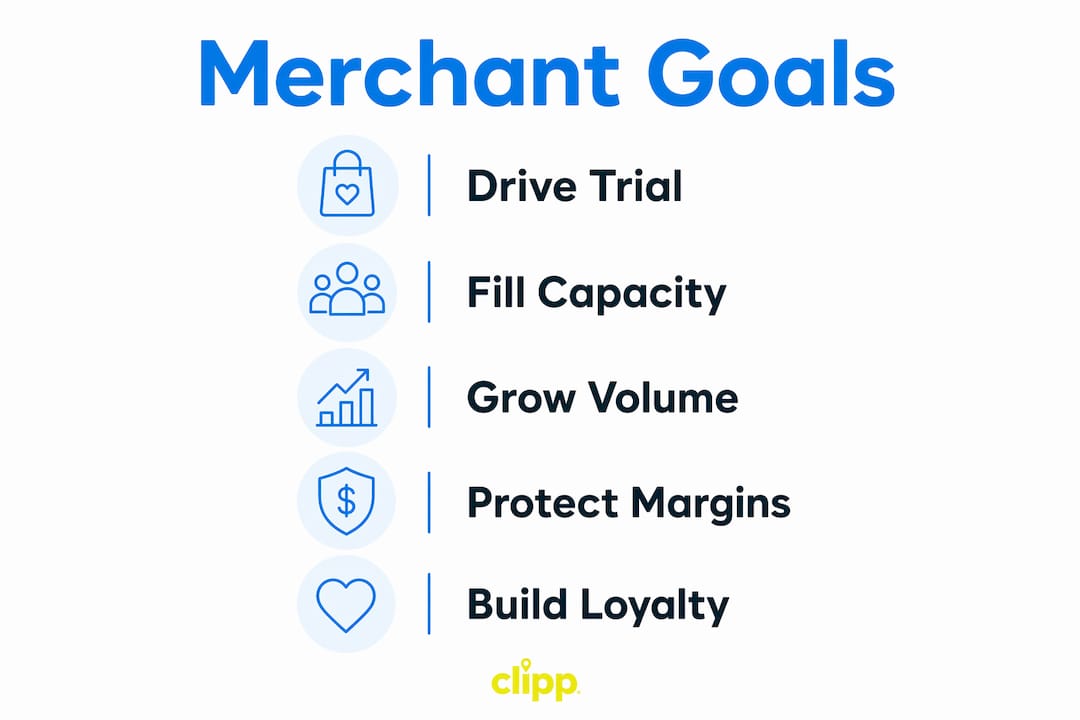
- Drive trial: Discounts get first-time customers through the door who might never have paid full price.
- Move inventory: Flash sales clear slow-moving stock before it ties up cash.
- Fill slow periods: Timed offers push bookings during off-peak hours or days.
- Increase foot traffic: Local deal platforms like Clipp connect nearby shoppers to businesses they haven't tried yet.
The sections below explain the merchant economics, the tactics used to reach you, the risks involved, and a quick checklist for judging whether a local deal is actually worth it.
Table of Contents
- Why do businesses target deal seekers?
- How do merchants actually reach deal hunters?
- What are the real risks for businesses that chase deal seekers?
- What do targeted deals actually mean for you as a consumer?
- How to evaluate a local deal before you use it
- How Clipp helps you find and use local deals
- Key Takeaways
- The deal economy rewards the skeptical
- Useful sources
- Clipp puts local savings where you can actually find them
Why do businesses target deal seekers?
Merchants pursue deal-seeking customers for one core reason: segmented pricing lets them sell the same product or service at different price points to different customer groups, which stabilizes revenue and grows total sales volume without alienating full-price buyers. A restaurant that runs a Tuesday lunch special isn't slashing its dinner menu; it's filling seats that would otherwise sit empty.
The economics work when discounts are targeted rather than blanket. Offering a coupon through a local deals platform reaches price-sensitive shoppers who wouldn't have visited otherwise, while regular customers keep paying standard prices. That separation is the whole point of strategic discounting.
| Merchant goal | What it looks like in practice |
|---|---|
| Drive trial | First-visit coupon for a new gym or salon |
| Clear inventory | Flash sale on slow-moving menu items or service slots |
| Fill slow periods | Weekday-only discounts at restaurants or spas |
| Test new products | Discounted intro offer on a new service or menu item |
| Increase foot traffic | Local deal platform listing that surfaces the business to nearby shoppers |
Pro Tip: When a business runs frequent flash sales, it usually signals excess capacity or slow-moving inventory. That's your cue to negotiate or wait for the next cycle rather than jumping at the first offer.
How do merchants actually reach deal hunters?
Merchants rely on behavioral targeting and personalization tactics and price-driven creatives to find you. Instead of targeting by age or zip code alone, platforms track browsing patterns, coupon clicks, and cart abandonment to build a deal-intent profile. If you've searched "restaurant coupons near me" or clicked a flash sale ad this week, you're already in a deal-seeker segment somewhere.
Common tactics merchants use:
- Coupon marketplaces: Listing deals on platforms like Clipp to reach shoppers already in a savings mindset.
- Flash sales and limited-time offers: Scarcity messaging ("48 hours only") pushes faster decisions.
- First-time discounts: A one-time offer to convert a browser into a paying customer.
- Loyalty-member early access: Giving loyalty program members first crack at deals, as retailers like Target have done with Deal Days events tied to their Circle program.
- Deal-focused paid search: Deal-seeking keywords in sponsored search drive roughly three times the sales of brand-seeking keywords in some analyses, so merchants bid heavily on terms like "cheap haircut near me" or "dining deals tonight."
Behavioral data, specifically browsing history, coupon click-throughs, and past purchase patterns, is more effective than demographic targeting for finding deal-intent users. That's why an ad for a local massage deal can follow you across three different apps after one coupon search.
When an offer looks almost too good, verify it before clicking. Check the merchant's own website to confirm the price is real, not inflated to make the discount look bigger than it is.

What are the real risks for businesses that chase deal seekers?
Targeted discounting creates a genuine tradeoff: short-term volume gains can come at the cost of long-term profitability if the strategy isn't managed carefully.
The biggest risk is low loyalty. First-time discounts frequently attract opportunistic buyers who redeem the offer and never return at full price. When the cost to acquire that customer exceeds the lifetime value they generate, the math breaks down fast. A spa that spends $20 in platform fees and ad costs to bring in a customer who only ever uses the $15 intro facial has lost money on the transaction.
Pro Tip: Merchants protect margins by using tiered incentives: a small discount to get the first visit, then a loyalty reward for the second visit at closer to full price. If a business only ever offers the same steep discount with no loyalty path, that's a sign they haven't solved the retention problem.
Margin erosion and brand dilution are the other two concerns. Constant discounting trains customers to wait for a deal, which makes it harder to sell at standard prices later. Businesses that use exclusive discounts strategically rather than habitually tend to avoid this trap.
What do targeted deals actually mean for you as a consumer?
Targeted deals are a net win for consumers who verify the terms. You get trial access to services that might otherwise be out of budget, real savings on everyday leisure, and the ability to discover local businesses you'd never have found otherwise.
The benefits are straightforward: a $30 dining coupon for $15 means you eat at a restaurant you've been curious about for half the cost. A discounted first yoga class lets you test a studio before committing to a monthly membership. These are genuine savings, not marketing tricks, when the offer is transparent.
That said, traps exist. Watch for:
- Restrictive redemption rules: Blackout dates, limited hours, or "dine-in only on Tuesdays" conditions that make the coupon nearly impossible to use.
- Steep upsells: A discounted entry price that requires a mandatory add-on to get the advertised experience.
- Misleading "original price" framing: An inflated list price that makes a modest discount look dramatic.
- Hidden fees: Service charges or gratuity requirements that eat into the stated savings.
Consumers who cross-check a deal against the merchant's own menu or price list before redeeming almost always get better value. The few minutes spent verifying terms is the single most effective habit a deal seeker can build.
Coupon aggregators like Clipp curate offers and list redemption terms clearly, which cuts through a lot of the noise. Checking top deal websites before committing to any single offer is a fast way to compare what's actually available locally.
How to evaluate a local deal before you use it
Run through this checklist in under a minute before redeeming any local offer.
- Check the redemption rules. What days and hours apply? Is there a minimum purchase? Dine-in only?
- Compute the net price. Subtract the coupon value, then add tax, mandatory gratuity, and any service fees. That's your real cost.
- Confirm blackout dates. Many dining and wellness deals exclude Fridays, Saturdays, and holidays.
- Read recent reviews. A deal at a business with a pattern of recent one-star reviews is rarely worth it.
- Check the refund policy. Some vouchers are non-refundable even if the business closes or changes its terms.
- Compare to nearby options. A quick search on Clipp for your city often surfaces a better deal two blocks away.
Pro Tip: For restaurant coupons specifically, check whether the discount applies to the full bill or only select menu items. A "50% off entrées" deal at a place where the entrées average $12 saves you $6, not $15.
Quick example: A $25 coupon for $50 of food sounds like a clean 50% off. Add an 18% mandatory gratuity on the pre-discount total ($9), plus tax ($4), and your out-of-pocket cost is $38 for $50 of food. Still a good deal, but not the 50% the headline implied. Knowing this math ahead of time is how you save big on dining without surprises at the table.
How Clipp helps you find and use local deals
Clipp solves the core consumer problem: finding curated, trustworthy local deals across dining, wellness, home services, and entertainment without wading through expired or misleading offers.
The platform organizes deals by location and category, with sections like Trending Deals, Near You, and Coupons making it easy to scan what's available right now. State and city pages let you drill down to your neighborhood fast.
How to use Clipp in four steps:
- Go to your state deals page (available for Texas, Virginia, Louisiana, Florida, and more).
- Filter by category: dining, wellness, home services, entertainment, or pet care.
- Click any deal to read the full redemption terms before claiming.
- Save or print the coupon and use it within the listed validity window.
- Deals are curated, so you're not sorting through hundreds of irrelevant offers.
- Redemption terms are listed upfront, which removes the guesswork at checkout.
- The Near You section surfaces local businesses you may not have discovered otherwise.
Pro Tip: Check Clipp's Trending Deals section first. Those offers move fast and often represent the best value-to-effort ratio on the platform.
Key Takeaways
Businesses target deal seekers to drive trial, fill slow periods, and grow sales volume without cutting prices for everyone. Consumers who verify redemption terms before claiming an offer almost always come out ahead.
| Point | Details |
|---|---|
| Merchant motive | Segmented pricing lets businesses sell to deal seekers without lowering prices for full-price customers. |
| Main consumer risk | Restrictive redemption rules and hidden fees can shrink real savings below the advertised discount. |
| Behavioral targeting | Merchants track coupon clicks and browsing patterns to serve deal-focused ads; deal-seeking keywords drive roughly 3x the sales of brand-seeking keywords. |
| Evaluation habit | Always compute net price after fees, gratuity, and tax before deciding a deal is worth it. |
| Use Clipp | Clipp curates local deals across dining, wellness, and services with redemption terms listed upfront. |
The deal economy rewards the skeptical
Most articles about deal seeking frame it as a simple win for consumers. Spend less, get more. But the reality is more interesting than that.
Merchants who run targeted discounts are making a calculated bet: they'll accept a lower margin on your first visit in exchange for the chance to convert you into a full-price regular. When that bet pays off, both sides win. When it doesn't, the merchant tightens the terms, adds restrictions, or pulls the offer entirely. The deals that disappear fastest are usually the ones that worked too well for consumers and not well enough for the business.
What this means practically: the best local deals are the ones where the merchant genuinely needs your first visit. A new restaurant trying to build a customer base, a gym opening a second location, a salon launching a new service. Those businesses have real incentive to give you a great experience, not just a discounted one. Clipp's consumer research shows that 91% of consumers actively seek coupons, which tells you the demand side is enormous. The supply side is merchants who want to stand out in a crowded local market. When those two things align around a transparent, well-structured offer, the deal economy works exactly as advertised.
Useful sources
The claims in this article draw from the following research and resources. Each is worth a direct look if you want to go deeper.
- MIS Quarterly: Deal-seeking vs. brand-seeking keywords in sponsored search — Academic analysis showing deal-seeking keywords drive significantly more sales than brand-seeking keywords.
- MDPI: Segmented pricing and targeted discounts — Market research on how treating deal seekers as a distinct segment stabilizes revenue.
- Criteo: Behavioral targeting — Explains how browsing and purchase data is used to personalize deal-focused ads.
- Disruptive Digital: ROAS and pricing analysis — Covers the CPA vs. LTV risk when acquiring deal-seeking customers through heavy discounts.
- Clipp consumer research: 91% seek coupons — Clipp's own data on the scale of coupon-seeking behavior among U.S. consumers.
- Target Deal Days press release — Real-world example of a major retailer using loyalty-member early access and timed events to capture deal-hunting traffic.
The 91% coupon-seeking figure from Clipp's consumer research is the clearest single indicator of how mainstream deal-seeking behavior has become in the United States. It's not a niche habit. It's the default.
Clipp puts local savings where you can actually find them
Real savings on dining, wellness, and local services are out there, but they're scattered across dozens of merchant sites, email lists, and apps that don't talk to each other. Clipp pulls the best local offers into one place, organized by state and city, with redemption terms you can read before you commit.
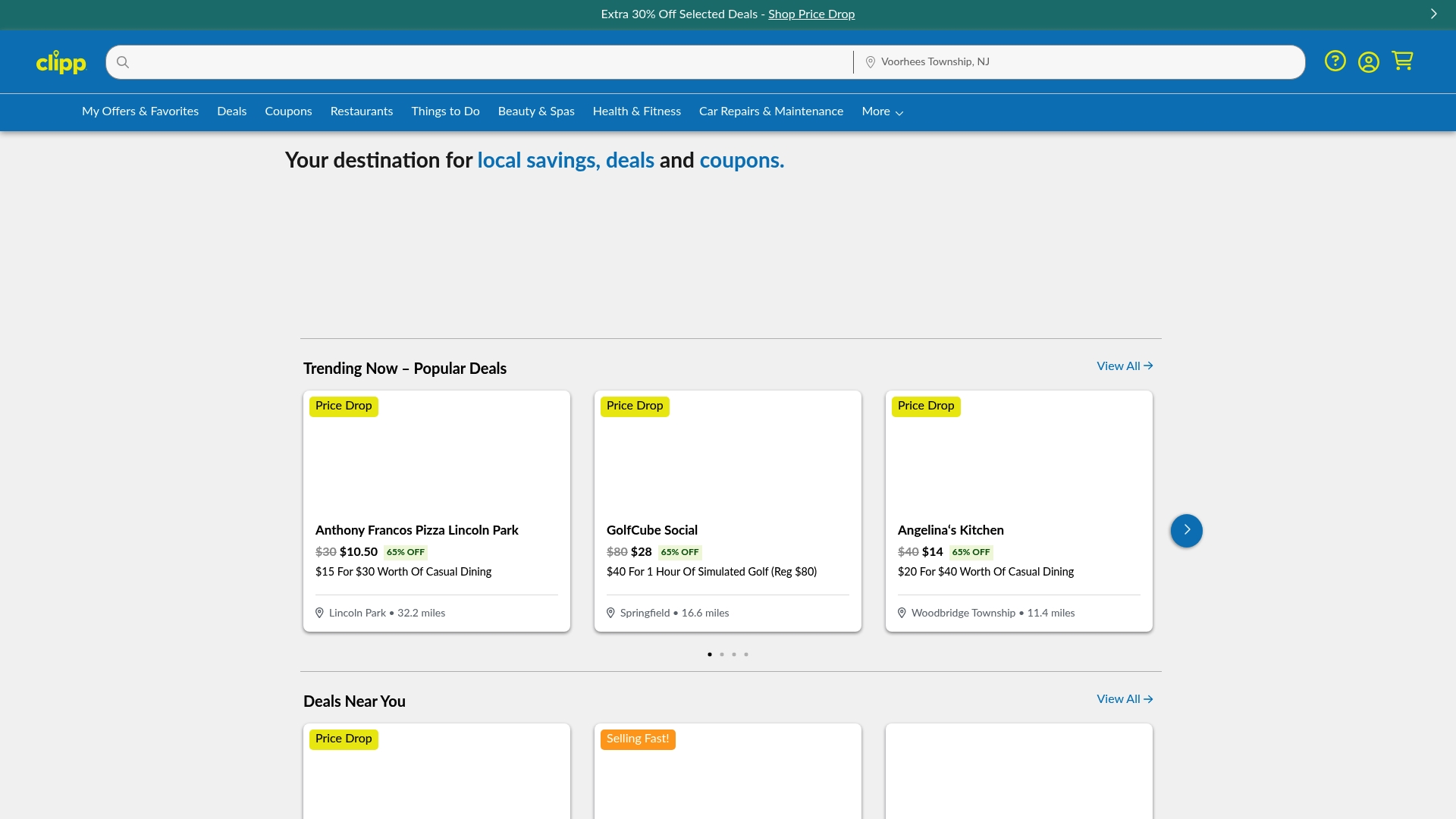
Whether you're looking for restaurant deals in Texas, spa discounts in Virginia, or local savings in Louisiana, Clipp's state pages give you a fast, filtered view of what's available near you right now. No membership fee, no subscription. Browse the deals, check the terms, and claim what fits. Head to Clipp.com to see what's trending in your area today.