

TL;DR:
- Shoppers who verify deal authenticity and subscribe to multiple alert channels save more money on limited-time offers. Using local deal platforms like Clipp and price verification tools ensures genuine discounts. Building a habit of checking and stacking offers helps avoid fake deals and missed opportunities.
A limited-time offer is a discounted promotion available for a short window, typically between 24 hours and 7 days, designed to reward fast action with real savings. Budget-conscious shoppers who know how to access limited-time offers consistently pay less for the same local services and products their neighbors pay full price for. The difference is not luck. It is a system: knowing where to look, how to verify what you find, and how to act before the clock runs out. Tools like CamelCamelCamel, Honey, and platforms like Clipp make that system repeatable and reliable.
How to find legitimate limited-time offers
The best limited-time deals come from sources you can verify directly. Retailer newsletters and official brand websites are the most reliable starting point. When a business sends a promotion by email, the deadline is real and the terms are clear.

Email and SMS marketing are the most direct channels for time-sensitive deals. Businesses use them to push offers with visible deadlines and clear calls to action, which means you see the deal before it sells out. Signing up for email lists from your favorite local restaurants, gyms, and salons puts those alerts directly in your inbox.
Beyond email, verified coupon aggregators and browser extensions add another layer of coverage. Tools like Honey automatically surface active promo codes at checkout. Platforms like Clipp curate local deals and coupons by neighborhood, so you are not sifting through national offers that do not apply to you.
Social media accounts from local businesses also post flash sales and limited-run promotions, often with shorter windows than email campaigns. Following your favorite spots on Instagram or Facebook gives you a real-time feed of what is available nearby.
- Sign up for email lists from local restaurants, salons, gyms, and pet services
- Install Honey or a similar browser extension for automatic code discovery
- Follow local business accounts on social media for flash sales
- Use Clipp to browse curated neighborhood deals by category
- Enable push notifications on deal apps so you never miss a short-window offer
Pro Tip: Subscribe to at least three channels per category you shop regularly. One channel will catch what another misses, and the overlap costs you nothing.
How to verify and avoid fake or misleading offers
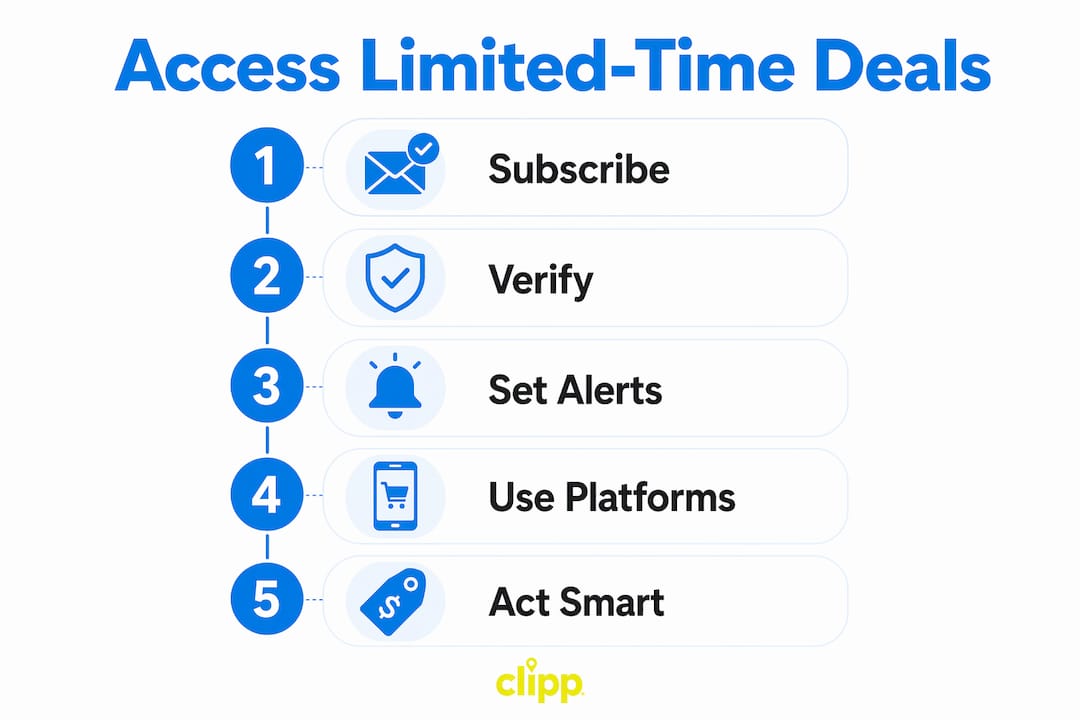
Not every countdown timer represents a real deadline. Artificial urgency tactics are common in online retail, where scarcity is manufactured rather than genuine. Knowing how to spot the difference protects your wallet and your time.
Price tracking tools are your first line of defense. CamelCamelCamel and Honey both show the full price history of a product, so you can confirm whether a "50% off" claim reflects a real discount or a temporarily inflated base price. If the current sale price matches the historical average, the deal is not as good as it looks.
Follow these steps to verify any limited-time promotion before you buy:
- Check the brand's official website. If the deal is not listed there or on a verified partner site, treat it with skepticism.
- Run the product through CamelCamelCamel or Honey. Confirm the sale price is actually below the historical low.
- Read the terms and conditions. Look for exclusions, minimum purchase requirements, and whether the discount applies to the specific item you want.
- Verify the expiration date. Cross-reference the deadline with past promotions from the same brand to confirm the urgency is real.
- Check the return policy. A deal with a no-return clause on a final-sale item changes the math entirely.
Offers found only on obscure third-party sites without a direct checkout path are often low-value ads, not genuine promotions. Stick to sources with a track record and transparent terms.
Pro Tip: Before any purchase over $30, spend two minutes on CamelCamelCamel. That habit has saved experienced deal hunters from more "sales" than any coupon code ever will.
Step-by-step methods to access local deals
Local deal platforms aggregate time-sensitive offers by location, making it faster to find relevant savings on dining, home improvement, wellness, and more. The process works best when you build a short routine around it rather than searching randomly.
Set up alerts before you need them
Configure push notifications on deal apps and email alerts from your favorite local businesses before a purchase decision is urgent. Reactive deal hunting, where you search only when you already need something, means you miss the best windows. Proactive alerts put the deal in front of you first.
Use a platform built for local offers
Clipp organizes deals by category and neighborhood, with sections like "Trending Deals" and "Near You" that surface what is relevant to your location. Browsing local deals by category takes less than five minutes and shows you what is available before you commit to full price anywhere.
| Method | Best for | Time required |
|---|---|---|
| Email newsletter signup | Consistent savings from known brands | 5 minutes setup |
| Honey browser extension | Online checkout savings | Automatic |
| Clipp app with push alerts | Local services and dining | 2 minutes daily |
| Social media follows | Flash sales and short-window offers | Ongoing |
| CamelCamelCamel price check | Verifying deal authenticity | 2 minutes per item |
Stack offers for maximum savings
Combining a limited-time offer with a coupon or loyalty reward multiplies the discount. Many local businesses on Clipp allow coupon stacking, where a percentage-off deal applies on top of an existing member discount. Check the terms first, but stacking is legal and common. You can find proven coupon strategies that work specifically for local deals if you want a deeper system.
- Clip the deal on Clipp before it expires
- Apply any available loyalty points at checkout
- Use a cashback credit card as the payment method
- Check whether a referral code from a friend adds another layer
Common mistakes that cost you savings
The biggest mistake budget-conscious shoppers make is acting on urgency without verification. Poorly tracked deadlines and artificial scarcity cues cause two opposite problems: buying something you did not need because a timer felt pressing, or missing a real deal because you assumed it would come back.
A second common error is ignoring the fine print. A 40% discount that excludes the specific service you want, or requires a minimum spend you did not plan for, is not a 40% discount for you. Reading terms before clipping a deal takes 60 seconds and prevents buyer's remorse.
The shoppers who save the most are not the fastest. They are the most organized. A simple notes app or spreadsheet tracking active deals, their deadlines, and their terms beats frantic last-minute searching every time.
Failing to verify price history is the third mistake. A retailer that raises its base price before a sale event and then discounts back to normal is not offering you a deal. CamelCamelCamel eliminates that problem in under two minutes.
- Do not buy under pressure without checking the price history first
- Do not skip the terms and conditions, even for small purchases
- Do not rely on a single channel. If one source misses a deal, another will catch it
- Do not assume a deal will return. Authentic limited-time offers with real scarcity do not repeat on schedule
Key takeaways
Shoppers who verify deal authenticity, subscribe to multiple alert channels, and use local platforms like Clipp consistently capture the most savings from limited-time promotions.
| Point | Details |
|---|---|
| Verify before you buy | Use CamelCamelCamel or Honey to confirm a sale price is a genuine discount. |
| Subscribe to multiple channels | Email, apps, and social media together catch deals that any single source misses. |
| Use local deal platforms | Clipp curates neighborhood offers by category, cutting search time significantly. |
| Stack offers when possible | Combining a limited-time deal with coupons or loyalty rewards multiplies savings. |
| Track deadlines actively | A simple list of active deals and expiration dates prevents missed opportunities. |
What I have learned from years of deal hunting
The conventional wisdom says to act fast on limited-time offers. My experience says to act smart first, then fast. The deals that burned me were always the ones I grabbed without checking the price history or reading the terms. The deals that paid off were the ones I had already researched before the offer appeared.
The system I use is simple. I subscribe to email lists from about a dozen local businesses I actually patronize. I have Honey installed and Clipp bookmarked. Every sunday, I spend five minutes checking what is active. That five minutes has replaced hours of reactive searching and eliminated most impulse purchases I later regretted.
The mental discipline matters as much as the tools. Real scarcity and timely communication drive the best deals. Manufactured urgency drives regret. Training yourself to pause for two minutes before acting on a countdown timer is the single habit that separates shoppers who save consistently from those who just feel like they are saving.
I also recommend building a short checklist you run before any deal purchase over $20. Is the price genuinely lower than usual? Do the terms match what I actually need? Can I stack this with anything else? Three questions, two minutes, and you will almost never regret a deal purchase again. For shoppers who want to go deeper, mastering the discount hunting process is worth the read.
— Mehmet
Clipp makes local limited-time deals easy to find
Clipp is built specifically for budget-conscious shoppers who want real savings on local services, not national offers that do not apply to their neighborhood. The platform curates deals across dining, wellness, home improvement, pet care, and entertainment, organized by location so you find what is relevant fast.
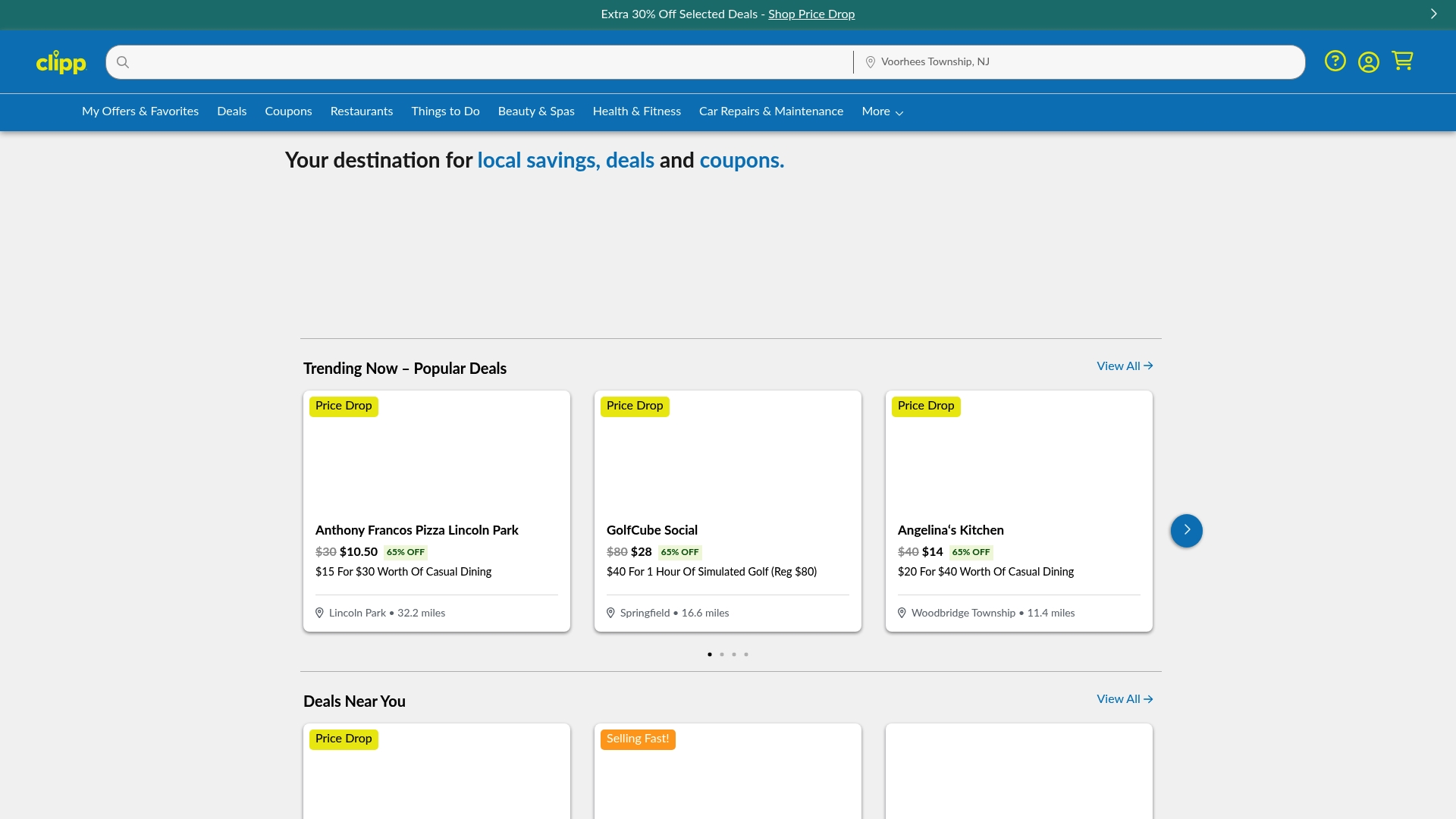
Clipp's mobile app sends push notifications when new limited-time offers go live near you, so you never have to search reactively. The "Trending Deals" and "Near You" sections surface the highest-value, fastest-moving promotions first. Browse local deals near you to see what is available right now, or visit Clipp.com to start saving on the local services you already use every week.
FAQ
What is a limited-time offer?
A limited-time offer is a promotion that provides a discount or added perk for a defined short period, typically between 24 hours and 7 days. The time constraint is designed to encourage faster purchasing decisions.
How do limited-time offers work?
Limited-time offers work by combining a real discount with a visible deadline, triggering urgency that moves shoppers from consideration to purchase. The shorter the window, the stronger the urgency signal.
How do I spot fake limited-time promotions?
Check the product's price history using CamelCamelCamel or Honey to confirm the sale price is genuinely lower than the historical average. Offers that appear only on obscure third-party sites without a direct checkout path are often not legitimate deals.
What are the main types of limited-time offers?
Common types include flash sales, seasonal clearance events, daily deals, and exclusive subscriber discounts sent by email or SMS. Local platforms like Clipp also feature location-specific promotions tied to nearby businesses.
How can I avoid missing limited-time deals?
Subscribe to email lists and push notifications from your favorite local businesses and deal platforms. Consumers who use multiple channels consistently capture more high-value offers than those who rely on a single source.