

TL;DR:
- Exclusive local discounts increase foot traffic by 30% and foster customer loyalty.
- They leverage psychological triggers like FOMO and community belonging to drive action.
- Well-structured programs deliver high ROI, strengthening local economies and consumer relationships.
Exclusive discounts are often dismissed as short-term marketing tricks, but local foot traffic jumps 30% during targeted promotions, which is far from a fleeting win. For families stretching every dollar and bargain hunters scouting their neighborhoods, these offers can mean the difference between a night out and staying home. This guide breaks down why exclusive local discounts work, what the data actually shows, how psychology plays a role, and how you can use these strategies to get more value from every deal you find near you.
Table of Contents
- How exclusive discounts drive foot traffic and retention
- The psychology behind exclusivity: Why deals for locals work
- The ROI of local exclusive discounts: Real-world benchmarks
- Best practices and pitfalls: Making exclusivity work for you
- The overlooked truth: Why smarter exclusives beat endless discounts
- Discover exclusive savings near you
- Frequently asked questions
Key Takeaways
| Point | Details |
|---|---|
| Foot traffic increases | Exclusive discounts can boost local business visits by over 30%. |
| High ROI for local programs | Citywide and retailer exclusives have returned more than 600% in spending. |
| Psychology powers exclusivity | Deals for locals tap FOMO and community bonds for higher loyalty. |
| Balance is key | Relying too much on discounts risks eroding long-term value for all. |
| Best value from smart offers | Tiered and experience-driven discounts yield better repeat customers than blanket promotions. |
How exclusive discounts drive foot traffic and retention
Before knowing why exclusives matter, let's see their true effects on real businesses. The numbers are more striking than most people expect.
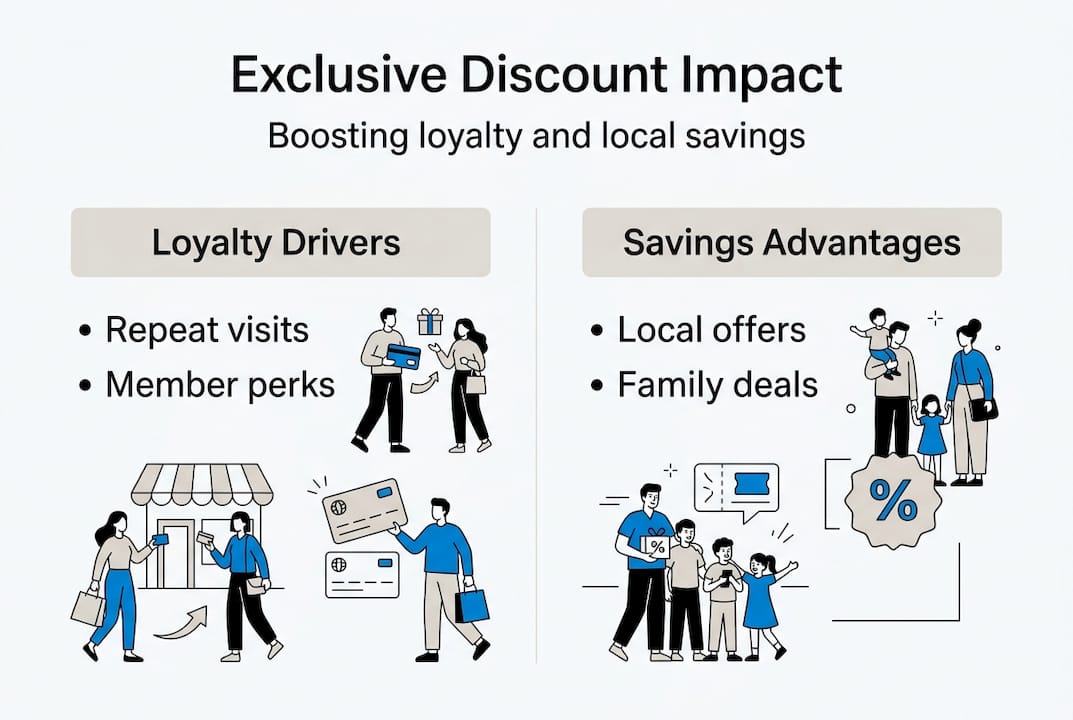
Businesses that run targeted local promotions see foot traffic increase 30%, turning first-time visitors into repeat customers. That is not a small bump. For a neighborhood restaurant or boutique gym, a 30% surge in walk-ins during a promo week can cover overhead costs and generate enough loyalty to sustain growth for months. The real prize, though, is not the spike itself. It is what happens after.
| Metric | Regular week | Promo week |
|---|---|---|
| Daily new visitors | 40 | 58 (+45%) |
| Repeat customer visits | 60 | 72 (+20%) |
| Average spend per visit | $28 | $31 |
| Total weekly revenue | $2,800 | $3,968 |
The table above reflects typical patterns seen in small local businesses during promotion periods. New visitors spike, but repeat visits also climb, which tells the real story.
"Exclusive local promotions do not just fill seats once. They create behavioral habits. A customer who redeems a deal and has a great experience is statistically more likely to return at full price." — Insight from local retail foot traffic analysis
What turns a one-time deal seeker into a loyal patron? Several factors come together:
- Positive first experience tied to a memorable deal creates emotional association
- Recognition on a return visit makes customers feel known and valued
- Tiered rewards give people a reason to keep coming back for higher perks
- Community ties reinforce the idea that shopping local is the right choice
- Convenience of redeeming deals through a single platform reduces friction
For big local savings to really pay off, the deal needs to deliver on its promise. A disappointing experience on a discounted visit rarely converts into loyalty. But when the offer is paired with genuine quality, that first visit becomes the beginning of a relationship. Understanding the local deal types available in your area helps you choose the ones most likely to deliver that full experience.
The psychology behind exclusivity: Why deals for locals work
Beyond the numbers, exclusivity isn't just about money. It's about mindset. The moment a deal is labeled "locals only" or "limited offer," something shifts in how people perceive it.
Exclusive local discounts tap into three powerful psychological triggers: FOMO (fear of missing out), loss aversion, and the desire for community belonging. These are not abstract concepts. They are the actual reasons you feel a pull when a neighborhood spot announces a flash deal just for regulars.
Here is how the customer journey typically unfolds when someone encounters an exclusive local offer:
- Awareness — You see a limited-time deal for a business near you. Curiosity kicks in.
- Urgency — The word "exclusive" or a countdown creates pressure to act before it disappears.
- Decision — Loss aversion (the fear of losing the deal) tips you from consideration to action.
- Experience — You redeem the offer and connect emotionally with the place and its community.
- Identity — You start to think of yourself as a regular. Belonging forms. Loyalty follows naturally.
This process explains why blanket discounts — available to everyone, everywhere — rarely produce the same results. When something is available to all, it feels cheap. When it is reserved for you, it feels valuable.
"A deal that says 'locals only' activates belonging signals in consumers, making them feel recognized and rewarded for being part of their community." — Research on consumer psychology of local offers
Businesses that lean into city-specific deals understand this. They are not just cutting prices. They are offering membership in something.
Pro Tip: If you want an exclusive deal to feel truly valuable, pair it with a real experience upgrade. A free appetizer for returning customers is remembered longer than a flat 10% off because it feels personal, not algorithmic.
The ROI of local exclusive discounts: Real-world benchmarks
Understanding the motivations is crucial. Now see how the numbers translate to local economic benefits.
The financial case for exclusive local discounts is not just theory. Real program data backs it up with hard figures. One city program found that a $100K investment generated $638K in additional local spending, a 642% ROI. That is not a rounding error. That is transformative economic impact driven by targeted, exclusive offers at the neighborhood level.
642% ROI — the return generated by a single city-level exclusive local discount program, with total impact reaching $737K from one coordinated initiative.

| Program type | ROI estimate | Notes |
|---|---|---|
| Broad blanket discounts | 80 to 120% | Low loyalty lift, high margin erosion |
| Exclusive loyalty programs | 300 to 450% | Strong repeat behavior, moderate cost |
| City-level exclusive initiatives | 600%+ | High community engagement, measurable local spend |
The gap between broad and exclusive programs is not subtle. It is the difference between a temporary sales bump and a lasting economic engine.
Where do exclusive discounts perform best? The data points to a few clear winners:
- Restaurants and cafes — High frequency of visits makes loyalty programs extremely effective
- Entertainment venues — Exclusivity adds perceived prestige to already enjoyable experiences
- Fitness and wellness studios — Membership-style exclusives drive habit formation
- Community events — Local-only deals create shared experiences that strengthen neighborhood bonds
Well-structured exclusive programs consistently outperform blanket discount campaigns because they reward behavior rather than just attracting opportunistic buyers. Exploring proven coupon strategies helps you identify which programs are genuinely designed to deliver lasting value versus those that simply chase short-term volume.
Best practices and pitfalls: Making exclusivity work for you
To really benefit from exclusivity, it pays to know which strategies work and which can backfire.
Not all exclusive deals are created equal. Some programs are built to reward loyalty and deepen community ties. Others are structured in ways that ultimately train you to only show up when prices drop. Knowing the difference saves you money and frustration.
Loyalty programs with exclusive discounts cost businesses roughly 2 to 5% of revenues but generate 18% higher spending from enrolled customers. That math works because the exclusivity keeps customers engaged between visits. Broad, open discounts rarely produce the same lift.
On the flip side, over-reliance on discounts risks training customers to wait for deals, which erodes margins and long-term loyalty. When a business constantly discounts, its full price starts to feel like a penalty rather than the norm.
Here is a practical guide to getting more from exclusive offers without falling into the discount trap:
Do:
- Seek out tiered programs where loyalty is rewarded with escalating perks
- Use exclusive deals to try new local spots, then return at full price if you love them
- Combine offers with experiences, not just price cuts (a free upgrade beats 15% off almost every time)
- Follow platforms that curate neighborhood offers instead of chasing every random coupon
- Check expiration dates and terms so you never feel rushed into a bad decision
Don't:
- Sign up for every deal program you find without evaluating the actual business quality
- Use discounts as your only basis for choosing where to eat, shop, or visit
- Wait indefinitely for a deeper deal that may never come
- Ignore programs with small perks — a free coffee after five visits adds up faster than you think
Pro Tip: Look specifically for programs with experience-led perks, like early access, free add-ons, or members-only events. These create memories and loyalty that a flat discount never will. Check out this coupon marketing guide and explore restaurant coupon types to find which formats give you the best return.
The overlooked truth: Why smarter exclusives beat endless discounts
These best practices set the stage, but there is a deeper lesson most guides leave out.
Most people assume the best exclusive deal is simply the biggest discount. That assumption leads to a lot of missed value. The real power of exclusivity is not in the price reduction. It is in what the offer signals: you matter here. That feeling of being recognized and rewarded is what keeps people coming back, not the number on the coupon.
Both businesses and consumers lose when discounts are poorly structured. Businesses erode their pricing power. Consumers teach themselves to devalue the full experience. The programs that actually work, the ones worth your time and attention, are built on community, personalization, and tiered rewards. They recognize that a loyal local customer is worth ten times a one-time deal seeker.
We believe the best exclusive offers are not about urgency tricks or flash sales. They are about building a relationship between a neighborhood and the people who live in it. That is why coupon value tips focused on long-term loyalty consistently outperform short-term price chasing. When you find a program that genuinely invests in you as a local, that is the one worth committing to.
Discover exclusive savings near you
Want to put these strategies into action? Here is where you can start getting more for your money.
Clipp.com is built specifically for local consumers who want real savings on dining, entertainment, wellness, and more in their own neighborhoods. We curate offers from local merchants who understand the value of building genuine relationships with their community, not just moving product with blanket deals.
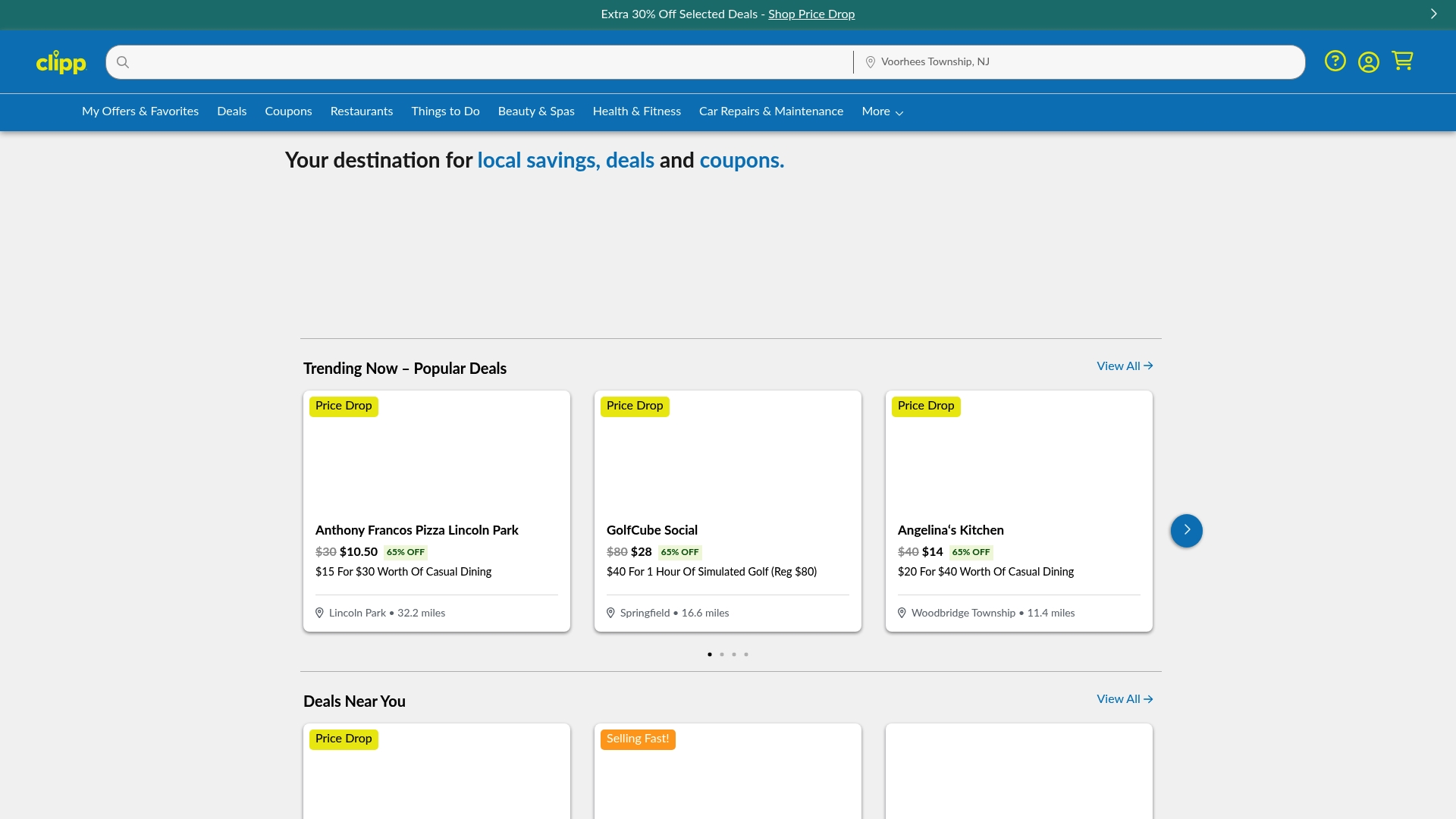
Browse Ashburn deals to find what is available near you right now, from restaurant offers to fitness perks and family-friendly entertainment. Every listing on exclusive Clipp savings is vetted for real value, so you spend less time sifting and more time saving. Limited-time offers move fast. Start exploring today.
Frequently asked questions
How do exclusive local discounts benefit families and bargain hunters?
These deals help families save on dining and entertainment while making local outings more affordable. They also boost local spending and reward repeat visits with greater value over time.
Is using exclusive discounts always better than broad discounts?
Exclusive offers encourage loyalty and higher spending, but balance matters. Over-discounting risks training customers to only buy on sale, so pairing exclusivity with genuine perks is the smarter long-term approach.
Can offering exclusive discounts actually help local economies?
Absolutely. Citywide exclusive programs have shown ROI of over 600%, channeling millions in additional spending directly into local businesses and communities.
Are there risks to offering too many discounts?
Yes. Constant discounting can create a feedback loop of deeper deals that erodes margins, trains customers to wait for sales, and ultimately weakens long-term brand loyalty.