

TL;DR:
- Discounts are strategic pricing tools used to achieve objectives like customer acquisition, inventory clearance, and cash flow improvement. When applied correctly, they enhance loyalty and volume, but excessive or poorly targeted discounts can erode margins and weaken brand perception. Effective discounting requires clear objectives, controlled frequency, and ongoing measurement to maximize benefits and minimize risks.
Discounts are deliberate price reductions businesses use to motivate purchases, shape customer behavior, and achieve specific commercial objectives. The role of discounts for businesses extends well beyond a simple sale tag. Done right, pricing promotions drive customer acquisition, accelerate cash flow, clear excess inventory, and build loyalty. Done wrong, they compress margins, train customers to wait for deals, and quietly erode brand value. This guide breaks down the mechanics, the risks, and the best practices so you can use discounts as a precision tool rather than a panic button.
What are the main types of business discounts and their strategic uses?
Pricing promotions, the industry term for structured discount programs, come in several distinct forms. Each type targets a different business objective, and mixing them up is one of the most common mistakes managers make.

Direct price reductions cut the listed price outright. Flash sales, seasonal markdowns, and clearance events fall here. They move volume fast but offer no protection against cannibalizing full-price sales from customers who would have bought anyway.
Conditional discounts require the customer to do something first. Volume discounts reward larger orders. Bundle pricing ties two products together at a combined savings. Loyalty program discounts gate the offer behind membership. These formats attract incremental buyers rather than simply rewarding existing ones.
B2B early payment discounts operate differently from retail promotions entirely. A supplier offering "2/10 net 30" gives buyers a 2% discount for paying within 10 days instead of 30. Early payment discounts improve cash flow by accelerating receivables and reducing credit risk. This is a financial instrument, not a sales volume driver.
Coupons and time-limited offers introduce urgency. Digital coupons distributed via email or SMS are now the dominant format. Over 81% of ecommerce SMS and push notifications include discounts, which signals just how central promotional pricing has become to digital retail.
| Discount type | Primary objective | Key risk |
|---|---|---|
| Flash sale / markdown | Inventory clearance, volume spike | Margin compression, brand dilution |
| Volume / bundle discount | Increase average order value | Complexity, lower per-unit margin |
| Early payment discount | Accelerate B2B cash flow | Reduces receivables revenue |
| Loyalty / member-only offer | Retention, repeat purchase | Program cost, exclusion backlash |
| Time-limited coupon | New customer acquisition | Discount habituation over time |

Pro Tip: Before launching any discount, write down the single business objective it serves. Acquisition, retention, cash flow, and inventory clearance each require a different discount structure. A coupon designed for acquisition should never look like a loyalty reward.
How do discounts influence customer acquisition, retention, and brand perception?
Discounts are one of the fastest ways to trigger a first purchase. A new customer who would never pay full price for an unfamiliar brand will try it at 20% off. That trial visit is the entry point for a longer relationship, which is why coupons increase visits and trials across nearly every retail category. The problem is that the same mechanism that drives trial can undermine retention if you are not careful.
Frequent discounting conditions customers to expect a lower price as the baseline. Customers conditioned by over-discounting begin to expect sales every six to eight weeks, which systematically undermines full-price purchases between cycles. You are essentially teaching your best customers to wait.
The brand perception risk is equally real. Frequent discounts weaken brand strength over time, even when short-term purchase intent rises. Luxury and premium brands feel this most acutely, but the effect applies to any business where quality perception drives pricing power.
Here is what the behavioral research actually shows about how discounts shape customer psychology:
- Discounts create a sense of urgency that shortens the decision cycle, which is useful for acquisition but counterproductive for building deliberate brand preference.
- "Pull-forward" effects are real. A promotion convinces customers to buy now instead of later, which means the weeks after a major sale often see depressed demand.
- Price-sensitive customers acquired through heavy discounts show lower lifetime value than customers acquired at full price.
- Member-only or exclusive discounts generate stronger loyalty signals than public promotions because they create a sense of belonging rather than just savings.
"Discounts influence purchase intention and trial behavior, but frequent discounts weaken brand strength over the longer term." — ResearchGate conceptual study on consumer behavior
The practical takeaway for managers: use discounts to open the door, then close it. A new customer acquired through a coupon should enter a retention program that gradually reduces discount dependency and builds full-price purchase habits. You can read more about how exclusive discounts build loyalty without eroding your price positioning.
What are the financial trade-offs and risks involved with offering discounts?
The math on discounts is less forgiving than most managers realize. A 20% discount on a product with a 40% gross margin does not just reduce revenue by 20%. It cuts your gross profit by 50%, because the discount comes entirely out of margin. To break even on that promotion, you need to sell significantly more units, not just a few extra.
Measuring revenue per session, rather than total revenue, is the clearest way to see whether a discount is actually profitable. Total revenue can rise during a promotion while profitability falls. Revenue per session captures whether each customer interaction is generating more or less value than it did before the discount.
The post-promotion hangover is a documented and quantifiable risk. Heavy discounting causes revenue drops of 27% after promotions end, driven by pull-forward effects that deplete demand from loyal customers. That 27% decline means the short-term revenue spike often does not compensate for the trough that follows.
There is also a cultural risk inside organizations. Managers often view discounting as a "white flag", a signal that the product is not selling on its merits. This perception leads to inconsistent discount strategy, where promotions are launched reactively in slow periods rather than planned as part of a deliberate pricing architecture.
The financial scenarios worth modeling before any promotion:
- Break-even volume: How many additional units must you sell to offset the margin loss from the discount?
- Incremental profit: Are the customers buying during the promotion genuinely new, or are they loyal customers who would have purchased at full price?
- Post-promotion baseline: Does your revenue per session return to pre-promotion levels within two to four weeks, or does it stay depressed?
- Lifetime value impact: Do discount-acquired customers convert to full-price buyers, or do they churn when the next promotion does not appear?
Pro Tip: Run a holdout test before scaling any discount program. Offer the promotion to 50% of your email list and compare purchase behavior, average order value, and 90-day retention against the non-discounted group. The data will tell you whether you are acquiring incremental customers or just subsidizing existing ones.
How can businesses design and implement effective discount strategies?
Effective discount strategy starts with a clear objective and ends with a measurement plan. The following framework applies whether you run a local restaurant, a retail shop, or a B2B services firm.
-
Define the objective first. Discounts tied to defined business outcomes such as acquisition, cash flow, inventory reduction, or retention perform better than undifferentiated price cuts. Write the objective before you set the discount percentage.
-
Build hurdles into the offer. Discount hurdles such as time limits, minimum purchase thresholds, or email sign-up requirements attract incremental buyers and deter full-price customers from migrating to the discounted tier. A "first order only" coupon is a hurdle. A "members only" flash sale is a hurdle. Both protect your full-price revenue.
-
Control frequency and duration. Running promotions more than four to six times per year in the same channel risks conditioning your audience to wait. Set a promotional calendar at the start of each quarter and stick to it.
-
Protect average order value. Bundle discounts and "spend X, save Y" offers maintain or increase average order value while still delivering perceived savings. A straight 20% off everything does the opposite.
-
Measure the right metrics. Track revenue per session, average order value, and 30-day repeat purchase rate during and after every promotion. Total revenue during a sale is a vanity metric. Incremental profit is the number that matters.
-
Plan your exit. Every discount program needs an end date and a transition plan. How will you move customers from discounted pricing back to full price? Loyalty points, exclusive content, or early access to new products all serve as non-price value substitutes.
Pro Tip: Protect your list price by never discounting the same SKU in the same channel twice in a row. Rotate which products are on promotion, and use bundles to create perceived value without touching your core price points.
For local businesses, platforms like Clipp make it easier to reach price-sensitive customers through proven coupon strategies without running blanket promotions that undercut your brand.
Key takeaways
Discounts work when they are tied to a specific objective, built with purchase hurdles, and measured on incremental profit rather than total revenue.
| Point | Details |
|---|---|
| Define the objective | Every discount must serve acquisition, retention, cash flow, or inventory goals before launch. |
| Use hurdles to protect margin | Time limits, minimums, and member-only gates prevent full-price customers from migrating to discounted tiers. |
| Monitor post-promotion revenue | A 27% post-promotion revenue drop is documented. Track revenue per session, not just total sales. |
| Limit frequency to avoid conditioning | Promotions running more than four to six times per year risk training customers to wait for sales. |
| Measure incremental profit | Revenue lift during a sale means nothing if margin loss and post-promotion declines erase the gain. |
Why discounts deserve a seat at the strategy table
I have watched managers treat discounts as an admission of failure for most of my career. The Harvard Business Review framing of discounting as a "white flag" resonates because I have seen it play out in real planning meetings. A product misses its quarterly number, someone suggests a 25% off promotion, and the room goes quiet as if the idea itself is embarrassing.
That mindset is the actual problem. The businesses I have seen use discounts most effectively treat them the same way they treat advertising spend: as a deliberate investment with an expected return. They know exactly which customer segment they are targeting, what behavior they want to trigger, and how they will measure success. They also know when to stop.
The data from Klaviyo's research on post-promotion revenue declines should be required reading for every retail manager. A 27% drop after a heavy promotion is not bad luck. It is a predictable consequence of pulling forward demand without a plan to replace it. The fix is not to stop discounting. It is to discount smarter, with tighter targeting, shorter windows, and a clear path back to full-price purchasing.
Technology has made this more achievable than ever. Platforms that segment customers by purchase history, channel behavior, and price sensitivity let you run a targeted 15% offer to lapsed customers while your active full-price buyers never see it. That is not a compromise. That is precision pricing.
The managers who will win on this are the ones who stop asking "should we discount?" and start asking "who should we discount to, when, and for how long?" Those are answerable questions with measurable outcomes.
— Mehmet
How Clipp helps businesses reach the right customers with the right offers
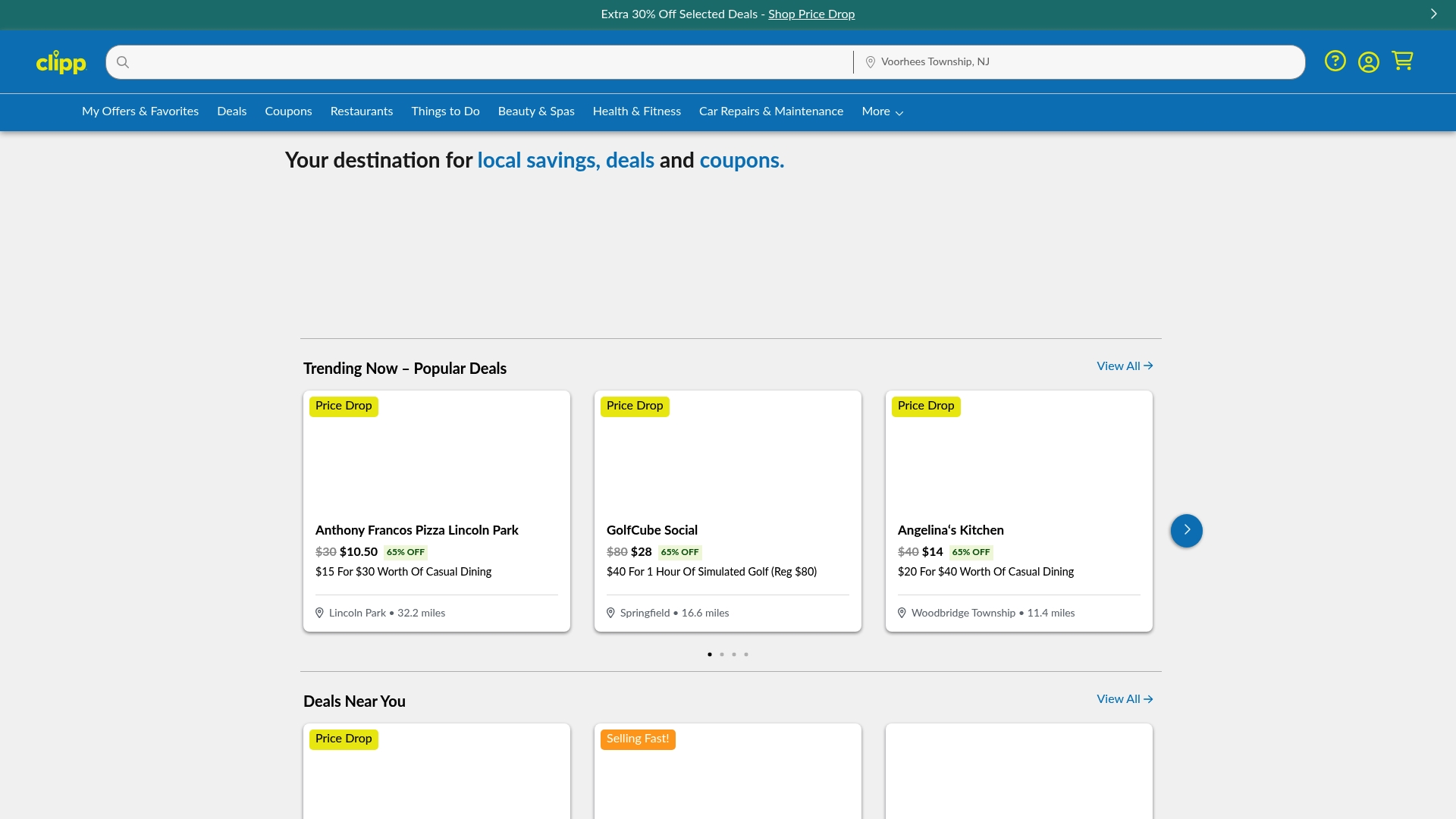
Clipp connects local businesses with price-conscious consumers actively searching for deals in dining, wellness, home services, and entertainment. For business owners who want to run targeted promotions without blanket discounting, Clipp's platform distributes curated offers to local audiences already in buying mode. Whether you are looking to drive foot traffic with local savings deals or reach customers in specific markets like Virginia and Massachusetts, Clipp gives you the distribution infrastructure to run promotions that attract new customers without training your existing base to expect permanent price cuts. The mobile app extends your reach to on-the-go deal seekers, making your offers visible at exactly the moment purchase decisions happen.
FAQ
What is the role of discounts for businesses?
Discounts serve as structured pricing tools that businesses use to achieve specific objectives including customer acquisition, inventory clearance, cash flow acceleration, and loyalty retention. Their effectiveness depends on clear objectives and controlled frequency rather than blanket price reductions.
How do discounts affect profit margins?
A discount reduces gross profit by a percentage greater than the discount itself, because the reduction comes entirely from margin. A 20% discount on a 40% margin product cuts gross profit by 50%, requiring a significant volume increase just to break even.
Can discounts hurt a brand long-term?
Yes. Frequent discounting conditions customers to expect lower prices as the baseline and weakens brand strength over time, according to ResearchGate research on consumer behavior. Premium and mid-market brands are both vulnerable to this effect.
What discount strategies protect average order value?
Bundle discounts, "spend X, save Y" thresholds, and member-only offers all maintain or increase average order value while delivering perceived savings. Straight percentage-off promotions on individual items are the least effective format for protecting order value.
How often should a business run discount promotions?
Running promotions more than four to six times per year in the same channel risks training customers to wait for sales rather than buying at full price. Build Grow Scale research shows customers conditioned by over-discounting begin expecting sales every six to eight weeks.