

TL;DR:
- Psychological triggers like loss aversion and scarcity make deals irresistibly appealing.
- Savvy consumers build systems using comparison sites, codes, apps, and social media for better savings.
- Relevance, timing, and personalization drive long-term engagement over just offering large discounts.
Most shoppers think they're getting the best deal. The truth? 91% of consumers regularly seek coupons, yet a large portion still leave money on the table because they don't understand what makes a deal truly worth grabbing. Knowing why you're drawn to a limited-time offer, or why a strikethrough price feels so satisfying, changes how you shop. This guide breaks down the psychology, the strategies, and the habits behind effective deal-hunting so you can walk away with real savings on dining, entertainment, and local services every time.
Table of Contents
- The psychology behind irresistible deals
- How consumers find and choose the best deals
- Why local and stacked deals boost engagement
- The risks of deal fatigue and how to keep savings fun
- Our take: The real secret to smarter local savings and lasting engagement
- Ready to unlock exclusive local savings?
- Frequently asked questions
Key Takeaways
| Point | Details |
|---|---|
| Deal psychology is powerful | Triggers like loss aversion and urgency drive immediate action on local savings. |
| Smart shoppers use multiple tools | Combining sites, codes, and apps leads to the biggest dining and service discounts. |
| Stacked and local deals win | Hyperlocal and combined offers are more engaging than single generic discounts. |
| Avoid deal fatigue | Focus on personalized, high-value deals to keep couponing rewarding. |
The psychology behind irresistible deals
Ever wonder why you feel a small rush when you spot a 50% off sign? That's not an accident. Retailers and local businesses design their offers around specific psychological triggers that make discounts feel urgent, exclusive, and almost impossible to ignore.
The biggest driver is loss aversion. Research shows that loss aversion is 2x stronger than the pleasure of gaining something equivalent. In plain terms: missing out on a deal hurts more than getting one feels good. That's why countdown timers and "only 3 left" labels work so well. They flip your brain into action mode.
Here are the core psychological triggers that make deals feel irresistible:
- Loss aversion: Fear of missing out pushes you to act before you overthink.
- Scarcity: Limited stock or time creates perceived value.
- Urgency: Deadlines force decisions, reducing hesitation.
- Anchoring: A crossed-out original price makes the sale price look like a steal.
- Social proof: "Trending" or "500 people bought this today" signals that others already validated the deal.
Local deals add another layer. When a neighborhood restaurant offers a Tuesday lunch special, it taps into what psychologists call a variable reward. You don't always know what deal will show up, so checking feels exciting. It's the same reason people enjoy scratch cards. The unpredictability is part of the appeal.
"Psychological triggers like loss aversion, scarcity, urgency, anchoring, and social proof drive engagement" and are the foundation of what makes any offer feel irresistible.
Understanding discount psychology explained helps you separate a genuinely good deal from one that just feels good. A 40% discount on something you'd never buy isn't savings. It's spending.
Pro Tip: Before you click "claim deal," ask yourself: would I buy this at full price? If yes, the discount is a bonus. If no, the psychology is working on you, not for you. Pair this mindset with coupon strategies for local deals to stay intentional and maximize every dollar.
How consumers find and choose the best deals
Knowing what pulls you in is only half the equation. The other half is knowing where to look. Savvy shoppers don't stumble onto savings. They build systems.
According to current data, 72% use price comparison sites, 38% actively search for discount codes, and 86% say price is a primary factor in their purchase decisions. That means the majority of shoppers are already doing some version of deal-hunting. The question is whether they're doing it efficiently.
Here are the most effective methods for finding local deals:
- Price comparison sites: Great for big-ticket items and recurring services.
- Discount code searches: Fast and easy, especially before online checkout.
- Deal apps and platforms: Push notifications keep you updated without constant searching.
- Email newsletters: Curated deals delivered to your inbox from your favorite local spots.
- Social media follows: Many local businesses post flash deals exclusively on Instagram or Facebook.
| Deal-finding method | Frequency of use | Best for |
|---|---|---|
| Price comparison sites | Very high | Services, electronics, dining |
| Discount code searches | High | Online purchases, takeout |
| Deal apps | Medium-high | Local restaurants, salons, gyms |
| Email newsletters | Medium | Loyal customers, weekly deals |
| Social media | Growing | Flash sales, pop-up events |
Interestingly, consumers aged 34 to 44 are the most aggressive deal-hunters. They combine multiple methods, cross-referencing apps with newsletters and comparison sites before committing. If you're not doing that yet, you're leaving savings behind.

Pro Tip: Stack your methods. Sign up for a deal platform newsletter AND enable app notifications for your favorite categories. This way, you catch both planned promotions and surprise flash deals. Check out restaurant coupon savings for a practical starting point, and browse top coupon tips to sharpen your approach.
Why local and stacked deals boost engagement
Not all deals are created equal. A generic 10% off code feels routine. A deal from your favorite neighborhood café, valid only this week, feels personal. That distinction matters more than most shoppers realize.
Hyperlocal offers work because they're relevant. When a deal matches your neighborhood, your habits, and your schedule, it doesn't feel like marketing. It feels like a tip from a friend. That relevance drives action. Stacked discounts outperform single equivalent discounts and local offers drive measurable acquisition growth, which is why platforms built around community deals consistently outperform generic coupon aggregators.
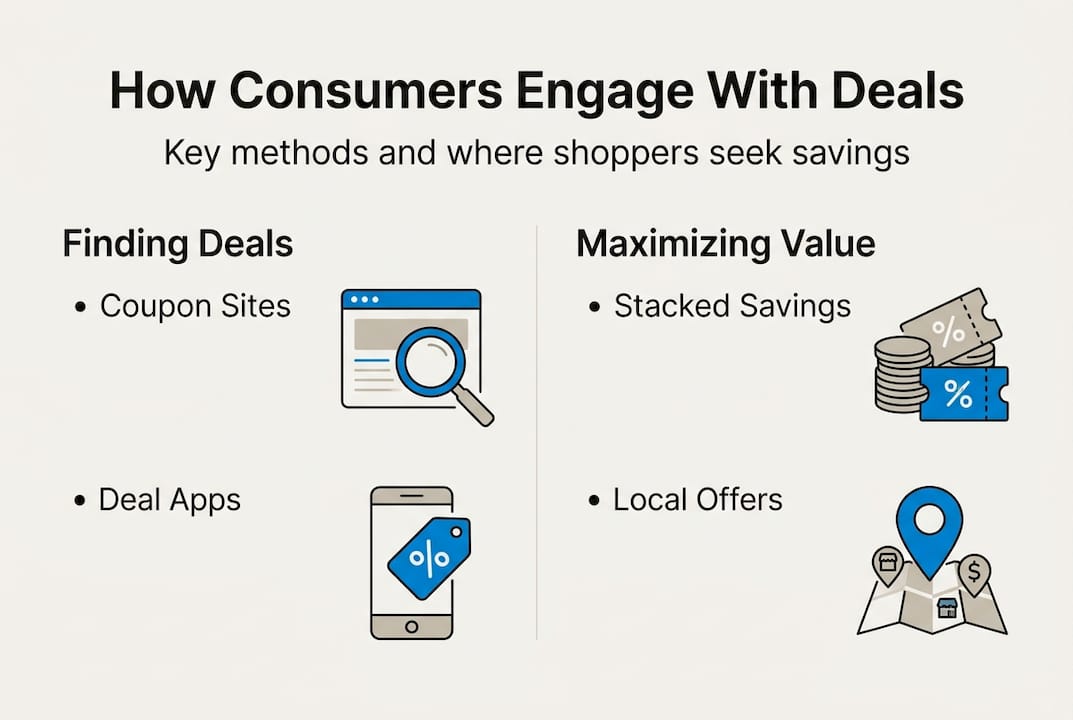
Stacking deals, meaning combining a store coupon with a loyalty reward and a seasonal promotion, creates what shoppers describe as a "smart shopper" feeling. It's not just about the money saved. It's about the satisfaction of working the system.
| Deal type | Psychological impact | Consumer response |
|---|---|---|
| Single discount | Moderate excitement | Occasional use |
| Stacked discount | High satisfaction | Repeat engagement |
| Hyperlocal offer | Strong relevance | Immediate action |
| Personalized deal | Highest engagement | Brand loyalty |
"Stacking deals feels smarter and more special" because it activates both the savings instinct and the sense of being a savvy, informed shopper.
Real-world examples back this up. A local café that runs weekday lunch specials often sees a consistent lift in foot traffic on otherwise slow days. Pop-up food events that offer limited-time bundles frequently generate user-created social content, extending reach far beyond paid advertising. The deal becomes the marketing.
But complexity can kill the excitement. Discount stacking research shows that when deal rules become too complicated, even a large discount loses its appeal. Consumers disengage when they have to do math to figure out what they're actually saving.
Pro Tip: When evaluating a stacked deal, count the steps required to redeem it. If it takes more than two steps, the friction may outweigh the reward. Explore types of local deals to find offers built for easy redemption, and check coupon platform benefits to understand what a quality platform should offer.
The risks of deal fatigue and how to keep savings fun
Here's something most deal guides won't tell you: too many deals can actually make you care less about saving. It sounds counterintuitive, but it's real, and it has a name: deal fatigue.
Frequent discounting causes expectation fatigue and loyalty erosion. When a brand constantly offers 30% off, that becomes the new normal. The discount stops feeling special, and consumers stop responding. Worse, they start waiting for deals before buying anything at full price, which actually hurts both the shopper's relationship with the brand and the brand's bottom line.
How do you know if deal fatigue is creeping into your shopping habits? Watch for these signs:
- You feel annoyed, not excited, when a deal notification pops up.
- You've stopped opening deal emails from platforms you once loved.
- You only buy from certain brands when they're on sale, regardless of need.
- You spend more time searching for deals than actually enjoying what you bought.
- Saving money feels like a chore rather than a win.
The fix isn't to stop looking for deals. It's to be more selective. Focus on categories that matter most to you, like dining, wellness, or entertainment, and set alerts only for those. Avoid subscribing to every deal source available. More noise means less signal.
Businesses can also help by curating fewer, better offers rather than flooding inboxes with daily promotions. Quality over quantity applies to deals just as much as it does to products. Check out coupon marketing tips for a look at how the best local businesses structure their promotions.
Pro Tip: Once a month, review your deal subscriptions and unsubscribe from any that aren't delivering savings in your top two or three categories. Fewer, more relevant alerts keep the excitement alive.
Our take: The real secret to smarter local savings and lasting engagement
Most shoppers chase the biggest discount. Most brands chase the highest volume of promotions. Both strategies miss the point.
The real driver of lasting engagement isn't the size of the discount. It's the fit. A 15% off deal at a restaurant you already love, delivered on a Thursday when you're planning the weekend, is worth more than a 40% off deal for something you'd never normally buy. Timing, relevance, and exclusivity beat raw discount size every time.
Hyperlocal, personalized deals create a flywheel effect: more relevance leads to lower customer acquisition costs and organic local buzz that no paid ad can replicate. That's the model that actually works long-term, for both shoppers and businesses.
Our advice: build a shortlist of two or three trusted deal sources that know your city and your categories. Don't try to track every platform. Go deep with the ones that consistently surface offers that match your life. Explore city-specific savings to see how location-based deal curation changes the savings game entirely. The shoppers who save the most aren't the ones who hunt the hardest. They're the ones who hunt the smartest.
Ready to unlock exclusive local savings?
You now understand what makes a deal worth grabbing, how to find the best ones, and how to avoid the traps that drain your enthusiasm. The next step is putting that knowledge to work.
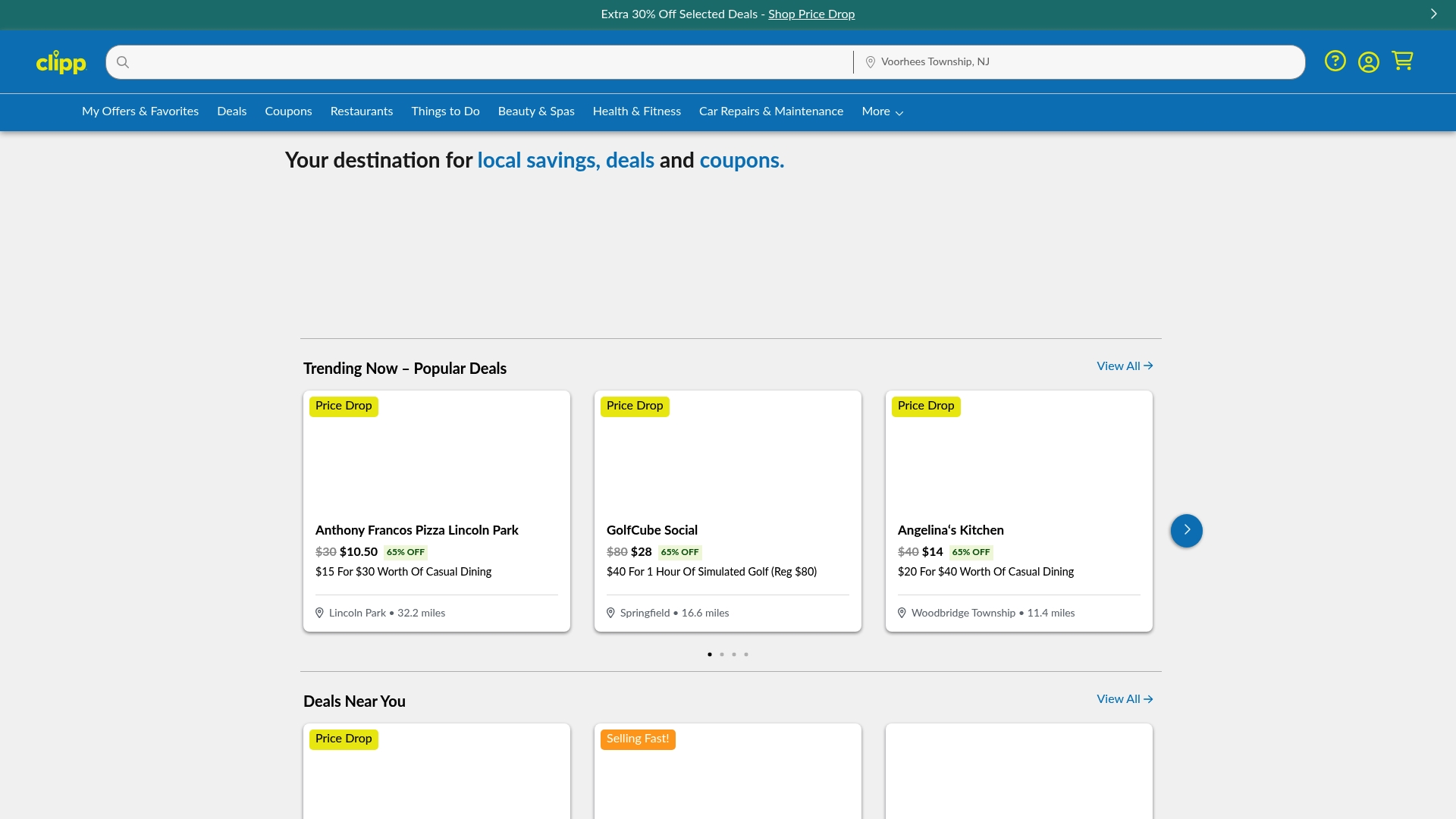
Clipp.com makes it easy to browse local deals in Ashburn and discover savings across dining, entertainment, wellness, and more in your neighborhood. You can also explore coupons for local savings organized by category so you only see what's relevant to you. For on-the-go savings, the Clipp mobile app sends personalized alerts so you never miss a deal that fits your lifestyle. Start with your favorite category and let the savings come to you.
Frequently asked questions
What psychological triggers make deals so engaging?
Key triggers include loss aversion, scarcity, urgency, anchoring, and social proof, all of which make deals feel too good to miss. These triggers work together to create a sense of urgency and reward that pushes consumers to act quickly.
How do most people find the best local deals?
Most people use price comparison sites and search for discount codes, while also signing up for deal newsletters or apps to track savings. Combining multiple methods consistently delivers better results than relying on just one source.
Are stacked deals always better than single discounts?
Stacked deals engage more and feel more rewarding, but they can become confusing if they include too many rules or conditions. The best stacked deals are simple to understand and easy to redeem.
Can looking for deals actually become exhausting?
Yes, frequent promotions cause deal fatigue, making people less excited about future discounts. Focusing on fewer, more relevant deal sources keeps the experience enjoyable and the savings meaningful.