

TL;DR:
- Daily deals offer significant savings and exclusive access to local services, often reducing costs by up to half.
- However, impulse buying and deal fatigue pose risks, so strategies like budgeting and timing are essential for maximum benefit.
The benefits of daily deals go far beyond a few dollars off your lunch tab. Nearly 85% of shoppers actively use digital deals in 2026, driven by real economic pressure and a smarter approach to spending. Yet plenty of people still assume deal hunting is either too much effort or a fast track to impulse buying. That assumption is worth challenging. When you know how to use daily deals strategically, they become one of the most practical tools for stretching your budget on dining, entertainment, wellness, and local services without giving anything up.
Table of Contents
- Key takeaways
- Benefits of daily deals you probably underestimate
- How limited-time deals and earned rewards work in your favor
- Pitfalls to watch for and how to avoid them
- Practical strategies to maximize your local deal savings
- My honest take on daily deals in 2026
- Start saving more on local dining and services with Clipp
- FAQ
Key takeaways
| Point | Details |
|---|---|
| Real savings on everyday spending | Daily deals cut costs on dining, entertainment, and local services by up to 50% or more. |
| Earned rewards beat blanket discounts | Action-triggered deals preserve value and feel more rewarding than generic sales. |
| Impulse buying is a real risk | 64% of consumers have made unplanned purchases because of a deal, so budgeting matters. |
| Timing and stacking multiply savings | Combining cashback, coupons, and limited-time offers maximizes what you actually save. |
| Deal aggregators simplify the process | Platforms like Clipp put curated local deals in one place so you spend less time searching. |
Benefits of daily deals you probably underestimate
Most people think of daily deals as a way to grab a discounted meal once in a while. The actual advantages run deeper than that.
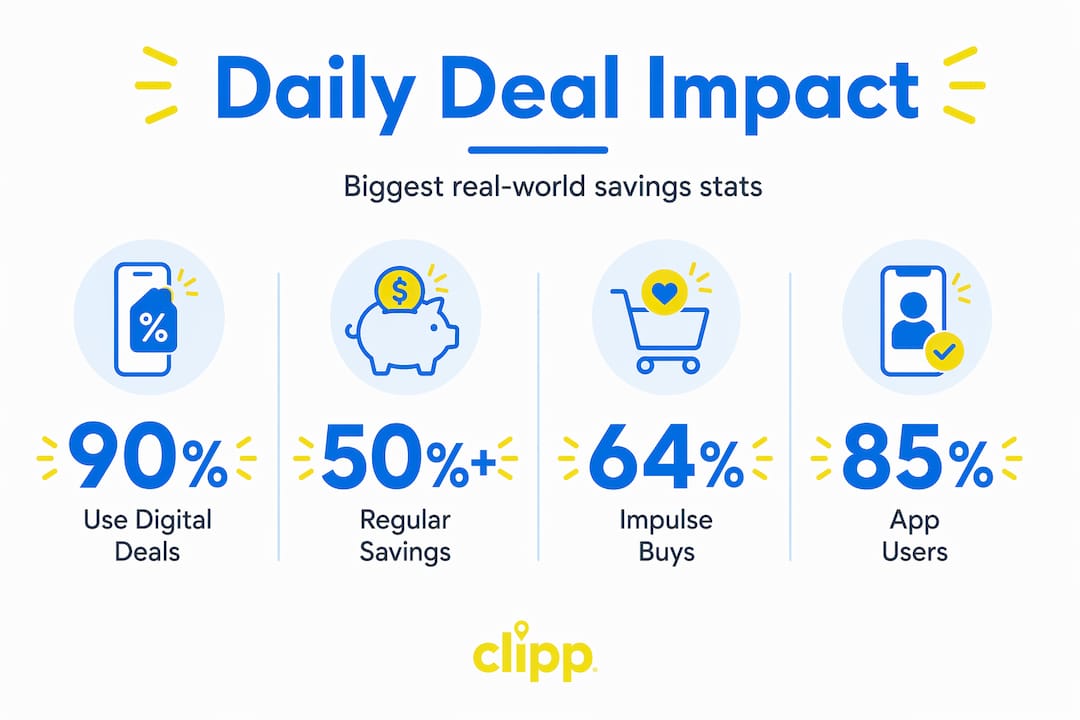
The most obvious benefit is cost savings, and it is genuinely significant. 90% of shoppers use digital savings, with cashback, rewards, and exclusive access ranking as the top perks. When you regularly apply deals to dining, spa services, gym memberships, or local entertainment, those savings add up fast across a month. A family that uses deals three times a week on dining alone could realistically save $150 to $300 monthly without changing what they eat or where they go.
Beyond the dollar amount, daily deals give you access to experiences you might otherwise skip. A 50% discount on an escape room, a cooking class, or a wine tasting is not just a financial win. It is permission to try something new without the usual hesitation. That is a genuinely underrated advantage.
Here is what the top benefits of discount offers actually look like in practice:
- Budget flexibility. Savings on services you already use free up money for things you want but normally delay.
- Exclusive access. Many platforms surface deals that are not publicly advertised, giving members a genuine edge.
- Cashback and rewards stacking. Combining deal discounts with a cashback credit card or loyalty program turns a single transaction into a multi-layered savings event.
- Local business discovery. Deals often introduce you to restaurants, salons, and service providers in your neighborhood that you would never have found otherwise.
- Controlled luxury. Premium experiences like spa days or chef's tasting menus become realistic on a regular budget when priced at 40 to 50% off.
Pro Tip: Before redeeming any deal, check whether the vendor also has a loyalty program. Stacking a deal discount with loyalty points is one of the fastest ways to get real value from routine spending.
Learning how to save on dining and local services does not require couponing expertise. It just requires knowing where to look and what to combine.
How limited-time deals and earned rewards work in your favor
Not every discount is created equal, and understanding the structure behind a deal helps you pick the ones worth your time.
Limited-time offers increase urgency and drive purchasing decisions in ways that a permanent markdown never does. The psychology behind this is straightforward: scarcity signals value. When a deal expires tonight, you evaluate it quickly and decisively instead of putting it off indefinitely. For consumers who tend to procrastinate on treating themselves, that built-in deadline is actually useful rather than manipulative.
The more interesting insight involves earned rewards versus blanket discounts. Research shows that earned rewards preserve perceived value better than a simple price cut applied to everyone. When you complete a specific action, like signing up, visiting a location, or hitting a spending threshold, the reward feels like an achievement. The product or service retains its perceived worth in your mind. Blanket sales, on the other hand, can quietly signal that something was overpriced to begin with.
Here is how to apply these insights when evaluating daily deals:
- Prioritize action-based rewards. Deals you unlock through specific behavior tend to reflect genuine value rather than a desperate attempt to move inventory.
- Check the original price before celebrating. A 60% discount off an inflated baseline is not always a better deal than 30% off a fair market price.
- Use urgency as a planning tool. When you see a limited-time offer on a service you already planned to buy, treat the deadline as a calendar reminder, not a panic button.
- Read the fine print on expiration dates. Some deals require redemption within a narrow window, so confirm the timing fits your schedule before purchasing.
- Match the deal to a real need. The strongest daily deal savings tips all point to the same conclusion: deals on things you were already going to buy are always the highest-value ones.
"Promotions that require customer action feel more valuable and preserve full price integrity better than blanket sales." The Psychology of Discounts
Understanding how daily deal sites work puts you in a better position to spot the genuinely good offers quickly.
Pitfalls to watch for and how to avoid them
Daily deals have real downsides, and skipping this part of the conversation would leave you worse off. The honest take on advantages of daily discounts includes knowing when they work against you.
The biggest trap is impulse buying. 64% of consumers have made unplanned purchases because a deal caught their eye, and 16% do it frequently. A $30 deal that saves you $30 off a $60 meal is not actually a win if you were not planning to spend $30 on dining that week. The savings you see on the screen do not account for the budget you did not plan to spend.

Deal fatigue is a subtler problem. When you sign up for too many deal alerts across too many platforms, the volume of notifications quickly becomes noise. You either start ignoring them all or start clicking on everything, which leads right back to impulse spending.
There is also a broader issue worth knowing. Heavy discounting can erode brand loyalty over time, training customers to wait for deals before buying anything. That dynamic works against you as a consumer when businesses respond by inflating base prices to protect margins on discounted transactions.
Smart ways to avoid these traps:
- Set a monthly deal budget. Decide in advance how much you will spend on deal-based purchases each month, and treat it like any other budget category.
- Curate your alerts. Stick to one or two platforms that specialize in your actual interests, like local dining or wellness, rather than general retail.
- Wait 24 hours on anything outside your plan. The urgency of a deal feels much less compelling after a night's sleep.
- Read reviews before redeeming. A 50% discount on a service with poor ratings is not a deal. It is a way to pay for a bad experience at a slight discount.
Pro Tip: Use the digital coupons guide to build a clear picture of which types of deals offer the most consistent value for your spending habits before committing to any single platform.
Practical strategies to maximize your local deal savings
Knowing the benefits is one thing. Actually capturing them is another. Here is how to turn daily deal usage into a real savings habit rather than an occasional lucky find.
Step 1: Start with a deal aggregator. Instead of checking individual restaurant or service websites, use a platform that pulls curated local offers into one place. Deal aggregators can unlock major local savings by doing the comparison work for you.
Step 2: Stack your savings layers. Combine a deal discount with a cashback credit card and any loyalty points the vendor offers. This three-layer approach is the single most effective daily deal savings tip you can apply immediately. A $50 restaurant tab discounted to $25 with a deal, then earning 3% cashback on the $25, brings your real cost even lower.
Step 3: Set targeted alerts. 85% of deal-driven shoppers rely on apps and digital tools to find and plan offers. Use push notifications for categories you actually buy in, like dining, fitness, or home services. This keeps your feed relevant instead of overwhelming.
Step 4: Plan around limited-time windows. Check deal platforms at the start of each week and map out which offers align with what you already planned to do. This is why use daily promotions consistently. They reward the people who plan ahead.
Here is a quick comparison of daily deals vs regular pricing on common local spending:
| Category | Regular price (avg.) | Deal price (avg.) | Typical savings |
|---|---|---|---|
| Restaurant meal for two | $75 | $37 | $38 (51%) |
| Spa or salon treatment | $90 | $45 | $45 (50%) |
| Local entertainment (escape room, etc.) | $60 | $30 | $30 (50%) |
| Gym day pass or class | $25 | $12 | $13 (52%) |
| Home cleaning service | $120 | $60 | $60 (50%) |
The pattern is consistent. For categories you spend in regularly, digital deals can boost savings by 50% or more without requiring you to compromise on quality or change your lifestyle.
My honest take on daily deals in 2026
I have watched deal-driven shopping shift from a fringe hobby to a mainstream strategy, and that shift tells me something worth paying attention to. What changed is not the deals themselves. It is the consumer's relationship with them.
In my view, the biggest mistake people make is treating every deal as a call to action. The smartest shoppers I have seen use deal platforms the way a good chef uses a pantry. They know what they need, they check what is available, and they build around what makes sense. They do not buy saffron just because it is on sale.
I also think the psychology angle is genuinely underappreciated. Behavior-based discounts are more profitable and more satisfying because both sides win. The consumer feels like they earned something. The business attracts a customer who is actually engaged.
Where I push back on deal enthusiasm is the idea that more deals equal more savings. That math only works when your baseline spending is honest. If you are buying things you did not need, the discount is not saving you money. It is just making overspending feel better. Deal usage with a clear monthly budget, specific category targets, and a little patience produces results that feel genuinely meaningful. That is the version worth building.
— Mehmet
Start saving more on local dining and services with Clipp
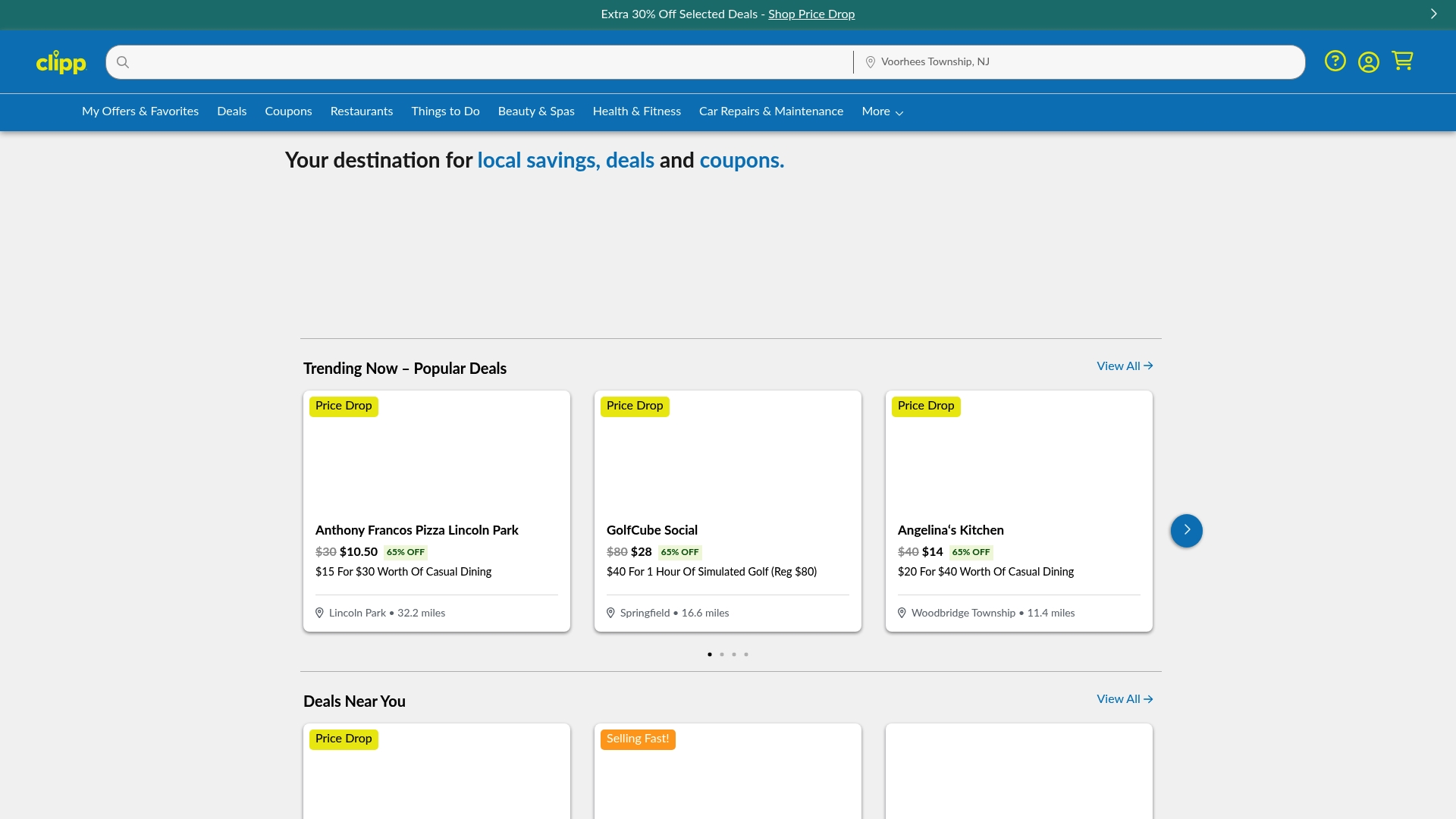
If the strategies above sound appealing but the execution feels like too much work, Clipp removes most of the friction. Clipp is a curated deal platform built specifically for local consumers who want real savings on dining, entertainment, wellness, home services, and more in their neighborhoods. Browse 50% off local deals across dozens of categories without wading through irrelevant national offers. Whether you are looking for deals near you or want to explore local coupons for everyday services, Clipp organizes everything in one place. The platform surfaces trending offers and fast-selling promotions so you catch the best value before it expires. Clipp is where the daily deal savings tips in this article actually come to life.
FAQ
What are the main benefits of daily deals for consumers?
The top benefits include significant savings of up to 50% on dining, entertainment, and local services, access to exclusive offers, and the ability to stack discounts with cashback and loyalty rewards for maximum value.
How do daily deals save money on local dining and entertainment?
Daily deals reduce the standard price of restaurant meals, spa treatments, classes, and experiences, often by 40 to 60%. When combined with cashback credit cards or loyalty points, your actual cost per outing drops substantially.
What are the biggest risks of using daily deals?
64% of consumers report making unplanned purchases because of deals, meaning impulse buying is the primary risk. Setting a monthly deal budget and sticking to planned categories keeps spending in check.
Are daily deals worth it for local services like gyms and salons?
Yes, particularly for services you use regularly. A discounted gym class or salon treatment at 50% off a service you planned to buy anyway represents pure savings with no behavioral change required.
How is daily deals vs regular pricing different in terms of value?
Daily deals consistently price local services 40 to 60% below standard rates. For high-frequency categories like dining and wellness, that gap translates to hundreds of dollars in annual savings for the average household.