

TL;DR:
- Daily deal sites offer genuine discounts on local services by selling vouchers upfront.
- Buyers should carefully vet deals, read terms, and use vouchers before expiration to maximize savings.
- Using deals strategically for new experiences and off-peak visits ensures the best value and satisfaction.
Plenty of people scroll past daily deal sites thinking the discounts are too steep to be real, or that there's always a catch buried in the fine print. The truth is more interesting. Daily deal sites can deliver genuine, measurable savings on local dining, entertainment, and services, and millions of Americans use them every month to try new restaurants, book spa days, and plan weekend activities at a fraction of the regular price. Once you understand how these platforms actually work, what to watch for, and when to use them, you'll stop second-guessing and start saving smarter.
Table of Contents
- What is a daily deal site?
- How daily deal sites work: Mechanics and key features
- Benefits and pitfalls of daily deal sites for consumers
- Maximizing value: When (and how) to use daily deal sites-to-use-daily-deal-sites)
- Why daily deal sites succeed—and where most people get them wrong
- Find your next local deal and save with Clipp.com
- Frequently asked questions
Key Takeaways
| Point | Details |
|---|---|
| Time-limited savings | Daily deal sites offer deep discounts on local dining, fun, and services—but only for a short time. |
| Know how deals work | Most deals are vouchers purchased up-front and redeemed like gift cards, with businesses and sites splitting the revenue. |
| Smart usage matters | Maximize value by reading fine print, acting quickly, and choosing deals on new or off-peak experiences. |
| Risks and rewards | Unused vouchers, overcrowded venues, and limited dates are pitfalls, but the cash value is usually protected by law. |
What is a daily deal site?
A daily deal site is exactly what it sounds like: a platform where businesses offer steep, time-limited discounts to attract new customers fast. But it's worth separating this from the broader world of coupons and cashback apps, because the model is genuinely different.
Standard coupon sites give you a code to enter at checkout. Cashback platforms refund a percentage after you spend. Daily deal sites work differently. You buy a voucher upfront, usually at a dramatically reduced price, and then redeem it directly with the business. According to Wikipedia's deal-of-the-day overview, a daily deal site is an e-commerce platform offering time-limited discounts (typically 24 to 72 hours) on local services like dining, spas, entertainment, and products, pioneered by sites like Groupon and Woot.
The model exploded around 2010 and 2011, when Groupon became one of the fastest-growing companies in history. The original concept relied on group buying: a deal would only activate if enough people purchased it within the time window. That "tipping point" mechanic created buzz and urgency. Today, most platforms have dropped the minimum buyer requirement and moved to instant-purchase deals, but the time pressure remains a core feature.
So why do local businesses sign up? A few reasons stand out:
- New customer exposure: A deal listing puts a restaurant or salon in front of thousands of local shoppers who may never have heard of them.
- Off-peak traffic: Businesses can fill slow weekday lunch slots or quiet Tuesday evenings.
- Low upfront cost: There's no advertising fee. The site only earns when a deal sells.
- Word of mouth: A customer who tries a new place through a deal and loves it often returns at full price.
You can explore the full range of types of local deals available in your area to get a feel for what's out there before you commit to anything.
Did you know? The daily deal industry helped reshape local advertising by shifting power to consumers. Instead of businesses broadcasting ads and hoping for clicks, deal sites let consumers opt in to exactly the offers they want.
| Platform type | Discount method | Purchase timing | Redemption |
|---|---|---|---|
| Daily deal site | Voucher upfront | Before visiting | At the business |
| Coupon site | Code at checkout | At time of purchase | Online or in-store |
| Cashback app | Rebate after spending | After purchase | Via app payout |
How daily deal sites work: Mechanics and key features
Understanding the definition, let's break down exactly how these platforms operate day to day.
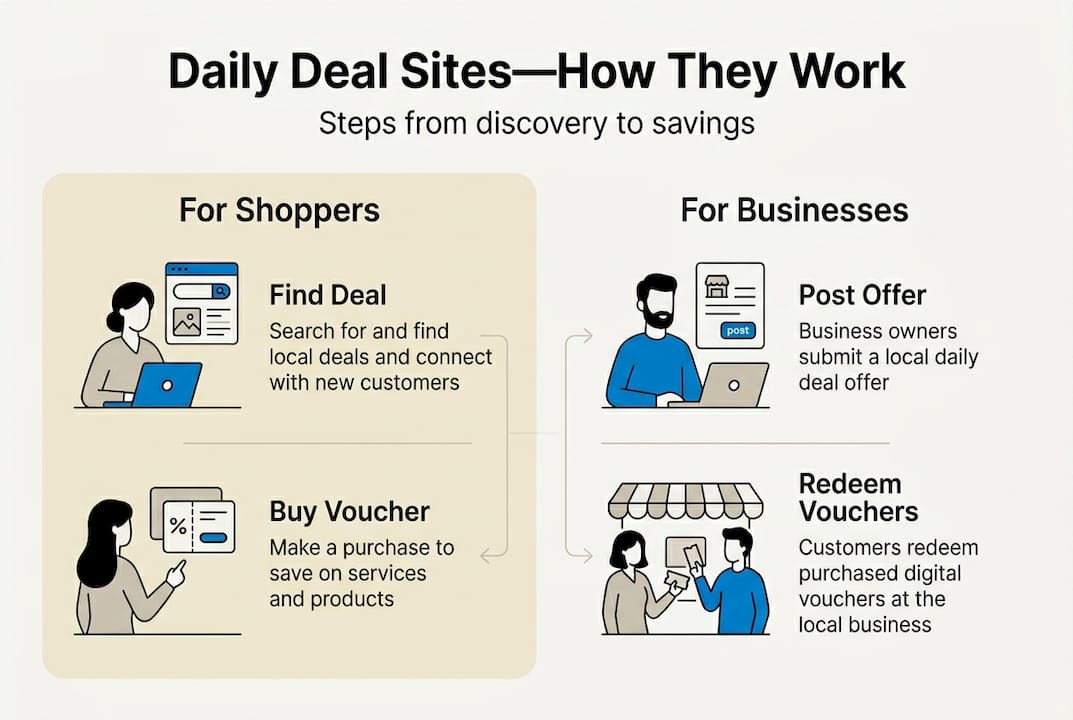
When a local business partners with a deal site, they agree to offer a specific service or product at a deep discount, usually between 30% and 90% off the regular price. The site lists the deal for a set window, often 24 to 72 hours. Consumers browse, buy a voucher, and then use that voucher at the business like a gift certificate.

Here's where the money flows: local businesses partner with the site to offer deep discounts (30 to 90% off), and the site typically takes a 30 to 50% commission on each sale. So if you buy a $50 voucher for $25, the site might keep $12.50 and pass $12.50 to the merchant. The merchant accepts this because the deal brings in customers who might not have come otherwise.
The group buying origins required a minimum number of buyers to activate a deal, but today most platforms skip that step entirely and rely on time limits to create urgency.
Sample deal breakdown:
| Deal item | Regular price | Voucher cost | Merchant receives | Site revenue |
|---|---|---|---|---|
| Dinner for two | $80 | $40 | $20 | $20 |
| Spa massage (60 min) | $90 | $45 | $22.50 | $22.50 |
| Escape room (2 people) | $60 | $30 | $15 | $15 |
| Cooking class | $100 | $50 | $25 | $25 |
Steps to find, buy, and redeem a deal:
- Browse the deal site by category or location to find an offer that fits your plans.
- Read the full terms, including expiration date, blackout dates, and any service minimums.
- Purchase the voucher using a credit or debit card through the site's secure checkout.
- Receive your voucher by email or in the site's app.
- Contact the business or book online to schedule your visit.
- Present the voucher (printed or digital) at the time of your visit.
- Pay any remaining balance if your total exceeds the voucher value.
You can also learn how city-specific deals work to target offers in your exact neighborhood, and check out tips on restaurant coupon savings if dining deals are your main interest.
Pro Tip: Set a reminder the day you buy a voucher. Most lost value comes from simply forgetting to use it before the expiration date. A calendar alert costs nothing and protects your purchase.
Benefits and pitfalls of daily deal sites for consumers
Once you know how daily deals work, it's smart to weigh their real-life pluses and minuses before you buy.
Key benefits for local consumers:
- Deep savings: Discounts of 30% to 90% on dining, entertainment, wellness, and services are genuinely achievable.
- Low-risk discovery: Trying a new restaurant or activity at half price reduces the sting if it doesn't wow you.
- Group activities: Many deals cover multiple people, making them great for date nights or friend outings.
- Legal value protection: Even if a voucher expires, paid value is honored for a set period under federal law, so you don't lose what you spent.
- Variety: One platform can surface dozens of local options you didn't know existed.
Common pitfalls to watch for:
Not every deal is a slam dunk. Overselling capacity leads to poor service when too many voucher holders show up at once. Businesses sometimes limit redemption to off-peak hours or exclude weekends, which may not fit your schedule. Most vouchers are non-refundable once purchased. And the savings only matter if you actually use the voucher.
A realistic redemption rate for daily deal vouchers tends to be well below 100%, which is actually part of how deal sites stay profitable. Non-redemptions benefit the site and the merchant. That's not a conspiracy; it's just math. The risk lands on you if you buy and forget.
Pro Tip: Before buying, search the business name plus "daily deal" or "voucher" in a review site. Other customers often flag issues like limited availability or poor service during peak voucher periods.
For a deeper look at making every purchase count, check out coupon strategies for local deals and explore types of restaurant coupons to match the right offer to the right occasion.
Maximizing value: When (and how) to use daily deal sites
Now that you know the pros and cons, let's focus on how to get the most out of every dollar spent on daily deal sites.
Daily deals work best in specific situations. They shine when you're trying a new restaurant for the first time, booking an activity during off-peak hours, or exploring a service you've been curious about but weren't ready to pay full price for. They're less useful for places you visit regularly, since you could easily spend more on vouchers than you would just paying the regular price over time.
Businesses that use deals for off-peak fill and excess inventory, rather than their core products, create the best experience for deal buyers. That's the sweet spot where everyone wins.
How to evaluate a deal before buying:
- Look up the regular price of the service or meal independently to confirm the discount is real.
- Read every line of the terms: expiration date, blackout periods, minimum purchase requirements, and excluded items.
- Check recent reviews of the business on Google or Yelp, not just the deal site's rating.
- Calculate your actual out-of-pocket cost, including any service fees the deal site charges.
- Confirm the business is still open and operating before completing your purchase.
Do's and don'ts of daily deal usage:
- Do use deals for new experiences and off-peak visits.
- Do buy as a gift for someone who will actually use it.
- Don't buy a deal just because it looks impressive if you have no concrete plan to use it.
- Don't assume all deals are equal. A 70% discount on a $10 service saves you $7. A 30% discount on a $200 experience saves you $60.
- Do check city-specific deal strategies to find offers timed to local events or seasons.
- Don't forget to tip based on the full pre-discount price. Your server's effort doesn't change because you used a voucher.
A practical example: you pay $25 for a $50 dining voucher. You order $55 worth of food, tip on the full $55, and pay the $5 difference. Your total out-of-pocket is $30 for a $55 meal. That's a real, tangible saving of $25 on a night out you were already planning.
Why daily deal sites succeed—and where most people get them wrong
Here's the part most deal guides skip: the consumers who get the most from daily deal sites are not the ones buying the most deals. They're the ones buying the right deals.
Conventional wisdom says more deals equal more savings. But chasing every offer leads to a pile of unused vouchers, mediocre experiences at businesses that are clearly overwhelmed by deal traffic, and a distorted sense of what things are actually worth. Businesses themselves treat deal listings as marketing and loss leaders, not profit centers. They know deal-seekers rarely return at full price. That dynamic matters for you as a consumer.
The smartest approach is to use deal sites as a discovery tool, not a default spending habit. Find one or two genuinely interesting local experiences per month, vet them carefully, and commit to actually going. That's how you get real enjoyment and real savings at the same time.
Long-term, the deal ecosystem only stays healthy when merchants attract customers who convert into regulars and when consumers focus on quality over quantity. Serial deal-hunting often delivers neither. Thoughtful, selective use of saving on local deals is what separates people who love these platforms from people who feel burned by them.
Find your next local deal and save with Clipp.com
Ready to put this into practice and find something worth doing in your town this week?
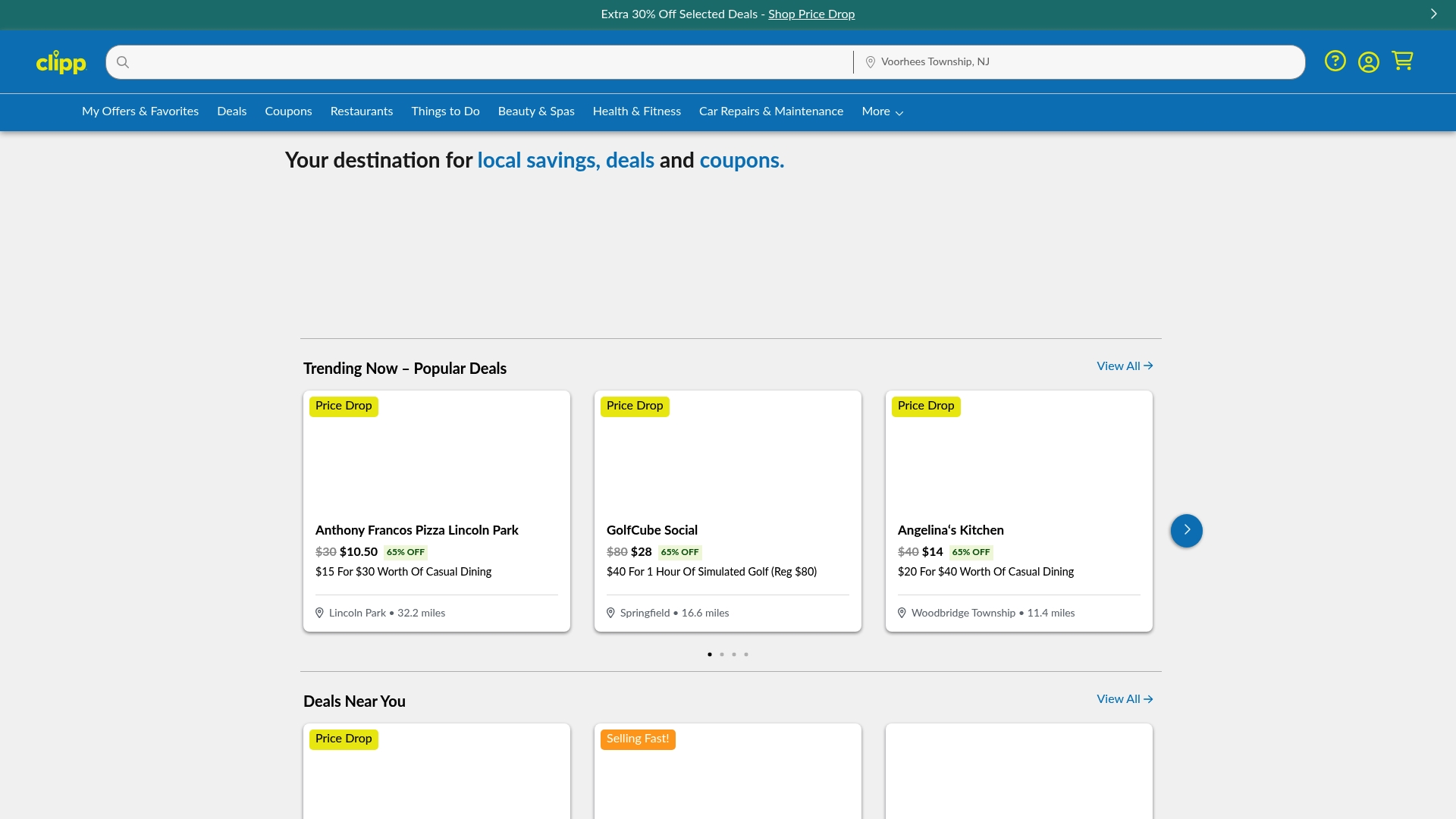
Clipp.com curates top local savings across dining, entertainment, wellness, and services, so you're never sifting through irrelevant offers. You can browse local deals at Clipp.com by category, or narrow things down by searching deals near you to see what's available in your neighborhood right now. If you're planning a trip or want to explore savings in another city, the deals by state page makes it easy to find offers wherever you're headed. Every listing is vetted and organized so you spend less time searching and more time enjoying.
Frequently asked questions
Do daily deal sites save you real money?
Yes, daily deal sites offer legitimate time-limited discounts, often 30% to 90% off on dining, services, and entertainment, but you must follow all terms and redeem vouchers before expiration.
What happens if I don't use my daily deal voucher?
If your voucher expires, federal law requires its paid value still honored for a set period, but the promotional value above what you paid may not be.
Can I combine daily deals with other offers or coupons?
Usually, you cannot combine daily deals with other coupons, lunch specials, or discounts. Always read the fine print before buying to avoid surprises at the register.
Why do some local deals sell out or become unavailable?
High demand or business capacity limits can cause popular deals to sell out quickly, and overselling capacity is a known issue, so acting fast on deals you want is always the right move.
Is it safe to use my credit card on daily deal sites?
Major daily deal sites use secure payment systems, but always verify the site's reputation and look for HTTPS in the URL before entering your card details to protect your information.