

TL;DR:
- Time-sensitive offers shorten the buyer's decision window by creating a sense of urgency. They leverage loss aversion and FOMO to prompt quick action, especially when properly coordinated across multiple channels. Properly timed, externally justified deadlines effectively boost conversions without damaging long-term trust.
Time-sensitive offers do one thing above everything else: they compress a buyer's decision window. Instead of letting a prospect think it over for three days, a well-constructed deadline forces the question now. That's the core job, and when it's executed cleanly, the payoff is measurable and fast.
The psychology behind it is loss aversion. Research shows that missing a discount feels roughly twice as painful as gaining an equivalent reward. That asymmetry is what makes a ticking clock so effective. And the numbers back it up: roughly 60% of consumers make reactive purchases because of FOMO, most within 24 hours of seeing an offer.
When to use them:
- Checkout acceleration (cart abandonment recovery, last-mile conversion)
- Inventory clearance before a seasonal reset
- Event-driven demand spikes (holidays, local events, product launches)
- Re-engaging lapsed customers who haven't purchased in 60–90 days
When to skip them:
- High-consideration B2B deals where trust-building takes weeks
- Premium or luxury positioning where urgency signals cheapness
- Any situation where the deadline can't be genuinely justified
The highest-ROI conditions: short, externally justified deadlines (seasonal, inventory-driven, anniversary); coordinated messaging across at least two channels; and terms simple enough to read in under ten seconds.
Table of Contents
- What a time-sensitive offer actually is and where it fits in your funnel
- Types of time-sensitive offers and how long each should run
- Why time-sensitive offers work: the psychology behind the purchase
- How to implement time-sensitive offers effectively
- How to measure success and design experiments
- Common pitfalls, ethical concerns, and how to avoid promotion fatigue
- How Clipp uses time-sensitive offers in a local deals marketplace
- Copy-ready examples and templates you can use today
- Key Takeaways
- The urgency trap most marketers fall into
- Clipp helps local merchants run time-sensitive deals that actually drive foot traffic
- Useful sources and further reading
What a time-sensitive offer actually is and where it fits in your funnel
A time-sensitive offer is a promotion with an explicit expiration, where the deadline itself is part of the value proposition. That separates it from quantity-based scarcity ("only 3 left in stock") and access-based restrictions ("members only"). The clock is the mechanic.

The marketer's jobs this tactic serves fall into three buckets. First, accelerating intent: a prospect who's already interested but hasn't committed gets nudged over the line. Second, reactivating lapsed customers, where a time-bound offer gives someone a concrete reason to return rather than a vague invitation. Third, creating acquisition touchpoints, where the offer itself becomes the reason a new customer encounters the brand at all.
Funnel position matters for duration. Top-of-funnel awareness campaigns can afford longer windows (7–14 days) because the goal is reach, not immediate conversion. Mid-funnel consideration benefits from 3–5 day windows that create enough pressure to prompt research without cutting it short. Bottom-of-funnel conversion is where flash mechanics (hours to 48 hours) do their best work. The shorter the window, the more the offer needs to be self-explanatory.
Types of time-sensitive offers and how long each should run
Not every deadline works the same way. The type of offer should match the objective, and the duration should match the type.
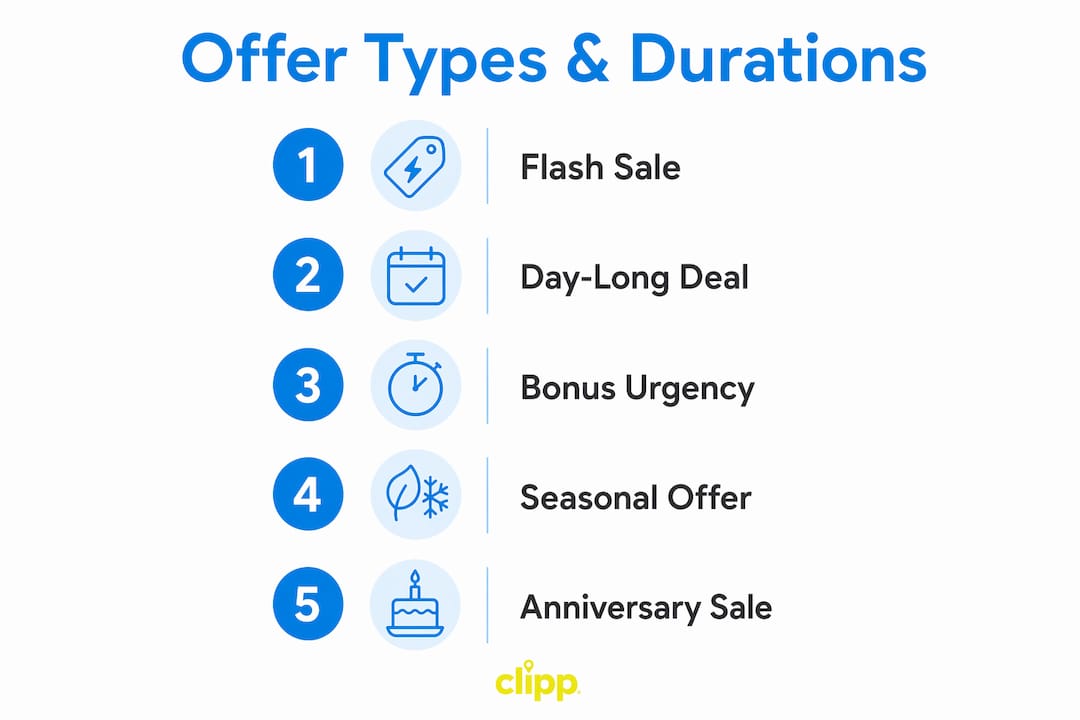
| Offer Type | Typical Duration | Primary Objective | Example Use Case |
|---|---|---|---|
| Flash sale | short duration | Immediate conversion, cart recovery | Sitewide discount, midnight to midnight |
| Weekend promotion | a few days | Volume lift, foot traffic | Friday–Sunday dining deal |
| Countdown discount | several days | Mid-funnel conversion | Decreasing discount as deadline nears |
| Limited-quantity drop | Until stock runs out | Scarcity signaling, exclusivity | 50 units at launch price |
| VIP / early-access window | up to two weeks | Loyalty reward, list building | Members get early access |
| Bonus / time-limited add-on | short window | Margin-friendly urgency | Free gift with purchase this weekend |
| Daily deal | about one day | Habit formation, repeat visits | One featured local merchant per day |
Flash sales work best when the audience is already warm. Sending a flash offer to a cold list wastes the urgency because the recipient doesn't have enough context to act. VIP early-access windows, by contrast, reward existing customers and generate social proof before the public launch, which is why platforms like Clipp use them to build anticipation for new merchant deals.
Bonus-based urgency (free gift, extra loyalty points) is worth calling out separately. When discounting would erode your margin or signal low quality, a time-limited add-on creates the same psychological pressure without touching the price. A local spa offering a free add-on service for bookings made before Sunday gets urgency without training customers to expect a lower price.
Why time-sensitive offers work: the psychology behind the purchase
The behavioral science here is well-documented, and understanding it helps you write better copy and design more credible campaigns.
The five core triggers:
- Loss aversion: Losing something feels about twice as bad as gaining the equivalent. A deadline reframes inaction as a loss.
- Scarcity: Limited availability raises perceived value. This works even when the scarcity is time-based rather than quantity-based.
- FOMO (fear of missing out): Social awareness that others are acting amplifies individual urgency. Showing redemption counts or "X people viewing this" activates it.
- Anticipatory regret: Consumers imagine how they'll feel after the deadline passes. Short-duration promotions often produce a bimodal redemption pattern: an early spike from decisive buyers and a second surge just before expiry from people acting on that anticipated regret.
- Social proof: An empirical study found social proof was the strongest individual driver of purchase intention within limited-time offer campaigns, stronger even than the discount itself.
The practical implication: your copy should name the loss, not just the gain. "Don't miss 40% off" outperforms "Get 40% off" because it activates loss aversion directly. Pair that with a visible countdown and a redemption count, and you've stacked three triggers in one unit.
One caution: online consumers detect manufactured scarcity more readily than in-store shoppers. The American Marketing Association advises that online scarcity tactics risk being perceived as manipulative, which means the justification for your deadline has to be credible. "Ends Sunday because we're resetting inventory for fall" is believable. "Ends Sunday because we said so" is not.
How to implement time-sensitive offers effectively
Execution is where most campaigns fall apart. The offer is fine; the coordination isn't.
Step-by-step campaign checklist:
- Set a single objective. Conversion lift, cart recovery, foot traffic, or reactivation — pick one. Multi-objective campaigns dilute messaging.
- Segment your audience. Warm subscribers and past buyers get different offers than cold prospects. Urgency lands harder when the recipient already knows the brand.
- Design the offer. Discount, bonus, or access-based. Match the type to the margin and the audience.
- Set the window. Use the table above as a starting point. Justify the deadline externally (seasonal, inventory, event).
- Plan the channel sequence. See the timing matrix below.
- Write the creative. Lead with the loss, include a countdown, and make redemption frictionless.
- QA the redemption path. Test the coupon code, the landing page, and the checkout flow before launch.
- Confirm legal and terms clarity. Exclusions, geographic restrictions, and expiration must be visible before checkout, not buried in fine print.
- Set a cadence cap. Decide how many time-sensitive offers you'll run per month before you start, not after you've trained your list to wait.
Channel timing matrix:
| Channel | When to Push | Purpose |
|---|---|---|
| Email (announcement) | Campaign launch | Reach the full list, set context |
| Onsite banner / popup | Launch through close | Capture in-session visitors |
| Paid social / display | Launch + final 6 hours | Reach non-subscribers, retarget |
| Email (reminder) | Midpoint of window | Re-engage non-openers |
| SMS | Final 2–4 hours | Last-call urgency for high-intent buyers |
| Organic social | Launch + last-hour countdown | Community awareness, FOMO amplification |

Multi-channel coordination is the single biggest operational lever. Practitioner guidance consistently shows that the final hours of a campaign drive a disproportionate share of conversions, which means the SMS and last-hour email are not optional extras.
Pro Tip: When discounting would hurt your margin, use bonus-based urgency instead. "Free dessert with any entrée booked before Sunday" creates the same deadline pressure as a price cut without touching your price point. Local service businesses, in particular, can use this to drive bookings without conditioning customers to expect a lower rate.
How to measure success and design experiments
The goal of measurement isn't just to confirm the campaign worked. It's to isolate why it worked so you can replicate the right variables.
| KPI | The Question It Answers |
|---|---|
| Conversion rate lift (vs. control) | Did the offer actually move buyers, or would they have purchased anyway? |
| Incremental revenue | What revenue is attributable to the deadline, not the discount alone? |
| Redemption rate | Did the offer resonate with the audience it reached? |
| Average order value | Did urgency prompt larger purchases or just faster ones? |
| Post-campaign repurchase rate | Did the offer attract quality buyers or one-time deal-seekers? |
| Customer acquisition cost (CAC) | Did the campaign acquire new customers efficiently? |
For A/B testing, the most common mistake is changing the discount and the duration at the same time. That makes it impossible to know which variable drove the lift. Run one variable per test. Frontiers in Psychology research on time-limited promotions specifically recommends controlling for timing effects and customer segments separately, because the urgency response varies significantly by segment.
Holdout groups matter more than most teams realize. If you don't have a control group that received no offer, you can't separate the time-effect from the price-effect. A 20% lift in conversion rate sounds strong until you learn that the same segment always converts 18% higher in October regardless of promotions.
Redemption rate is your fastest signal. Low redemption on a high-traffic campaign means the offer didn't resonate. High redemption with low repeat purchase means you attracted deal-seekers, not loyal customers. Both are useful data points; neither is a failure if you planned for them.
Common pitfalls, ethical concerns, and how to avoid promotion fatigue
The tactics that work best are also the easiest to abuse. Here's where campaigns go wrong:
- Fake countdown timers that reset on page refresh. Consumers notice, and the trust damage outlasts the campaign. This is the single fastest way to erode brand credibility.
- Weekly flash sales that run every Friday. After three or four cycles, your audience learns to wait. You've trained them out of paying full price, which is the opposite of the goal. Discounting strategy research consistently flags this as a long-term margin risk.
- Restrictive redemption rules that create friction at checkout. Research on psychological reactance shows that when consumer flexibility is restricted (no returns, narrow redemption windows, complex exclusions), the positive effect of a limited-time offer reverses into a negative one. The fix: include a statement about future regret ("You'll wish you'd grabbed this") and remove as much friction as possible from the path to redemption.
- Confusing terms buried in footnotes. If a customer gets to checkout and finds the offer doesn't apply to what they chose, you've created a negative experience at the highest-intent moment in the funnel.
- Promotion fatigue. An empirical study on online shopping platforms found that ethical, transparent strategies outperform manipulative ones in sustained purchase intention. Frequency caps and genuine justifications for deadlines aren't just ethical guardrails; they're performance levers.
Practical ethical guidelines: Use exogenous justifications (seasonal, inventory, anniversary, event-driven) rather than arbitrary deadlines. State terms clearly before checkout. Cap time-sensitive campaigns to a frequency your audience can absorb without tuning out. Monitor unsubscribe rates and coupon abandonment as early-warning signals of fatigue.
How Clipp uses time-sensitive offers in a local deals marketplace
Clipp operates as a curated deals marketplace connecting local merchants with consumers actively looking for savings on dining, wellness, entertainment, and home services. The time-sensitive offer isn't a feature of the platform; it's the core mechanic.
A representative campaign structure on Clipp works like this: a local restaurant partners with Clipp to offer a limited-time dining deal with a meaningful discount available for a defined window, often about one to two weeks. The deal appears in Clipp's "Trending Deals" and "Near You" sections, which surface offers by proximity and popularity. Consumers purchase a voucher, redeem it in-store, and the merchant receives foot traffic that would otherwise require paid advertising to generate.
The operational lesson for other marketers is the simplicity of the redemption path. Clipp's fast-selling promotions consistently show that the easier the redemption, the higher the conversion from purchase to actual use. A voucher that requires a phone call to book, a specific table, and a minimum party size will underperform a voucher that just needs to be shown at the door.
For local merchants, the follow-up tactic matters as much as the initial offer. Clipp's deal structure encourages merchants to capture contact information or loyalty sign-ups at redemption, converting a one-time deal buyer into a repeat customer. That's where the long-term ROI of a time-sensitive offer actually lives.
Copy-ready examples and templates you can use today
Email subject lines:
- "48 hours left: your [category] deal expires Sunday"
- "Last call: 40% off ends tonight at midnight"
- "You left something behind — and it's almost gone"
- "Members only: your early access closes in 24 hours"
Homepage banner / onsite countdown:
- "Flash Sale: 30% off everything. Ends in [countdown timer]."
- "This weekend only: [Offer]. Saturday–Sunday, while supplies last."
SMS last-call:
- "⏰ 2 hours left on your [Brand] deal. Tap to redeem: [link]"
- "Last chance: your exclusive offer expires at midnight. Don't miss it."
Template A: 48-hour flash sale (ecommerce)
- T-48h: Email announcement to full list
- T-24h: Onsite banner goes live; paid retargeting activates
- T-6h: Email reminder to non-openers
- T-2h: SMS to high-intent segment
- T-0: Offer closes; confirmation email to purchasers
Template B: 7-day VIP early access (loyalty members)
- Day 1: Email to loyalty list with exclusive access link
- Day 1: Onsite personalized banner for logged-in members
- Day 3: Midpoint reminder email with redemption count ("thousands of members have already claimed this")
- Day 6: Final-day email + SMS to members who opened but didn't convert
- Day 7: Offer closes; public launch begins for non-members
Both templates follow the multi-channel coordination principle: announcement, reminder, and last-hour push across at least two channels. The VIP template adds social proof at the midpoint, which addresses the FOMO trigger for members who are aware but haven't acted.
Key Takeaways
Time-sensitive offers drive the fastest conversion lift when the deadline is short, externally justified, and backed by a coordinated multi-channel close across email, SMS, and onsite.
| Point | Details |
|---|---|
| Short windows outperform long ones | Flash and day-length offers produce faster redemption; longer windows need community or seasonal justification to maintain urgency. |
| Multi-channel close is non-negotiable | Final-hour SMS and email reminders drive a disproportionate share of conversions; skipping them leaves measurable revenue on the table. |
| Measure redemption rate first | Redemption rate answers offer resonance fastest; post-campaign repurchase rate tells you whether you attracted loyal buyers or one-time deal-seekers. |
| Ethical execution protects long-term performance | Fake timers and weekly flash sales train buyers to wait and erode brand trust; exogenous justifications and frequency caps preserve both. |
| Clipp for local merchants | Clipp's deals marketplace runs time-limited local promotions for restaurants, salons, and service providers, connecting them with deal-seeking consumers nearby. |
The urgency trap most marketers fall into
The conventional wisdom says "add urgency and conversions go up." That's true, but it's incomplete in a way that costs marketers real money.
The mistake I see most often is treating urgency as a volume dial you just turn up. Run more flash sales. Shorten every window. Add a countdown to everything. What actually happens is the opposite of what's intended: customers learn the pattern, start waiting for the next sale, and your full-price conversion rate quietly collapses over six to twelve months.
The research on psychological reactance makes this concrete. When the redemption rules are too restrictive, or the deadline feels arbitrary, the offer doesn't just fail to convert; it actively damages product evaluation. You've spent money to make people like your product less.
The rule of thumb that actually holds up: shorter windows need bigger perceived value, and longer windows need a credible community or seasonal reason to exist. A 4-hour flash sale with 50% off a popular item works. A 4-hour flash sale with 10% off something nobody wanted at full price just looks desperate. And a 14-day "sale" with no stated reason teaches customers that your prices are negotiable indefinitely.
The marketers who get consistent results from time-sensitive offers treat them as a precision tool, not a default setting. They run them infrequently enough that the audience hasn't been conditioned to wait. They justify the deadline. They make redemption frictionless. And they measure post-campaign repurchase rates, not just conversion spikes, because that's where the real signal lives.
Clipp helps local merchants run time-sensitive deals that actually drive foot traffic
Local restaurants, salons, gyms, and service providers get the most out of time-sensitive offers when the platform does the distribution work for them. Clipp is built exactly for that. Merchants list a limited-time deal, Clipp surfaces it to nearby consumers actively searching for savings, and the redemption mechanic is simple enough that buyers complete it in under a minute.
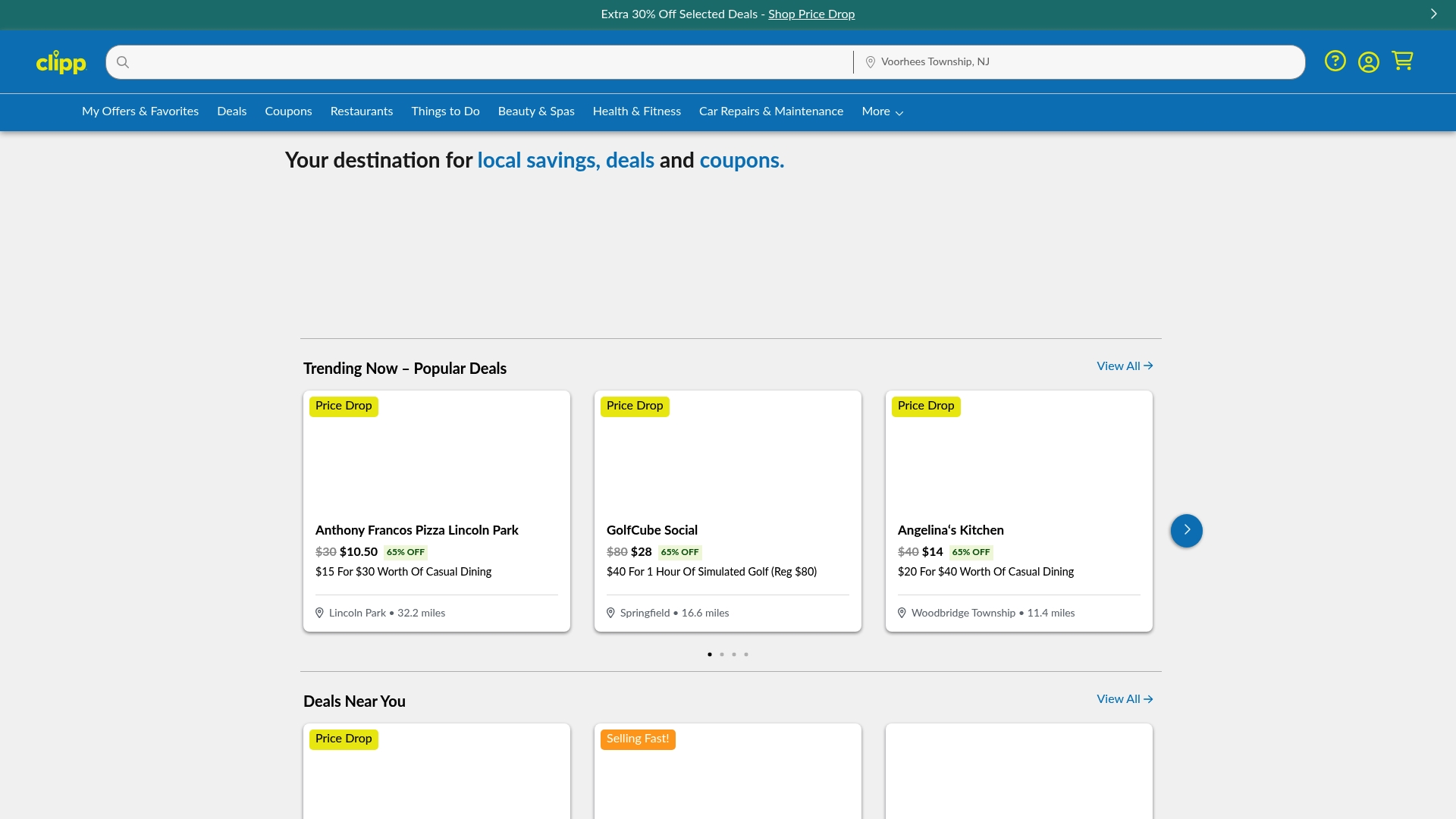
For a local business that needs a short-term revenue burst without building a full campaign infrastructure, Clipp removes the friction on both sides. The merchant sets the offer terms and duration; Clipp handles the audience, the placement in "Trending Deals" and "Near You," and the coupon mechanics. If you run a restaurant, spa, or local service business in Texas, Florida, Virginia, or across the country, the fastest next step is to list your deal on Clipp and let the platform's deal-seeking audience do the rest. Browse local deals near you to see the format your customers already use.
Useful sources and further reading
| Source | Why It's Useful |
|---|---|
| Consumer flexibility and limited-time offers (ScienceDirect) | Eight-study paper on how redemption restrictions trigger psychological reactance and reverse the positive effect of LTOs. |
| Limited-Time Offers: 10 Proven Ways to Drive Ecommerce Sales (Drip) | Practitioner playbook covering flash sale mechanics, FOMO statistics, and multi-channel sequencing. |
| Why Limited-Time Offers Entice Shoppers to Buy (Psychology Today) | Explains the bimodal redemption pattern (early adopters + anticipatory regret spike) and its implications for reminder timing. |
| Limited-time offers and online consumers (AMA) | American Marketing Association research on why online consumers detect manufactured scarcity and how exogenous justifications restore credibility. |
| Impact of LTOs on e-consumers (Frontiers in Psychology) | Academic study on S-O-R effects and the importance of controlled experiments to isolate urgency from price variables. |
| LTO impact on consumer purchase behavior (IJSair) | Empirical study finding social proof as the strongest driver within LTO campaigns and recommending ethical, transparent execution. |
| How to Use Limited-Time Offers to Drive Sales (Mailchimp) | Channel sequencing templates and scheduling recommendations from a major email platform. |
| Why highlight fast-selling promotions (Clipp Blog) | Clipp's own guidance on surfacing urgent offers in restaurant and local-service marketing. |
| Step-by-step deal promotion for local businesses (Clipp Blog) | Practical campaign checklist for local merchants running time-sensitive deals. |
| The role of discounts for businesses (Clipp Blog) | Broader discounting strategy context, including how to avoid training customers to always wait for a sale. |