

TL;DR:
- Highlighting fast-selling promotions leverages urgency signals to increase conversion rates by triggering scarcity, loss aversion, and FOMO. Authentic real-time labels, such as "Selling Fast," are more effective than static badges like "Best Seller," and should be coordinated across multiple channels. Honest, short-term offers with operational readiness create trust, boost inventory turnover, and benefit both consumers and businesses through quicker sales and increased engagement.
Highlighting fast-selling promotions is the single most effective tactic for converting browsing consumers into buyers by triggering urgency, scarcity, and loss aversion at the exact moment of decision. The industry term for this practice is promotional urgency signaling, and it covers everything from "Selling Fast" badges on product pages to countdown timers in email campaigns. Platforms like Clipp, Movable Ink, and Drip have built entire strategies around it because the psychology is reliable and the results are measurable. This guide breaks down why highlight fast-selling promotions works, which formats perform best, and how local businesses and marketers can apply these tactics right now.
Why highlight fast-selling promotions: the psychology behind it
Promotional urgency signaling works because it exploits three hard-wired cognitive biases: scarcity, loss aversion, and FOMO (fear of missing out). Each one compresses the time a consumer spends deliberating before a purchase.
Scarcity is the most direct trigger. When a product is labeled "Only 3 Left" or "Selling Fast," the brain assigns it higher value automatically. This is not a marketing trick. It is a documented cognitive response that has been studied across retail, hospitality, and digital commerce. The scarcity principle tells us that perceived rarity increases desirability, which is why limited-time deals consistently outperform evergreen promotions in click-through and conversion rates.
Loss aversion amplifies the effect. Research from Drip shows that customers find losing a discount twice as painful as gaining an equivalent benefit. That asymmetry is the engine behind every "Don't miss out" subject line and every expiring coupon. When you frame a promotion as something a consumer is about to lose rather than something they might gain, motivation to act increases sharply.
FOMO layers on top of both. Social proof signals, such as "47 people bought this today" or "Trending in your area," tell consumers that others are already acting. That social validation removes hesitation and creates a self-reinforcing cycle of urgency.
- Scarcity signals raise perceived product value and reduce comparison shopping
- Loss aversion framing converts passive interest into active purchase intent
- FOMO and social proof validate the decision and accelerate the final click
- Visual badges combining icons and text produce stronger emotional engagement than text-only labels, according to research on promotional label elements
Pro Tip: Segment your badge design by shopper type. Hedonic shoppers, those browsing for enjoyment, respond better to visual icon-plus-text badges. Pragmatic, value-focused buyers convert more reliably with numeric labels like "Save $12 today." Matching label format to consumer motivation is a proven conversion driver.
"Selling fast" vs. "best seller": which label wins?
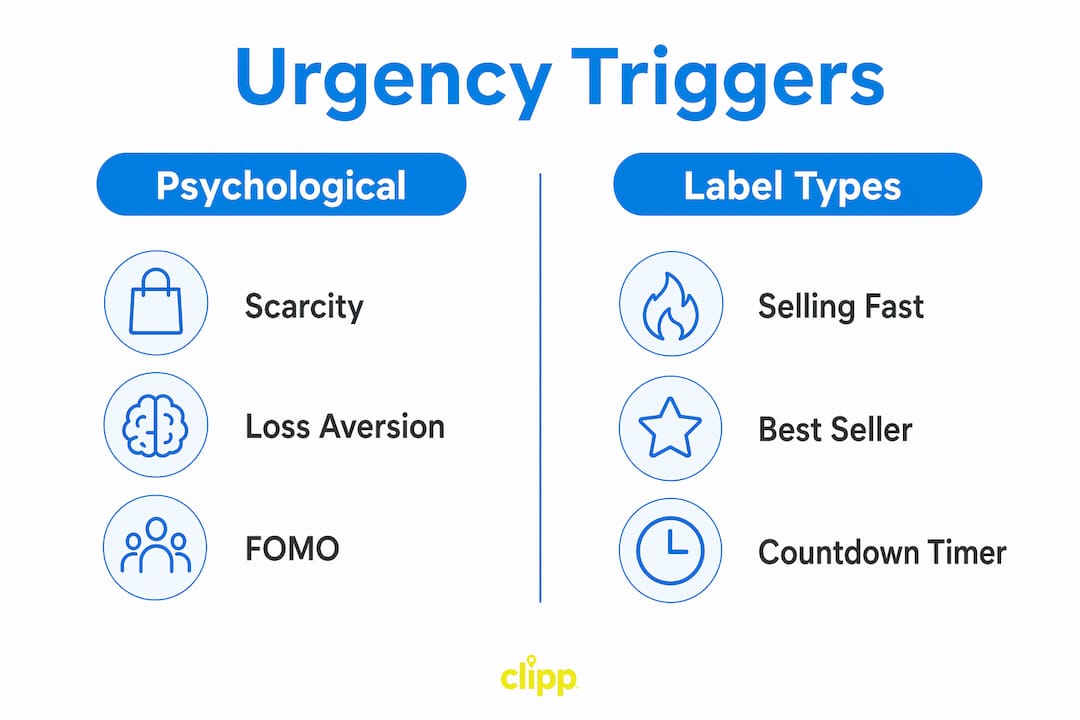
Not all promotional highlight styles deliver equal results. The format you choose determines how authentic the urgency feels and how much it moves the needle on sales.
Static "Best Seller" badges signal past popularity. They build trust but create no time pressure. A consumer sees "Best Seller" and thinks, "Good choice." They do not think, "I need to act now." Dynamic labels like "Selling Fast," "Trending Today," or "Only 2 Left" create present-tense urgency. The difference in conversion impact is significant because one badge describes history while the other describes a live situation.
The authenticity requirement is non-negotiable. Real-time momentum triggers that reflect actual purchase activity within a 24–48 hour window produce authentic urgency. Static badges applied to slow-moving inventory destroy credibility the moment a consumer notices the label has not changed in weeks.
| Label Style | Effectiveness | Best Use Case | Key Risk |
|---|---|---|---|
| "Best Seller" (static) | Moderate | Trust-building on evergreen products | No urgency created |
| "Selling Fast" (dynamic) | High | Flash sales, limited inventory | Requires real-time data |
| "Trending" (social proof) | High | New products gaining traction | Needs volume to be credible |
| Numeric discount badge | Moderate to high | Price-sensitive, pragmatic buyers | Can feel transactional |
| Icon + text visual badge | High | Impulse categories, hedonic shoppers | Heavier page load if image-based |
One technical pitfall kills the gains from even the best label strategy. Image-heavy badges deployed poorly can slow page loading speed, harming user experience and offsetting every conversion gain. CSS-based badges load faster, score better on Core Web Vitals, and are easier to update in real time. If your site slows down during a flash event, you lose the sale regardless of how good the label copy is.
Fake scarcity is the other major pitfall. Displaying "Only 1 Left" on a product with 500 units in stock is a short-term tactic that harms trust and long-term retention. Consumers notice, and they do not forget.
Pro Tip: Use CSS-based badges instead of image files for all urgency labels. They render faster, update dynamically from your inventory feed, and keep your Core Web Vitals scores healthy during high-traffic flash events.
How to showcase top-selling offers in 2026
The best practices for displaying fast-selling promotions have shifted toward multi-channel coordination and real-time data integration. A badge on a product page is no longer enough on its own.

Build your promotion around a real urgency window. Flash sales lasting 24 hours with steep discounts generate the sharpest impulse-purchase spikes. Anything longer than 48 hours dilutes the urgency signal. Set a hard end time and communicate it clearly across every channel.
Here is a practical checklist for implementing fast-selling promotion highlights in 2026:
- Update labels in real time. Connect your badge system to live inventory or sales data. Labels reflecting activity from the past 24–48 hours feel credible. Labels that never change feel fake.
- Coordinate across email, social, and your website. A promotion that appears only on your product page misses consumers who are not actively browsing. Push the same urgency signal through email subject lines, social media stories, and website banners simultaneously.
- Design email for the Promotions tab. Brands that design for the Promotions tab with explicit deal annotations in the preview text attract higher-quality engagement. Consumers who open a deal email from the Promotions tab are already in buying mode.
- Use countdown timers sparingly. A countdown timer on a 24-hour flash sale creates genuine urgency. A countdown timer on a promotion that resets every day trains consumers to ignore it.
- Keep your UI light. Use CSS badges, compressed images, and minimal JavaScript for promotion overlays. Performance is part of the conversion equation.
- Prepare your fulfillment operation. Operational readiness before a flash event prevents the negative reviews and returns that erase profit from a successful sale.
Trending deals on local platforms follow the same rules. A neighborhood restaurant running a "Tonight Only" dinner special needs the same real-time urgency signaling as a national e-commerce brand. The scale is different. The psychology is identical.
How buyers and businesses both win
The importance of fast-selling promotions extends beyond a single transaction. Both consumers and businesses gain measurable advantages when urgency signals are honest and well-executed.
For consumers, highlighted promotions cut through decision fatigue. The average shopper encounters hundreds of offers daily. A clear "Selling Fast" or "Limited Today" label does the filtering work for them. It signals: this deal is worth your attention right now. Research from Drip confirms that limited-time offers reduce hesitation and make customers more likely to buy immediately rather than delay. Consumers who act on these signals also tend to feel satisfied with their decision because the urgency framing reinforces that they made a smart, timely choice.
For businesses, the benefits stack up across multiple dimensions:
- Faster inventory turnover. Moving stock quickly improves cash flow and reduces carrying costs. A well-run flash sale can clear slow-moving inventory in hours.
- Higher qualified engagement. Consumers who respond to urgency signals are already motivated buyers. They convert at higher rates and generate fewer abandoned carts than general browsers.
- Email list activation. Deal annotations in email previews help subscribers quickly evaluate relevance, which means the clicks you get are from people ready to buy.
- Customer acquisition. Flash sales attract new customers who might not have discovered your business otherwise. A first-time buyer acquired through a limited-time deal has long-term value if the experience is positive.
- Social sharing. Genuinely good deals get shared. A local gym offering a "48-Hour New Member Special" through Clipp can generate organic word-of-mouth that extends well beyond the original promotion window.
The benefits of daily deals compound over time when businesses run promotions consistently and honestly. Consumers learn to trust the platform and the brand, which turns one-time buyers into repeat customers.
Key takeaways
Highlighting fast-selling promotions drives conversions because it combines scarcity, loss aversion, and real-time social proof into a single, credible urgency signal that compresses consumer decision timelines.
| Point | Details |
|---|---|
| Psychology drives results | Scarcity, loss aversion, and FOMO are the three core mechanisms that make urgency labels convert. |
| Real-time data is required | Labels must reflect actual purchase activity within 24–48 hours to stay credible and effective. |
| Format matches buyer type | Visual icon-plus-text badges work best for impulse shoppers; numeric labels convert pragmatic buyers. |
| Multi-channel coordination wins | Align urgency signals across email, social media, and your website for maximum reach and impact. |
| Honesty protects long-term value | Fake scarcity destroys trust; operational readiness before a flash event protects customer satisfaction. |
What i've learned running urgency campaigns
Most marketers treat urgency labels as decoration. They slap a "Best Seller" badge on a product and expect results. That is not how it works. The label has to mean something, and the consumer has to believe it.
The campaigns I have seen fail almost always share one flaw: the urgency is manufactured, not real. A countdown timer that resets daily, a "Low Stock" warning on a product with unlimited digital inventory, a "Trending Now" badge that has not been updated in three weeks. Consumers are sharper than most marketers give them credit for. They notice the inconsistency, and once they do, every future promotion from that brand gets discounted in their mind.
The campaigns that work are built on honest data and genuine scarcity. A local salon offering five discounted appointment slots on a Tuesday afternoon is running a real flash sale. The scarcity is real. The urgency is real. The consumer who books feels like they won something. That emotional payoff is what drives the social share, the repeat visit, and the five-star review.
My strongest advice: before you design the badge, design the offer. Make sure the scarcity is real, the fulfillment is ready, and the window is short enough to matter. The label is just the last step.
— Mehmet
Discover fast-selling local deals on Clipp
Clipp connects local consumers with the best fast-selling promotions in their neighborhoods, from dining and wellness to home services and entertainment. Every deal on the platform is time-sensitive and locally curated, so you are always seeing offers that are actually available near you right now.
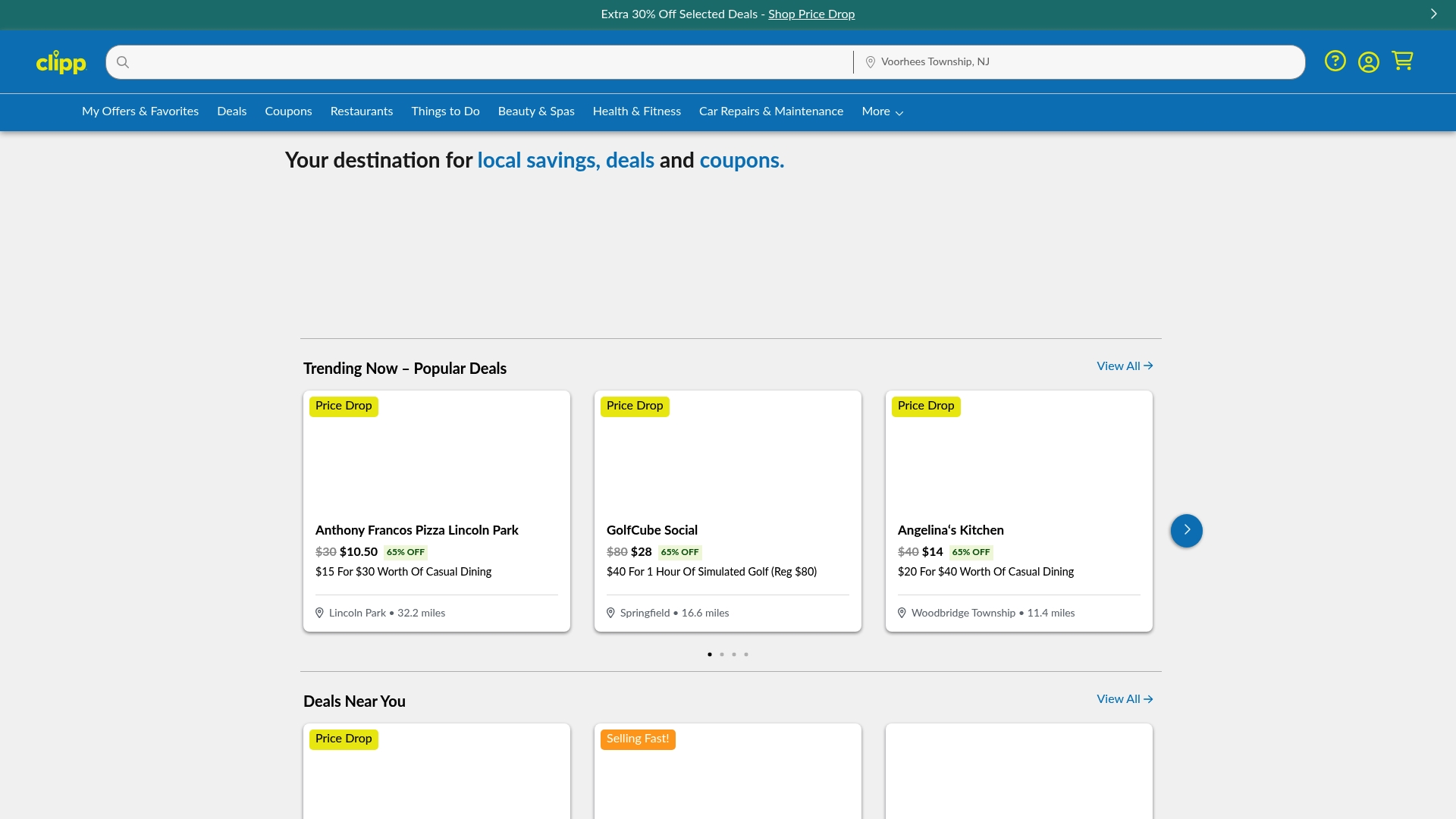
For businesses, Clipp offers a direct channel to motivated local buyers who are actively searching for deals. Listing a limited-time promotion on Clipp puts your offer in front of consumers who are already in buying mode. For shoppers, the platform's local deals section surfaces the most urgent and best-value offers in your area, updated continuously. Whether you are a business looking to drive foot traffic or a consumer hunting for savings, Clipp.com is built for exactly this moment.
FAQ
What does it mean to highlight a fast-selling promotion?
Highlighting a fast-selling promotion means using urgency signals like "Selling Fast," countdown timers, or low-stock badges to draw consumer attention to a time-sensitive offer. The goal is to compress decision timelines and drive immediate purchase action.
Why do limited-time deals outperform standard promotions?
Limited-time offers reduce hesitation by creating urgency through scarcity and loss aversion, making consumers act now rather than delay. Standard promotions without a deadline give buyers no reason to prioritize the decision.
How long should a flash sale last to be effective?
Effective flash sales typically run for 24 hours with steep discounts to maximize impulse purchases. Extending beyond 48 hours weakens the urgency signal and reduces conversion rates.
What is the biggest mistake businesses make with urgency labels?
The biggest mistake is using fake scarcity, such as displaying "Only 1 Left" on a product with abundant stock. This harms trust and long-term retention once consumers recognize the tactic.
Should i design my promotional emails for the promotions tab?
Yes. Brands that design for the Promotions tab with explicit deal annotations attract higher-quality engagement because subscribers who open from that tab are already in a deal-seeking mindset.