

TL;DR:
- Promotional pricing is a short-term, goal-driven strategy with a fixed start and end date to boost sales and clear inventory.
- It requires planning, measurement, and discipline to avoid margin erosion, brand dilution, and customer conditioning.
Promotional pricing is defined as a temporary reduction in price or addition of value, applied within a fixed campaign window to drive a specific business outcome. Unlike general discounting, it has a clear start date, an end date, and a measurable goal. Brands from local restaurants to national retailers use promotional pricing strategies to move inventory, win new customers, and compete on attention. Tools like flash sales, BOGO offers, and targeted promo codes are the most common execution formats. Platforms like Salesforce and HubSpot have both published detailed frameworks on how to run these campaigns without destroying margins.
What is promotional pricing and how does it work?
Promotional pricing is a short-term, time-bound strategy with defined start and end dates. That time limit is what separates it from a permanent price cut. The urgency created by a deadline is what makes the tactic work psychologically.

The mechanics are straightforward. A business sets a reduced price or adds a bonus offer, runs it for a fixed period, then returns to the original price. The campaign has a goal: increase sales volume, clear end-of-season inventory, attract first-time buyers, or win back lapsed customers. Without a defined goal, a promotion is just a margin sacrifice.
Common promotional tactics include flash sales, BOGO (buy one, get one) offers, and promo codes targeted at specific customer segments. Flash sales create urgency through extreme time compression, often running for just hours. BOGO offers increase basket size while making the customer feel they are getting more value. Targeted promo codes let businesses reward loyalty or test price sensitivity in specific segments without broadcasting a discount to everyone.
Pro Tip: Test your discount depth before committing to a full campaign. A 25% discount often achieves strong perceived value while protecting margins better than deeper cuts. Start there and measure response before going lower.
Timing matters as much as depth. Promotions aligned with marketing campaigns and seasonal demand cycles generate more lift than standalone discounts dropped without context. A restaurant running a BOGO deal during a slow Tuesday lunch period will see better incremental results than running the same deal on a busy Friday night when customers would have come anyway.
How does promotional pricing compare to other pricing strategies?
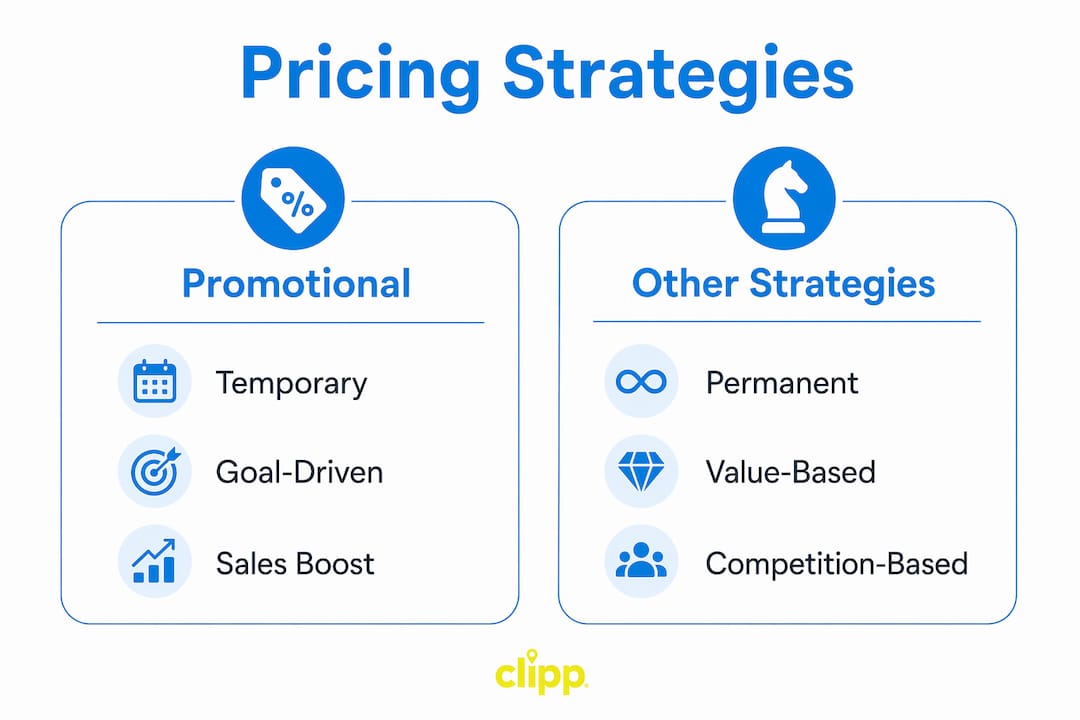
Promotional pricing is one of several pricing approaches, and confusing them leads to poor decisions. The table below clarifies the key differences.
| Strategy | Timing | Primary intent | Business impact |
|---|---|---|---|
| Promotional pricing | Temporary, campaign-based | Drive volume, trial, or clearance | Short-term revenue lift, potential margin risk |
| Discount pricing | Ongoing or permanent | Compete on price | Lower perceived value over time |
| Value-based pricing | Permanent | Capture willingness to pay | Higher margins, requires strong brand |
| Competition-based pricing | Ongoing | Match or undercut rivals | Margin pressure, reactive positioning |
Discount pricing, by contrast, is a permanent or semi-permanent price reduction. A retailer that always sells at 20% below competitors is practicing discount pricing, not promotional pricing. The distinction matters because discount pricing reshapes how customers perceive your brand permanently. Promotional pricing, when executed correctly, does not.
Value-based pricing sets prices based on what customers believe the product is worth, not on cost or competition. It requires strong brand equity and deep customer insight. Promotional pricing can complement a value-based model by creating entry points for new customers without permanently lowering the anchor price.
Competition-based pricing reacts to what rivals charge. It is reactive by nature. Promotional pricing is proactive. You choose when to run it, for how long, and for whom. That control is what makes it a genuine marketing tool rather than a defensive reflex.
What are the benefits and risks of promotional pricing?
The benefits of promotional pricing are real and well-documented. Done right, a promotion drives measurable volume, brings in new customers who would not have tried your product at full price, and clears inventory that would otherwise sit idle. For local businesses, a well-timed deal can fill seats, book appointments, or sell gift cards during slow periods.
The risks are equally real. The three most damaging outcomes are:
- Margin erosion. A discount that is too deep, or a campaign that runs too long, can wipe out profit even when sales volume rises.
- Brand value dilution. Discounting flagship products trains customers to see your best offerings as less premium. Promotions should focus on complementary or secondary lines, not your signature product.
- Customer conditioning. Frequent or deep discounts teach customers to wait for sales. Once that behavior sets in, full-price sales drop permanently.
"Strategic discounting acts as a precise growth tool if used surgically and data-driven, avoiding blunt pricing approaches that erode profits." — Harvard Business Review, 2026
The HBR framing is the right one. Promotional pricing is a scalpel, not a sledgehammer. The businesses that get hurt are the ones that reach for it too often or without a clear exit plan.
About 60% of promotional campaigns are unprofitable due to invisible cannibalization and brand dilution. That number should stop any business owner from running promotions casually. Rigorous data analysis before, during, and after every campaign is not optional.
Pro Tip: Never put your flagship product on deep discount. If you need to run a promotion, apply it to a bundle, an add-on, or a secondary SKU. Protect the product that defines your brand.
Practical tips for running effective promotional pricing campaigns
Effective promotional pricing requires discipline before, during, and after the campaign. The following steps give you a repeatable framework.
-
Define the goal first. Write down exactly what the promotion is meant to achieve: new customer acquisition, inventory clearance, basket size increase, or lapsed customer reactivation. Every other decision flows from this.
-
Set your measurement metrics. The three metrics that matter most are net price (the actual revenue per unit after the discount), uplift (incremental sales generated by the promotion), and cannibalization (sales shifted away from other products or future full-price purchases). Uplift tells you whether the promotion created new demand. Cannibalization tells you whether it just moved demand around.
-
Run an A/B test before scaling. Test two discount depths or two offer formats on a small segment before committing your full budget. A 20% discount and a 25% discount may produce very different response rates. The data will tell you which one earns more net revenue, not just more units.
-
Keep the offer simple. Simple, clearly worded offers aligned with your brand positioning get higher engagement and customer trust than complex multi-step deals. "Buy one entrée, get one free on Tuesdays in march" is clear. "Spend $75, get 15% off your next order of $50 or more, excluding sale items" is not.
-
Set a hard end date and honor it. The urgency of a deadline is a core part of what makes promotional pricing work. Extending a promotion repeatedly signals to customers that the discount is the real price.
-
Audit the results against your baseline. Compare sales, margins, and customer acquisition costs during the promotion against the same period in a prior year or a control group. Without a baseline, you cannot know whether the promotion worked.
| Metric | What it measures | Why it matters |
|---|---|---|
| Net price | Revenue per unit after discount | Shows true profitability per sale |
| Uplift | Incremental sales from promotion | Confirms new demand was created |
| Cannibalization | Sales shifted from other products | Reveals hidden profit loss |
| Customer acquisition cost | Cost to win each new buyer | Benchmarks promotion efficiency |
A common pitfall is overuse. Running promotions every month removes the urgency that makes them effective. Customers stop responding because they know another deal is coming. Space promotions out, and make each one feel like a genuine event. For discount campaign ideas that hold their impact over time, the principle is the same: scarcity and timing drive response, not just price.
Pro Tip: Track cannibalization on every campaign. If your promotion on Product A causes Product B sales to drop by the same amount, you have not grown revenue. You have just moved it.
Key Takeaways
Promotional pricing works when it is time-bound, goal-driven, and measured against net price, uplift, and cannibalization.
| Point | Details |
|---|---|
| Define the campaign window | Set a hard start and end date to create urgency and prevent customer conditioning. |
| Protect flagship products | Apply discounts to secondary lines or bundles, not your signature offerings. |
| Measure uplift and cannibalization | Track both metrics on every campaign to confirm you are creating new demand, not just shifting it. |
| Keep offers simple | Clear, brand-aligned promotions outperform complex multi-step deals in customer engagement. |
| Test before scaling | Run A/B tests on discount depth before committing full campaign budgets. |
The uncomfortable truth about promotional pricing
Most businesses use promotional pricing as a panic button. Sales slow down, and the first instinct is to cut the price and see what happens. That reflex is understandable, but it is almost always the wrong move.
What I have seen repeatedly is that the businesses that get the most out of promotional pricing treat it like a product launch, not a clearance event. They plan it weeks in advance, tie it to a specific customer segment or seasonal moment, and measure it against a clear baseline. The ones that run promotions reactively almost never know whether they worked.
The HBR framing on surgical discounting is exactly right. A promotion that is not tied to a goal is just a margin donation. The businesses that build real pricing discipline treat every discount as a hypothesis: "If I offer 25% off this product to lapsed customers in april, I expect to reactivate X buyers at a cost of Y." Then they measure it. That mindset is what separates promotional pricing as a growth tool from promotional pricing as a bad habit.
The other thing worth saying plainly: simplicity wins. The clearest, most direct offers get the highest response rates. If your customer needs to read the fine print to understand what they are getting, the promotion has already failed.
— Mehmet
How Clipp can support your promotional pricing strategy
Running a promotional pricing campaign is only as effective as the audience it reaches. Clipp connects local businesses with deal-seeking customers across dining, wellness, home services, and entertainment.
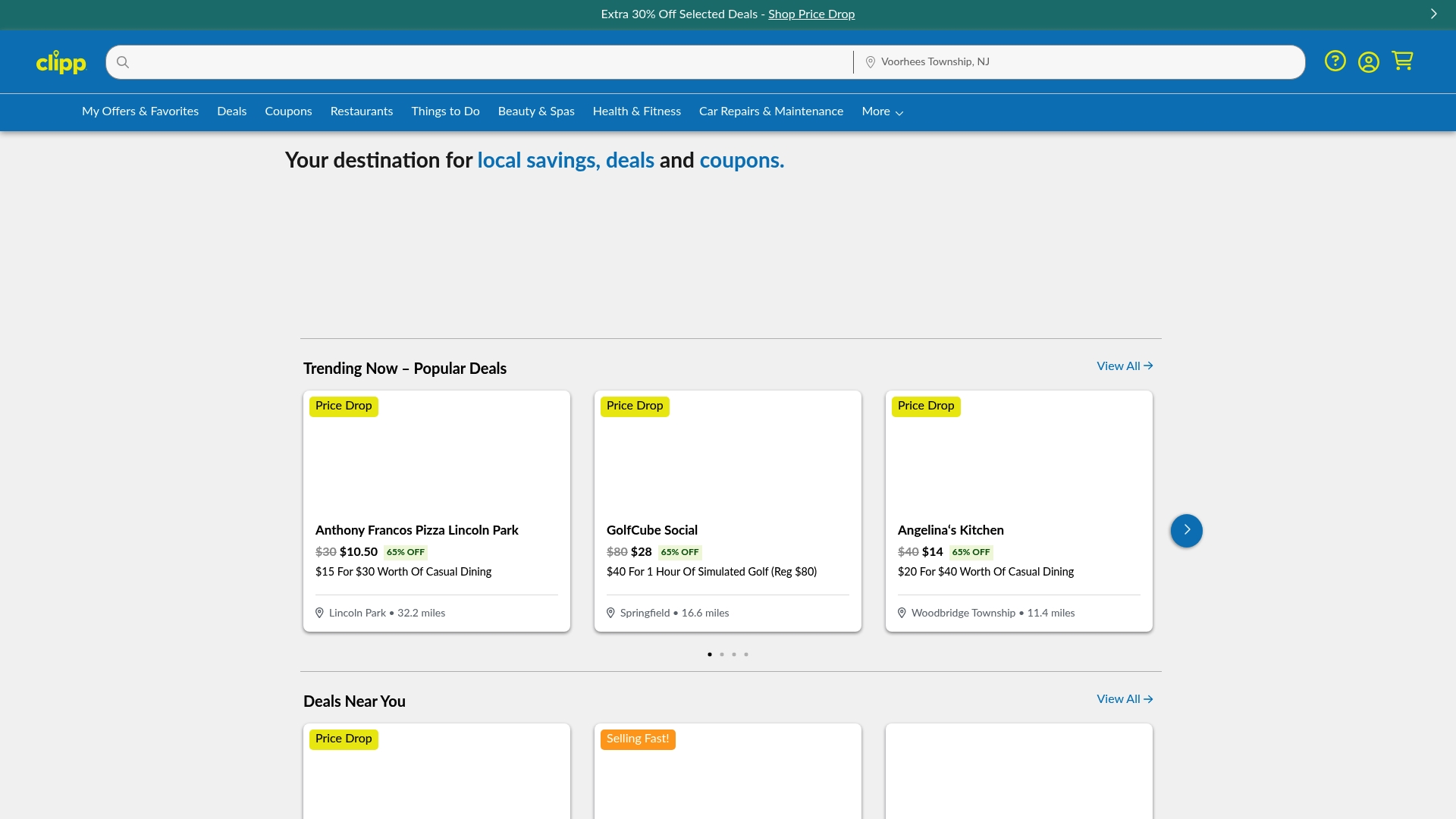
Businesses listed on Clipp gain immediate visibility among customers who are actively looking for local promotions. The platform is built around time-limited offers and curated deals, which means your campaign lands in front of the right audience at the right moment. Whether you run a restaurant, a salon, or a fitness studio, Clipp gives your promotion the reach it needs to generate real uplift. Customers in Massachusetts, Virginia, and Texas can find your deals directly through the platform's localized savings pages.
FAQ
What is the difference between promotional pricing and discount pricing?
Promotional pricing is time-bound with defined start and end dates, while discount pricing is an ongoing or permanent price reduction. Promotional pricing is a campaign tactic; discount pricing is a long-term positioning choice.
How do I measure whether a promotional pricing campaign worked?
Track three metrics: net price (revenue per unit after the discount), uplift (incremental sales created by the promotion), and cannibalization (sales shifted from other products). All three together give you a complete picture of campaign profitability.
What types of promotional pricing work best for local businesses?
Flash sales, BOGO offers, and targeted promo codes are the most effective formats for local businesses. Each creates urgency and drives foot traffic without requiring a permanent price reduction.
Can promotional pricing hurt my brand?
Yes. Discounting flagship products or running promotions too frequently can lower perceived value and train customers to wait for deals. Apply promotions to secondary lines and space campaigns out to protect brand equity.
How deep should a promotional discount be?
A 25% discount is a strong starting point that balances perceived value with margin protection. Test this depth first, then adjust based on measured response and net revenue, not just unit volume.