

TL;DR:
- Strategic discounts in salon marketing can build loyalty and increase client lifetime value if used correctly.
- Running too many promotions or offering deep discounts can erode profit margins and train clients to wait for sales.
Discounts in salon marketing are defined as strategic price reductions or value-added promotions designed to attract new clients, retain existing ones, and drive repeat bookings. The role of discounts in salon marketing goes far beyond simply filling empty appointment slots. Done right, promotions build loyalty, increase lifetime client value, and differentiate your salon in a crowded local market. Done wrong, they train clients to wait for sales, erode your margins, and attract deal-seekers who never return. This guide gives you the data, the frameworks, and the practical steps to use discounts as a growth tool, not a crutch.
How do discounts impact salon profitability and client behavior?
The financial math on salon discounts is brutal, and most owners underestimate it. The average salon net profit margin sits at approximately 8.2%. That means a 10% discount can require 50% more business volume just to break even on profit. Over 60% of salon promotions destroy value rather than create it. That statistic should stop you cold before you post your next "20% off everything" offer on Instagram.

The client behavior side is equally damaging over time. Constant discounting trains clients to see the reduced price as the real price. Once that psychological anchor sets in, your full-price services feel like an overcharge. Price-driven clients leave the moment a cheaper competitor appears down the street. That is not a client base. That is a liability.
The acquisition cost problem compounds this further. Customer acquisition costs for beauty services rose to $50–$127 per new client in 2026, up from $20–$30 in 2023. That means a discounted first visit that does not convert to a rebooked full-price appointment is a net loss, not a marketing win.
The core problem with salon discounting is not the discount itself. It is running promotions without a conversion plan attached.
The salons that profit from promotions treat every discounted visit as the first step in a structured client journey, not a one-time transaction.
What discount strategies preserve value and encourage loyalty?
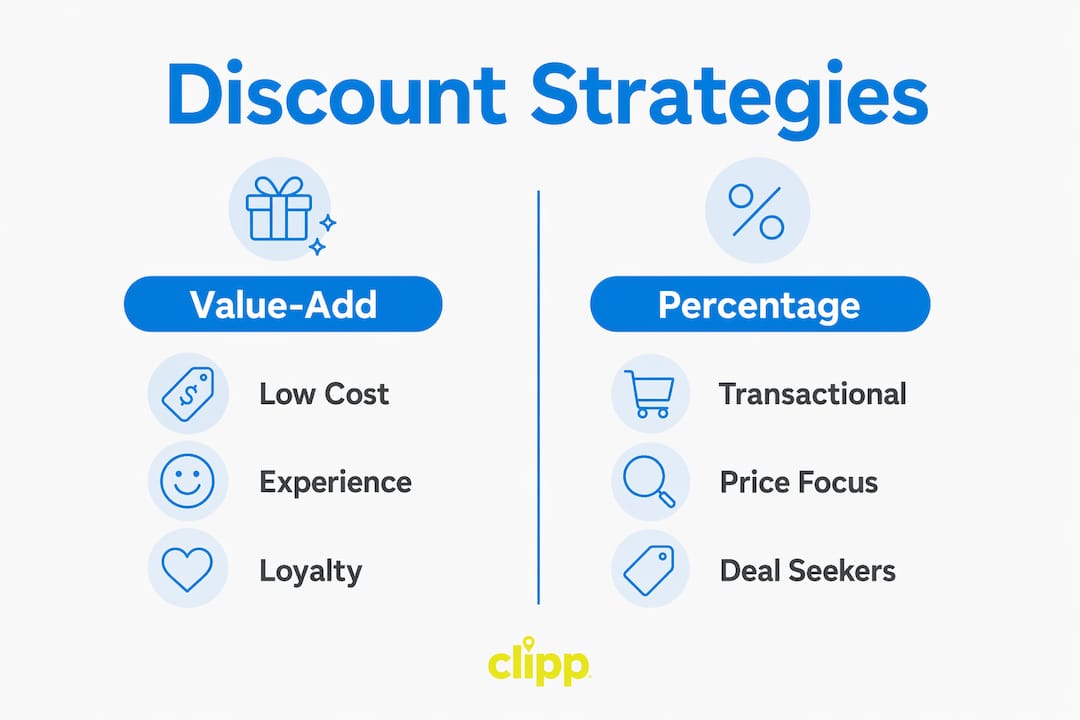
The most effective discount strategies for salons are built around two principles: modest entry offers and value-add promotions that protect your core pricing. Industry data recommends first-time client discounts in the 15%–30% range. Discounts above 50% attract deal-hopping clients with low retention and low lifetime value. A 20% first-visit offer paired with an immediate rebooking incentive outperforms a 50% flash sale every time.
Value-add promotions are the smarter play for existing clients. Consider these options:
- Free scalp massage added to a color service
- Complimentary conditioning treatment with any cut over $60
- Priority booking access for loyalty members
- A free product sample from a retail line you carry
- Birthday month upgrade to a premium service tier
Low-cost add-ons like scalp massages or conditioning treatments cost your salon $3–$8 but carry a perceived value of $20–$40 to the client. That gap is where loyalty is built. You are enhancing the experience without touching your service price.
Timing and frequency matter as much as the offer itself. Effective salon marketing runs only 4–6 strategic promotional events per year. Seasonal timing works well: a back-to-school color refresh in august, a holiday glam package in november, a spring renewal offer in march. Space your promotions so clients feel urgency, not routine.
Pro Tip: Frame every promotion around an experience, not a price. "Complimentary scalp massage with your next color" lands better than "10% off color services." The first feels like a gift. The second feels like a clearance sale.
Contrast this with percentage discounts, which are transactional by nature. A 15% off coupon tells clients your service is worth less. A free add-on tells clients you value their experience. The psychological difference is significant, and it shows up in rebooking rates.
What are the hidden discount pitfalls that silently erode salon profits?
Phantom discounts are the most overlooked margin leak in salon businesses. Phantom discounts are unrecorded price reductions: rounding a $97 service to $90 at checkout, throwing in a free gloss treatment without logging it, or spending an extra 20 minutes on a client without charging. Individually, each feels like good customer service. Collectively, they can be the difference between a profitable month and breaking even.
Here is how to identify and reduce phantom discounts in your salon:
- Audit your point-of-sale data monthly. Compare scheduled service prices against actual charged amounts. Any gap is a phantom discount.
- Log every complimentary service. Even if you do not charge for it, record it. You need to know the true cost of your generosity.
- Set clear add-on policies. Define which services can be comped, by whom, and under what circumstances. Remove the guesswork for your team.
- Review stylist-level data separately. Phantom discounts often concentrate around one or two staff members who are generous by habit.
- Use salon management software like Vagaro, Mindbody, or Square Appointments to flag price overrides automatically.
Relentlessly tracking every discounted dollar, including phantom discounts, is the only way to accurately measure campaign ROI and identify where your margins are leaking.
Relationship discounts are a separate but related problem. Personal discounts to friends and family can cost salons thousands of dollars annually. The fix is not to stop being generous. Replace heavy discounts with experiential perks: a complimentary gloss, a take-home product, or a priority booking slot. The gesture feels personal. The revenue impact is minimal.
Pro Tip: Create a "friends and family" service menu with set perks rather than open-ended discounts. It protects your margins and actually feels more intentional than a vague "I'll give you a deal."
How can salon owners implement effective discount campaigns?
Every effective discount campaign starts with a clear goal. Are you filling slow Tuesday afternoons? Launching a new service? Reactivating lapsed clients? The goal determines the offer, the audience, and the success metric. Without a defined goal, you are just running a sale.
The core elements of a campaign that converts are:
| Campaign type | Primary goal | Best offer format | Key metric |
|---|---|---|---|
| New client acquisition | Fill new bookings | 15%–20% first visit off | Rebooking rate within 60 days |
| Lapsed client reactivation | Win back clients gone 90+ days | Free add-on with return visit | Return visit rate |
| Slow period fill | Boost midweek bookings | Time-restricted flash offer | Appointment fill rate |
| Service launch | Introduce new treatment | Complimentary trial upgrade | Upgrade conversion rate |
| Loyalty reward | Retain top clients | Exclusive member perk | Retention rate at 12 months |
Profitability calculation comes before you publish any offer. Know your service cost, your labor cost, and your break-even price. If a blowout costs you $22 in labor and product, and you normally charge $55, a 30% discount brings revenue to $38.50. That is a $16.50 margin. Is that enough to justify the slot? Only you can answer that, but you must ask the question first.
Limited-time and quantity-driven promotions convert better by creating urgency and exclusivity. "Book by Friday" outperforms "available all month." "First 10 new clients only" outperforms "open to everyone." Scarcity is a real psychological driver, and it filters out low-intent deal-seekers.
After the discounted visit, your follow-up sequence determines whether you made money or lost it. Send a personalized rebooking message within 48 hours. Offer a small loyalty incentive for booking the next full-price appointment. AI-driven retention tools and automated rebooking prompts after discounted first visits can increase lifetime client value substantially. Tools like Vagaro and Mindbody both offer automated follow-up sequences built for exactly this purpose.
One more data point worth building your strategy around: upselling service upgrades to loyal clients yields 28%–35% upgrade rates to higher-tier full-price services. That outperforms discounting as a revenue strategy. Your best clients do not need a discount. They need a personalized recommendation from a stylist they trust.
Key takeaways
Discounts work in salon marketing when they are structured, time-limited, and tied to a conversion goal. Running promotions without a rebooking plan attached is the single most common reason salon discounts hurt rather than help.
| Point | Details |
|---|---|
| Discounts cut deeper than they look | A 10% discount can require 50% more volume to maintain profits at an 8.2% margin. |
| First-time offers have a sweet spot | Keep new client discounts at 15%–30% to attract quality clients who rebook at full price. |
| Value-adds beat price cuts | A $3–$8 add-on with $20–$40 perceived value builds loyalty without touching your pricing. |
| Phantom discounts are a real threat | Unlogged comps and rounded totals silently erode margins; audit your POS data monthly. |
| Frequency determines culture | Limit promotions to 4–6 events per year to preserve urgency and avoid training clients to wait for sales. |
Why I stopped thinking of discounts as a marketing tool
I have watched salon owners run the same 20% off promotion every month for years, convinced it was driving growth. What it was actually driving was a client base that would never pay full price. The discount had become the product.
The shift that changes everything is treating a promotion as a client acquisition cost, not a revenue event. You are paying for the relationship, not the appointment. That reframes every decision: how deep the discount goes, what follow-up you attach, and whether the offer attracts the kind of client you actually want to build a business around.
The salons I have seen thrive are the ones that use exclusive offers to reward loyalty rather than broadcast discounts to attract strangers. They run fewer promotions, but each one is deliberate. They know their cost per acquisition, their rebooking rate, and their 12-month client value. Discounting without those numbers is just guessing.
My honest advice: audit your last six months of promotions. Calculate the actual margin on each one after phantom discounts, labor, and product costs. You will probably find that two or three of them were profitable and the rest were expensive experiments. Build from what worked.
— Mehmet
Find salon deals that work for your business with Clipp
Running a promotion that actually fills your chair and converts to loyal clients requires the right platform behind it. Clipp connects salon owners with local deal-seekers who are actively looking for services in their area, making your promotions visible to the right audience at the right moment.
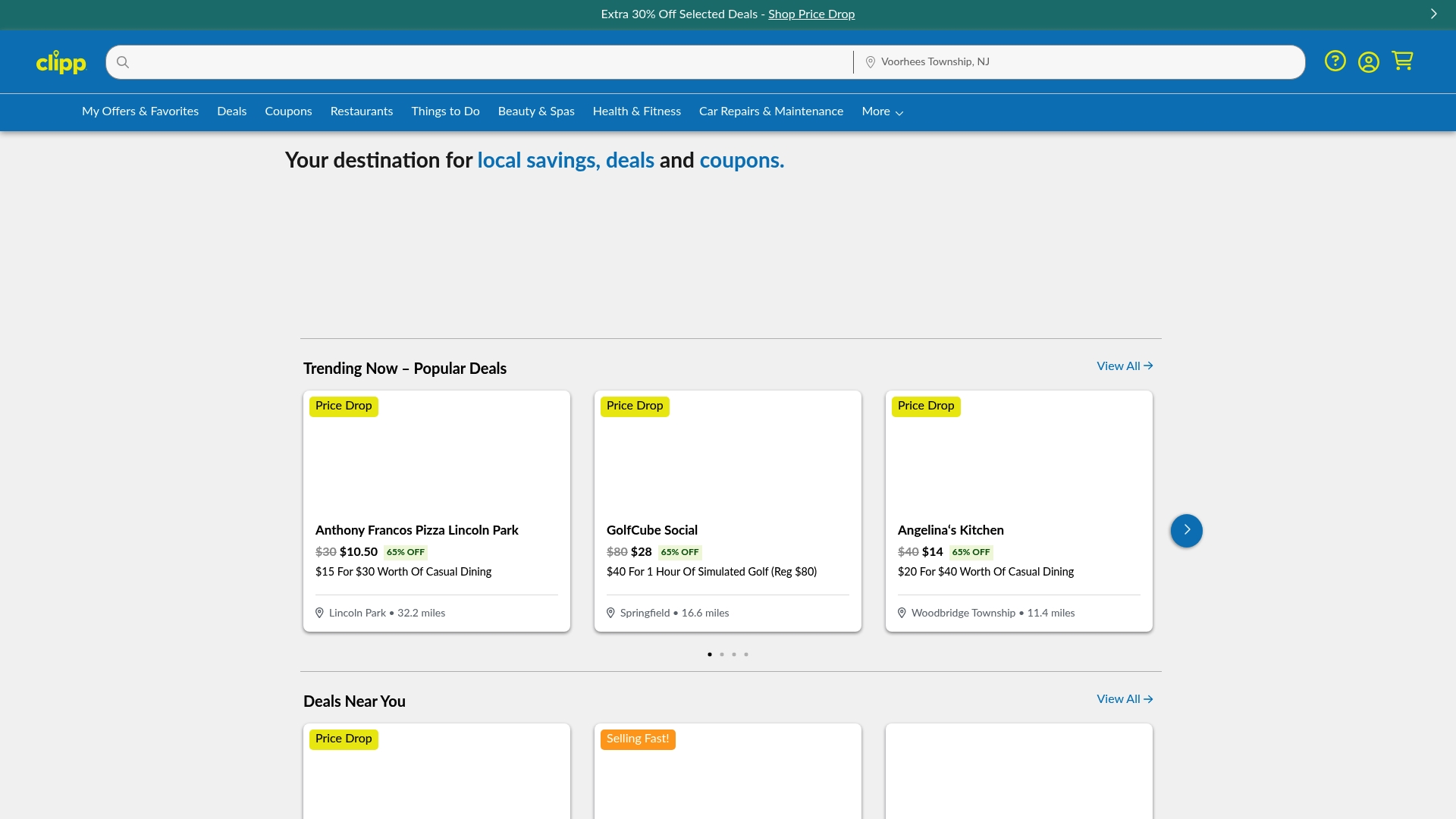
Whether you are launching a first-time client offer, filling slow midweek slots, or testing a new service package, Clipp gives you a targeted channel to run salon service deals that reach motivated local buyers. The platform is built for local businesses that want trackable results, not just impressions. Explore current deals on Clipp to see how other local salons are structuring their promotions and find the format that fits your goals.
FAQ
What is the role of discounts in salon marketing?
Discounts in salon marketing serve as client acquisition and retention tools when used strategically. Their primary purpose is to lower the barrier for new clients to try your services and to reward loyal clients, while protecting profitability through structured offers and follow-up rebooking plans.
How much should a salon discount for first-time clients?
The recommended range for first-time client discounts is 15%–30%. Discounts above 50% attract deal-hopping clients with low retention rates and low lifetime value, which costs more in acquisition than it returns in revenue.
What are phantom discounts in a salon?
Phantom discounts are unrecorded price reductions such as rounding totals, comping add-ons, or providing extra service time without charging. They silently erode profit margins and can be the difference between a profitable month and breaking even.
How often should a salon run discount promotions?
Effective salon marketing limits discount events to 4–6 per year. Running promotions more frequently trains clients to wait for sales and erodes the perceived value of your full-price services.
Are value-add promotions better than percentage discounts?
Value-add promotions generally outperform percentage discounts for client loyalty. A low-cost add-on costing $3–$8 carries a perceived value of $20–$40 to the client, preserving your core pricing while enhancing the experience.