

TL;DR:
- Best-value promotions offer the lowest true final cost after discounts, fees, and conditions. They focus on what you will realistically pay, not just advertised percentages or bonuses you cannot use.
Best-value promotions are defined as offers that minimize your realistic final cost after all discounts, fees, and usability factors are applied. The headline percentage means nothing if shipping, taxes, or restrictive conditions eat up your savings. Shoppers who focus only on the biggest advertised number routinely overpay. This guide breaks down how to evaluate any promotion by its true out-of-pocket cost, compares the most common deal types, and shows you exactly how to apply that thinking to local dining, entertainment, and services.
What are best-value promotions, really?
A best-value promotion is not the one with the largest discount number. It is the one that leaves you with the most money in your pocket after every cost and condition is counted. Realistic final cost includes the item or service price after discounts, plus shipping, taxes, fees, and any rewards you may never actually use.
That definition matters because retailers and local businesses design promotions to look bigger than they are. A "40% off" restaurant deal that requires a minimum party of six, excludes weekends, and expires in two weeks is not the same as a straightforward 25% off any visit. The first deal may cost you more in practice.
Consumer Reports takes this approach when curating deals. It combines price attractiveness with product quality and performance, not just the size of the markdown. That standard is worth applying to every local offer you evaluate.
How to evaluate a promotion's true value
The total cost of a promotion has five components: the price after the discount, shipping or delivery fees, taxes, any required add-ons, and the realistic value of bonuses like free gifts or loyalty points. Missing any one of these gives you a false picture of your savings.

Return and cancellation policies are part of that picture too. A generous return policy raises real value beyond the price cut because it reduces your risk. A store-credit-only refund or a short return window works in the opposite direction. Treat the return policy as a cost factor, not a footnote.
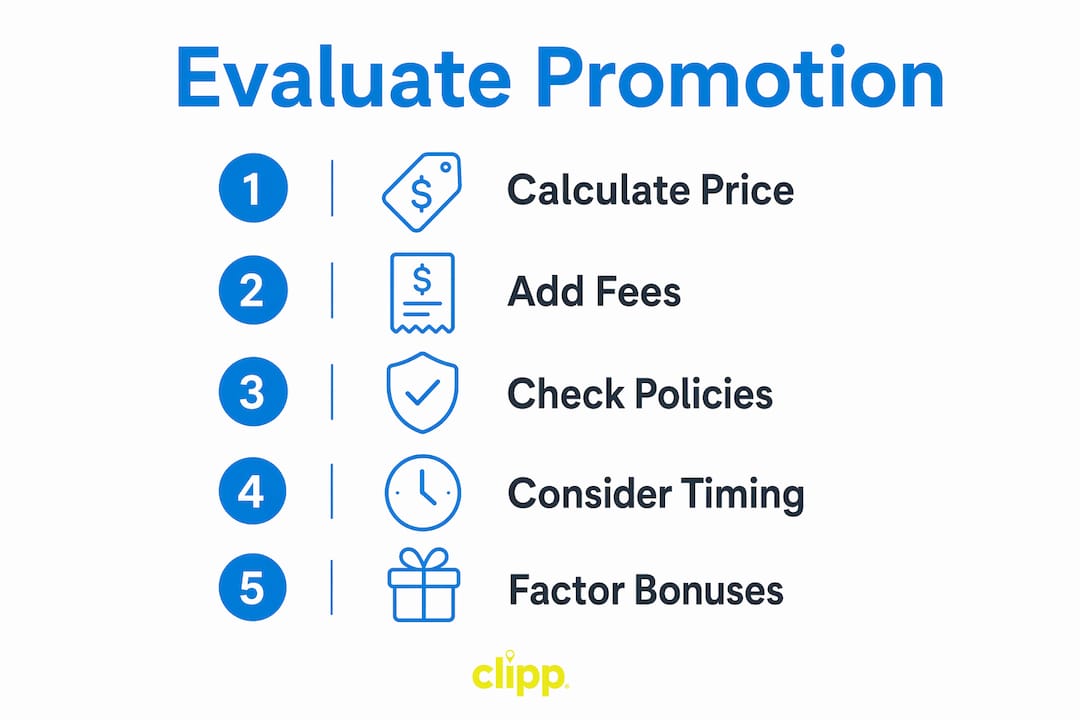
Timing adds another layer. Waiting for the absolute historical low price can cost more in lost utility than the savings you gain. A threshold of within 10–15% of a historical low balances savings against the risk of waiting too long. For local dining and entertainment, that window closes faster because deals expire and availability is limited.
Bonuses like bundled items, free gifts, and loyalty points only add value when you will actually use them. An extra appetizer you would not have ordered is not a saving. A free gym session attached to a spa deal is only worth something if you go.
Pro Tip: Before accepting any promotion, write down the full price you will pay at checkout, including all fees and taxes, then subtract only the bonuses you are certain to use. That number is your real saving.
Promotion types compared: which one offers the best deal?
Not all promotions work the same way. Each type has a scenario where it delivers the most value and a scenario where it falls flat.
Percentage discounts are the clearest format. You see the price, you see the reduction, and the math is simple. The limitation is that percentage discounts say nothing about quality. A 50% discount on a mediocre meal is still a mediocre meal. Price accounts for 60%–90% of value perception, but true value includes quality and whether the experience exceeds your price expectations.
Bundle deals outperform coupons when every item in the bundle is something you would buy separately. A dinner-plus-dessert bundle at a restaurant you already visit regularly is genuine value. A bundle that forces you to buy a service you do not want just to access the one you do is not. Bundles and promo codes each have scenarios where they provide superior value, and the deciding factor is always buyer intent.
Free gift promotions require the same scrutiny. The gift has real value only if you would have paid for it otherwise. A free bottle of wine with dinner adds value if you drink wine. If you do not, it is a marketing cost the restaurant passed to you in the base price.
Loyalty points and cashback are the most commonly overvalued promotion type. Cashback and points should be treated as discounted savings unless redemption is easy and likely. Points that expire, require a minimum balance, or can only be used in narrow windows are worth less than their face value.
| Promotion type | Main advantage | Key risk | Best scenario |
|---|---|---|---|
| Percentage discount | Simple, transparent math | Ignores quality | High-quality product or service at a verified price |
| Bundle deal | Higher total saving when all items are wanted | Forces unwanted extras | You already buy all bundled items separately |
| Free gift | Adds tangible value at no extra cost | Gift may be unwanted or low quality | Gift is something you would have purchased anyway |
| Loyalty points/cashback | Compounds savings over time | Delayed, probabilistic, may expire | Easy redemption with no minimum balance required |
For local dining and entertainment deals, percentage discounts and bundles tend to deliver the most reliable value because the saving is immediate and the conditions are visible upfront.
How to calculate your real cost on local deals
Local promotions for dining, entertainment, and services carry friction points that online product deals do not. Minimum spend requirements, blackout dates, restricted party sizes, and limited redemption windows all affect the true cost. Converting an offer into a per-person or per-session cost is the most reliable way to compare local deals accurately.
Use this process for any local promotion:
- Find the base price. Write down the full price of the experience without the deal.
- Apply the discount. Subtract the advertised saving to get your post-discount price.
- Add all required extras. Include mandatory gratuity, booking fees, taxes, and any minimum spend above what you planned.
- Divide by the number of people. Get a per-person cost so you can compare deals fairly across different group sizes.
- Check the conditions. Note blackout dates, expiration, and party size limits. If the deal only works on a Tuesday at 5 p.m. and you cannot make that time, its value is zero.
- Assess redemption ease. A deal you have to print, call to book, or redeem through a complicated process has a hidden time cost. Factor that in.
A practical example: a restaurant promotion offers two entrees for $30, saving you $20 off the regular price. That looks strong. But if the deal excludes friday and saturday nights, requires a minimum of two drinks per person, and expires in ten days, your actual saving may shrink to $8 after the drink minimum. The per-person cost rises accordingly.
Pro Tip: Treat redemption windows and return terms as part of your total cost. A deal that expires before you can use it costs you the purchase price with zero benefit.
Common mistakes consumers make with promotions
The biggest error is treating the advertised discount as the actual saving. Best-value is net savings after all conditions, not the largest number on the banner. Shoppers who skip the conditions and focus on the headline routinely end up spending more than they planned.
These are the most common mistakes worth avoiding:
- Ignoring return and cancellation policies. Return windows, restocking fees, and store-credit-only refunds can reduce deal value more than the discount amount suggests. Always check before you buy.
- Overvaluing loyalty points. Points that are hard to redeem or that expire quickly are worth a fraction of their stated value. Treat them as a bonus, not a core saving.
- Comparing discounts instead of final prices. A 30% discount on a $100 service and a 20% discount on a $70 service are not comparable by percentage. The second costs $56. The first costs $70. Final price wins.
- Buying to save, not to use. Purchasing a deal for a restaurant, gym, or service you would not have visited otherwise is spending, not saving.
- Skipping the fine print on local deals. Blackout dates and party size minimums are buried in terms. Missing them turns a good deal into a frustrating experience.
Platforms like Clipp surface verified local deals with clear terms, which removes much of this friction. But the evaluation habit still matters regardless of where you find the offer.
Key takeaways
Best-value promotions deliver the lowest realistic final cost for what you actually receive, not the biggest advertised discount.
| Point | Details |
|---|---|
| Define value by final cost | Add all fees, taxes, and conditions before comparing any two promotions. |
| Scrutinize bonus usability | Free gifts and loyalty points only count if you will realistically use them. |
| Convert to per-person cost | Divide local deal totals by party size to compare offers fairly. |
| Check return and cancellation terms | Restrictive policies increase your real risk and reduce the deal's net value. |
| Avoid buying just to save | A deal on something you would not have bought is spending, not saving. |
Why I think most shoppers evaluate deals backwards
Most shoppers start with the discount percentage and work backward. That is the wrong direction. The number that matters is what you will actually pay and whether you would have spent that money anyway.
I have watched people buy restaurant deals for places they had never planned to visit, purely because the discount looked large. They spent $40 to "save" $20 on a meal they did not want. That is a $40 loss dressed up as a win. The most effective promotions fit buyer needs closely and minimize friction in redemption. That principle cuts through almost every misleading headline.
The habit I recommend is simple: before you buy any deal, ask whether you would pay the post-discount price for that exact experience on its own terms, with its exact conditions. If the answer is yes, it is a good deal. If you are hesitating because of the blackout dates, the minimum party size, or the expiration window, those conditions are telling you something real about the value.
Checklists and per-person cost calculations sound tedious, but they take about two minutes and they consistently surface the deals that actually save money versus the ones that just look good. Smart shoppers use bundle deal structures and verified platforms to cut that evaluation time further. The goal is not to be skeptical of every offer. It is to be accurate about what you are actually getting.
— Mehmet
Clipp makes finding real local value straightforward
Clipp connects you directly with verified promotions on local dining, entertainment, wellness, and services across the country. Every offer on the platform is curated for clarity, with terms visible upfront so you can apply the evaluation approach covered here without hunting through fine print.
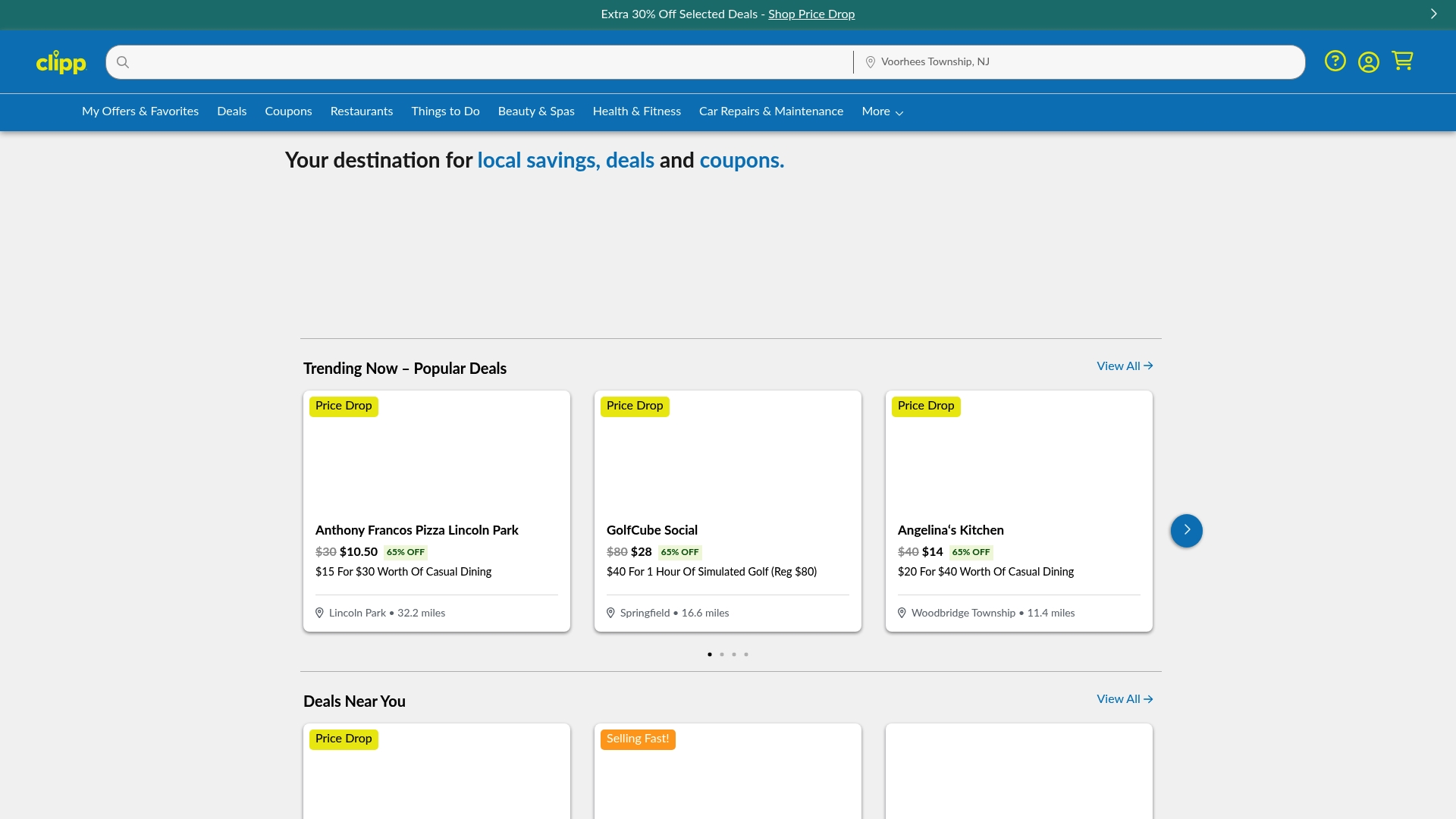
Clipp's "Trending Deals" and "Near You" sections surface the offers with the strongest real-world value right now, not just the biggest headline numbers. Whether you are looking for local savings near you or want to browse service deals in your area, Clipp gives you a starting point that already filters for quality. Shoppers in Texas can check deals across TX, and Virginia residents can browse local offers in VA for dining, entertainment, and more.
FAQ
What are best-value promotions in simple terms?
Best-value promotions are offers that give you the lowest realistic final cost after all discounts, fees, and conditions are applied. They are not necessarily the deals with the highest advertised percentage off.
How do I compare two local dining promotions fairly?
Convert both offers into a per-person cost that includes all required extras, taxes, and fees. The promotion with the lower per-person final price is the better value, regardless of which has the larger headline discount.
Are loyalty points and cashback worth counting as savings?
Loyalty points and cashback count as savings only when redemption is easy and likely. Points that expire or require a high minimum balance should be treated as a small bonus, not a core part of the deal's value.
Why do return policies matter for promotions?
A restrictive return policy increases your financial risk on a purchase. Return windows, restocking fees, and store-credit-only refunds can reduce a deal's net value more than the discount amount suggests.
What is the fastest way to spot a bad deal?
Check whether the deal requires conditions you cannot realistically meet, such as blackout dates, minimum party sizes, or short expiration windows. If those conditions make the offer difficult to use, the advertised saving is largely theoretical.