

TL;DR:
- A bundle deal combines two or more related products or services at a lower overall price, saving consumers money. They offer benefits such as reduced decision-making, combined billing, and lower shipping costs, increasing perceived value. To ensure a bundle's worth, always compare individual component prices and consider all associated fees before purchasing.
A bundle deal is defined as two or more related products or services sold together at one combined price, typically lower than purchasing each item separately. Salesforce describes bundle pricing as selling multiple products together at a discount, a practice found across retail, subscriptions, dining, and local services. Whether you're grabbing a meal combo at a neighborhood restaurant or signing up for a streaming package, bundle deals shape how consumers spend every day. Understanding how they work puts real money back in your pocket.
What is a bundle deal and how does it save you money?
Bundle deals deliver two distinct advantages: lower prices and reduced purchasing complexity. Bundle offers typically save consumers 5 to 25% compared to buying the same items individually, depending on how the seller structures the deal. That range matters because a 5% discount on a $200 home cleaning and lawn care package still saves $10 without any extra effort on your part.

The convenience factor is just as real as the price cut. Bundles reduce decision fatigue by collapsing multiple purchase decisions into one. Instead of comparing a gym membership, a nutrition plan, and a personal training session separately, a wellness bundle presents a single choice with a single price.
Here is what makes bundle deals genuinely useful for everyday shoppers:
- Single checkout: One transaction covers multiple products or services, saving time and reducing the chance of cart abandonment.
- Combined billing: Subscription bundles like streaming packages consolidate monthly charges into one line item, making budgets easier to track.
- Reduced shipping costs: Ordering a printer and its ink cartridges together typically costs less to ship than two separate deliveries. Bundle savings extend beyond the sticker price when you factor in those combined shipping fees.
- Perceived value: Bundles increase perceived value and simplify purchasing decisions, which is why consumers often feel more satisfied with bundled purchases even when the discount is modest.
Pro Tip: Before dismissing a bundle as "only 10% off," add up what you would pay in separate shipping fees, service charges, or booking fees. The real savings are often 15 to 20% once those extras are included.
What are the two main types of bundle offers?
Not all bundles work the same way, and the structure of a bundle directly affects how much flexibility you have as a buyer. Salesforce identifies two core bundling types: pure bundling and mixed bundling. Knowing the difference protects you from paying for items you do not need.
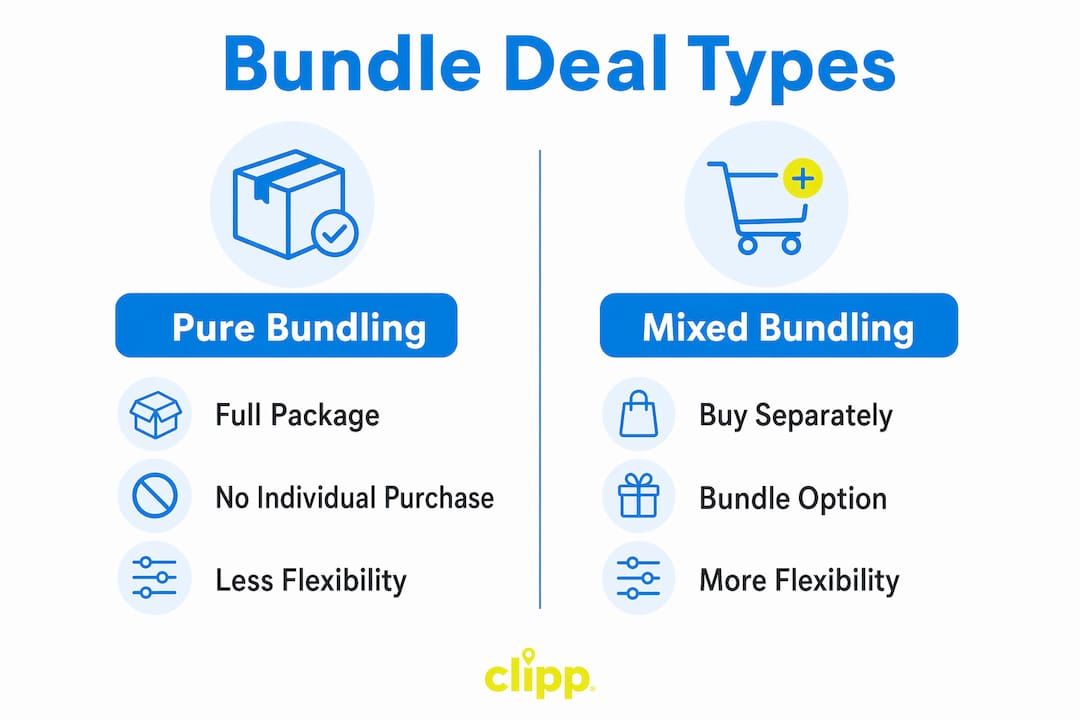
| Bundle type | How it works | Consumer flexibility | Common example |
|---|---|---|---|
| Pure bundling | Items are only sold as a package, never individually | Low. You buy the full set or nothing. | Microsoft Office suite (historically sold as one package) |
| Mixed bundling | Items are available individually or as a bundle | High. You choose based on value. | Disney+ with or without Hulu and ESPN+ add-ons |
Pure bundling locks you into a full package. This can be great when you genuinely want everything included, but it becomes a poor deal when you only need one or two components. A spa that sells a facial, massage, and manicure only as a three-service package is using pure bundling. If you only want the massage, you are paying for services you will not use.
Mixed bundling gives you the best of both worlds. You can buy items individually at standard prices or choose the bundle for a discount. Software platforms like Adobe Creative Cloud use this model, offering individual apps like Photoshop or Illustrator at higher per-unit prices alongside an all-apps bundle at a lower combined rate.
Pro Tip: With mixed bundles, always price out the individual components first. If the bundle saves you money on items you actually want, take it. If it bundles in extras you will never use, buy individually instead.
Real-world examples of bundle deals in local services and retail
Bundle deals are not limited to tech companies and streaming giants. They appear in the everyday local services and retail purchases you make throughout the week.
- Restaurant meal combos: A burger, fries, and drink sold together for $10.99 instead of $13.50 separately is the most familiar bundle deal in existence. Many local restaurants extend this to family meal deals, where an entrée, two sides, and a dessert are packaged at a flat rate. Exploring restaurant savings near you often reveals these combos at deeper discounts than the menu price suggests.
- Streaming service packages: Disney and Hulu's combined subscription is a textbook mixed bundle. Warner Bros. Discovery CEO David Zaslav reported that streaming bundles reduced churn dramatically, proving that consumers stay longer when they perceive higher combined value. Paying $18 per month for Disney+, Hulu, and ESPN+ instead of $27 for all three separately is a concrete, recurring saving.
- Retail product bundles: Electronics retailers regularly pair a printer with a starter ink cartridge set at a combined price below what each costs separately. Camera bundles with memory cards, cases, and cleaning kits follow the same logic.
- Subscription boxes: Services like HelloFresh or local meal kit providers bundle ingredients, recipes, and delivery into one weekly price. The bundle purchase meaning here goes beyond discount. You are also buying planning convenience and reduced grocery trips.
- Home services packages: Local contractors often bundle gutter cleaning, window washing, and pressure washing into a seasonal home maintenance package. These local service bundles are where platforms like Clipp shine, connecting you with neighborhood deals on services you would otherwise book and pay for separately.
- Wellness and fitness bundles: Gyms frequently bundle membership with a set number of personal training sessions or group classes at a rate that undercuts buying each component on its own.
The significance of bundle deals in local commerce is that they make premium services accessible. A salon offering a haircut, color, and deep conditioning treatment as a bundle brings the total cost closer to what many consumers would pay for just the color alone at a standalone appointment.
How to tell if a bundle deal is actually worth it
Not every bundle is a genuine saving. Some retailers inflate individual prices to make the bundle look more attractive than it really is. A systematic approach protects you from that trap.
- Price each component separately. Look up the individual price of every item in the bundle before you commit. Mixed bundling lets you compare components to the bundle total directly, and this two-step check is the most reliable way to verify real savings.
- Account for all fees. Add shipping, service charges, and booking fees to the individual prices. A bundle that saves $5 on product price but eliminates $12 in separate shipping fees is actually saving you $17.
- Assess how many components you actually want. A pure bundle that includes three services when you only need two is only a deal if the two you want cost more than the full bundle price.
- Watch for artificial urgency. "Bundle expires tonight" messaging is a marketing tactic. Genuine best bundle deals are available long enough for you to do the math. If a retailer rushes you past the comparison step, that is a signal to slow down.
- Check the quality of each component. Some bundles pair a high-demand item with slow-moving inventory to clear stock. A gym bundle that includes premium personal training sessions alongside an outdated fitness app subscription may not deliver equal value across all components.
- Compare across platforms. The same bundle structure may be available at different price points through different providers. Local deals platforms aggregate offers so you can see food and service deals side by side without visiting each merchant individually.
Pro Tip: Screenshot the individual prices before clicking "buy bundle." Retailers occasionally adjust individual prices after a bundle promotion ends, making it harder to verify what you actually saved.
Key takeaways
Bundle deals deliver the most value when you want most or all of the included items, understand the bundle type, and verify savings against individual prices.
| Point | Details |
|---|---|
| Core definition | A bundle deal combines two or more products or services at one discounted price. |
| Typical savings range | Bundles save consumers 5 to 25% compared to buying items separately. |
| Two bundle structures | Pure bundles lock you into full packages; mixed bundles let you buy individually or together. |
| Hidden value | Combined shipping and single checkout add real savings beyond the listed discount. |
| Evaluation method | Always price individual components first, then compare the total to the bundle price. |
Why bundle deals deserve more credit than they get
I have spent years watching consumers dismiss bundles as a retailer trick, and I understand the skepticism. Some bundles genuinely are designed to move slow inventory or obscure real pricing. But the blanket dismissal costs people real money.
The most underrated benefit of a bundle deal is not the discount. It is the decision it removes from your day. When a local wellness studio bundles three massage sessions at a flat monthly rate, you stop negotiating with yourself about whether this week's appointment is "worth it." The decision is already made. That psychological relief has measurable value that never shows up in a price comparison spreadsheet.
Where I think consumers go wrong is treating pure and mixed bundles identically. Pure bundles require a different level of scrutiny. If a home services company only sells a cleaning and pest control package together, you need to want both services genuinely. Mixed bundles are far more forgiving because you can always fall back to individual pricing.
My honest advice: use bundles aggressively for recurring services like dining, streaming, and wellness, where the savings compound month over month. Be cautious with one-time pure bundles in categories you do not know well. And always do the five-minute math check before committing. The best bundle deals are the ones where you would have bought every component anyway, and the bundle just made it cheaper and easier.
— Mehmet
Find local bundle deals worth your money on Clipp
Clipp connects you with curated bundle deals and discounts on local services across dining, wellness, home improvement, pet care, and more in your neighborhood.
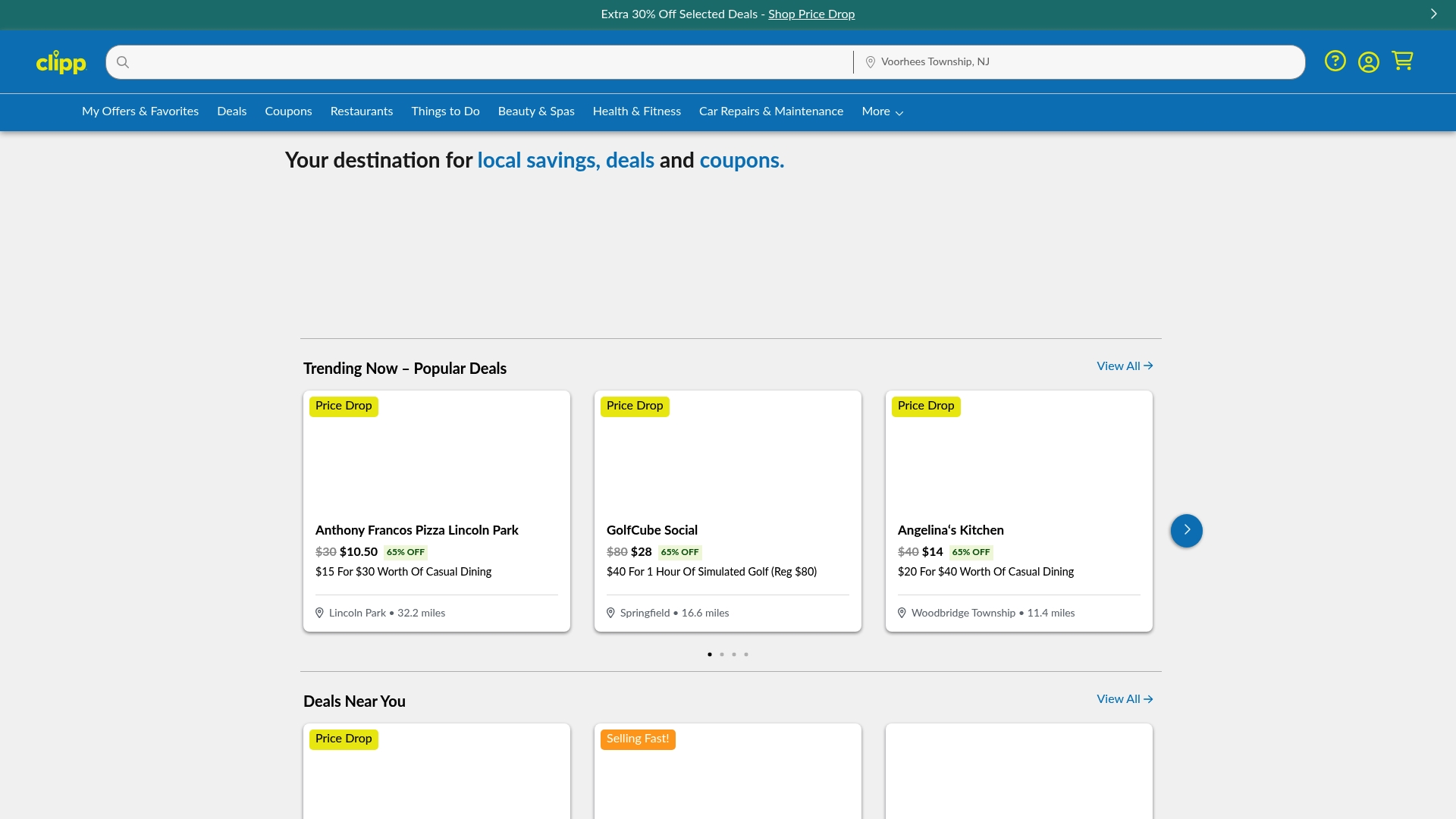
Browsing local deals near you on Clipp surfaces the kind of bundled offers that local merchants rarely advertise widely. From restaurant meal combos to salon service packages, the platform aggregates real savings so you spend less time hunting and more time enjoying. You can also explore local coupons in your area to stack additional savings on top of bundle prices. Clipp's "Trending Deals" and "Near You" sections make it straightforward to find the highest-value bundles available right now, without comparing a dozen merchant websites individually.
FAQ
What is a bundle deal in simple terms?
A bundle deal is when two or more products or services are sold together at one combined price that is lower than buying each item separately. The discount typically ranges from 5 to 25% depending on the seller.
What is the difference between pure and mixed bundling?
Pure bundling requires you to buy the full package with no option to purchase items individually. Mixed bundling lets you buy items separately at standard prices or together at a discounted bundle price, giving you more flexibility.
Are bundle deals always worth it?
Bundle deals are worth it when you genuinely want most or all of the included items and the combined price is lower than the sum of individual prices plus fees. Always price each component separately before buying to confirm real savings.
What are common examples of bundle deals?
Common bundle deals include restaurant meal combos, streaming service packages like Disney+ with Hulu, printer and ink cartridge sets, home services packages, and wellness bundles that combine gym memberships with personal training sessions.
How do bundle deals reduce more than just price?
Beyond the discount, bundles reduce decision fatigue and eliminate extra costs like multiple shipping fees or separate booking charges, making the total value higher than the listed percentage off suggests.