

TL;DR:
- By understanding store markdown cycles and verifying deals through a disciplined system, shoppers can consistently save money.
- Using targeted online tools, local deal platforms, and timing purchases around seasonal discounts enhances savings effectively.
Most shoppers spend more than they save. They chase promo codes that expire at checkout, fall for "sale" prices that were never real to begin with, and waste an hour finding discounts only to walk away with fifty cents off. The discount hunting process does not have to work that way. With the right preparation, a repeatable system, and a sharp eye for what counts as a real deal, you can cut your spending reliably every single month. This article walks you through that system from start to finish, covering both online coupon strategies and local in-store treasure hunting.
Table of Contents
- Key takeaways
- Setting up your discount hunting toolkit
- The step-by-step online discount process
- Finding deals in local stores
- Spotting false savings before you buy
- Timing your purchases for maximum savings
- My honest take on building a real savings habit
- How Clipp makes your discount hunt faster
- FAQ
Key takeaways
| Point | Details |
|---|---|
| Prepare before you shop | Know your baseline price and gather tools before starting any discount hunt. |
| Verify every coupon code | Test codes one at a time and confirm net savings after tax and shipping. |
| Use store markdown cycles | In-store color tags and flyer schedules signal the deepest deals before they sell out. |
| Time purchases strategically | Align big purchases with predictable seasonal sales to capture 20 to 35 percent off. |
| Document what you save | Screenshots of cart totals before and after codes create proof and sharpen your process. |
Setting up your discount hunting toolkit
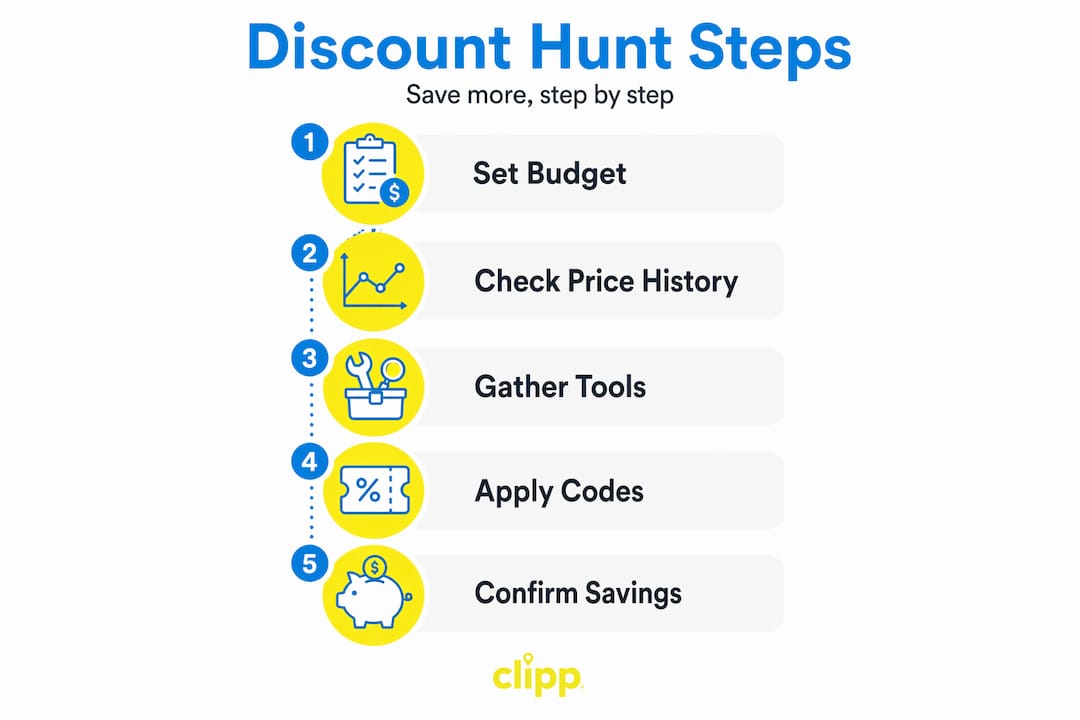
Before you hunt a single deal, you need the right foundation. Jumping into coupon sites without a plan is exactly how most people waste time.
Start with a short, trusted list of platforms. Broad coupon aggregators, browser extensions that auto-apply codes at checkout, and local deal platforms like Clipp give you layered coverage without the noise. The key word is short. Reliable savings come from consistent testing across a few trusted portals, not from racing through twenty sites hoping something sticks.
Here is what your toolkit should include:
- A price tracking extension. Tools that show you price history graphs tell you immediately whether today's "deal" is actually below average or just average with a red tag on it.
- A local deals app. Platforms focused on your neighborhood surface restaurant, gym, and service discounts that national coupon sites completely miss.
- A simple notes document. Track what you buy, what you paid, and what the baseline price was. This takes two minutes and becomes genuinely useful after two weeks.
- Retailer email subscriptions. Signing up for store emails is worth it when you treat the inbox as intelligence, not clutter. Many exclusive codes only appear there.
You also need to understand retailer discount cycles before you walk into any store or open any cart. Most major chains mark down specific departments on specific days of the week. Grocery stores typically rotate markdowns midweek. Clothing retailers clear inventory on Saturdays. Knowing this schedule turns random browsing into targeted, time-efficient shopping.
Pro Tip: Before adding anything to your cart, look up the item's 30-day price history. If the current price is above or at the historical average, the discount is probably not worth your time.
Finally, read the exclusions. Most coupons list them in fine print: sale items, specific brands, minimum order sizes. Skimming those terms before you even start saves you from a frustrating surprise at checkout.
| Tool type | What it does for you |
|---|---|
| Price tracking extension | Shows historical prices so you know if today's deal is genuine |
| Local deal platform | Surfaces neighborhood-specific offers from restaurants, gyms, and services |
| Notes document | Tracks baselines and past savings for smarter future decisions |
| Retailer email list | Delivers exclusive codes and early sale access before the public |
The step-by-step online discount process
This is the workflow that separates disciplined savers from frustrated coupon chasers. Follow it in order every time.
- Build your cart with items you actually intend to buy. Do not start coupon hunting and then decide what to purchase. Desire drives impulse spending disguised as saving.
- Check the coupon terms before applying anything. Look specifically for product category exclusions, minimum spend thresholds, and new-customer-only restrictions. Many codes fail at checkout for exactly these reasons.
- Apply one code at a time. Note the exact dollar change the code produces. Then remove it and test the next. You cannot compare codes if you stack them blindly.
- Compare the final price against your baseline. Include shipping and applicable tax in that number. A real deal means net savings compared to every alternative, including buying locally. A code that saves you eight dollars but adds ten dollars in shipping is not a deal.
- Check for cashback conflicts. Some codes disable cashback rewards entirely or require you to add unnecessary items to qualify. Always weigh what you gain against what you give up.
- Take a screenshot of your cart before and after applying the code. Screenshots verify real savings over time and provide evidence if a return or price adjustment dispute comes up later.
- Make the purchase or set a price alert. If the price is not quite right yet, use a tracking tool to wait. Buying at the wrong time costs more than any coupon saves.
Pro Tip: If a code requires you to spend more than you originally planned to qualify, calculate whether the discount covers the extra spending. It usually does not.
Understanding how to apply promo codes correctly is genuinely a skill that gets faster with practice. After a few rounds of this process, it takes under three minutes per cart.
Finding deals in local stores
Online shopping gets most of the attention in discount advice, but local in-store hunting often produces the deepest cuts. The difference is knowing how the store's discount system actually works.

Most stores do not discount randomly. They use structured markdown schedules tied to inventory turnover. Color-coded tags signal markdown depth, and specific colors rotate on specific days. A yellow tag today might become an orange tag next Tuesday at fifty percent off. If you know the store's color sequence, you shop with precision instead of luck.
Here are the habits that separate effective in-store hunters from people who just browse clearance racks:
- Check the weekly flyer before entering. Starting with flyers and discount boards rather than wandering the aisles focuses your time on items that are actually marked down, not just rearranged.
- Go straight to clearance and closeout sections first. Rotating inventory, packaging changes, and seasonal closeouts often land there before they get promoted publicly.
- Combine in-store coupons with card-linked loyalty offers. Stacking a paper or app-based coupon with a store loyalty reward can double your discount on a single item, as long as the terms allow it.
- Use a local deal app during your visit. Some platforms update offers in real time, meaning a restaurant next to your grocery store might have a lunch discount active right now.
- Time your visit to post-holiday or end-of-season windows. Clearance after major holidays often hits fifty to seventy percent off as stores reset floor inventory.
Pro Tip: Ask a store associate which day their department gets marked down. Most will tell you. That single conversation is worth more than an hour of browsing.
For local coupon strategies that cover dining, services, and retail, having a go-to local platform in your phone shortens the research time considerably.
Spotting false savings before you buy
The most dangerous part of the discount hunting process is the deal that looks real but is not. Retailers are skilled at creating urgency and perceived value that evaporate under scrutiny.
The comparison table below shows common tactics and how to counter them:
| Tactic you will see | What it actually means | How to counter it |
|---|---|---|
| "Was $120, now $60" | Original price may have been inflated or never charged | Check price history for the past 90 days |
| "Only 3 left!" | Often a display default, not actual inventory | Check other retailers for the same item |
| Coupon requiring add-ons | Forces unnecessary spending to unlock savings | Calculate total cost with add-on included |
| Free shipping threshold | Makes you spend more to avoid a fee | Compare total cost to a competitor without the threshold |
| "Today only" countdown | Often resets or repeats next week | Check if the offer was running the previous week |
Reading a price history before purchasing is the fastest way to confirm whether a discount is genuine. If the "original" price appeared for three days last November and nowhere since, you are looking at an inflated anchor price, not a real markdown.
Testing coupon codes systematically one variable at a time also prevents what professionals call false stacking, where two active codes appear to work together but one silently removes a reward you had already earned.
Pro Tip: Keep a simple running log of what you paid and what you expected to pay. After a month, patterns emerge fast. You will start recognizing which retailers consistently honor their discounts and which ones play games.
Knowing when to walk away matters just as much as knowing how to apply a code. If the savings feel thin, if the terms are confusing, or if you are spending more than planned to qualify, leave the cart. A purchase you did not need is never a saving, no matter the percentage off.
Timing your purchases for maximum savings
Seasonal discount patterns are predictable. Retailers follow inventory cycles that repeat every year, and aligning your purchases to those cycles is one of the most underused savings techniques available.
| Season / Period | Best categories to buy |
|---|---|
| January to February | Holiday leftovers, winter apparel, fitness equipment |
| March to May | Tax software, spring cleaning supplies, outdoor furniture |
| June to August | Air conditioners, swimwear, back-to-school items |
| September to December | Kitchen appliances, electronics, holiday decor |
Kitchen appliances around Memorial Day drop 20 to 35 percent at major retailers. Air conditioners are cheapest in late August when demand drops. These windows are not surprises. They are calendar events you can plan around months in advance.
Practical habits that make timing work for you:
- Set price alerts for items on your list so you get notified the moment the price hits your target.
- Price trackers prevent impulse buying by shifting your mindset from "this deal expires tonight" to "I will buy when the data tells me it is right."
- Write down the three or four biggest purchases you expect to make this year and map them to their ideal buying windows right now.
- If a "limited time" offer keeps reappearing, it is not actually limited. Stop treating it as urgent.
Planned purchases aligned with retailer discount patterns consistently outperform reactive coupon chasing. The difference between these two approaches, over twelve months, often amounts to several hundred dollars.
My honest take on building a real savings habit
I have watched people spend forty-five minutes hunting a coupon code for a product they could have bought at a local store for less with zero effort. The discount hunting process is genuinely valuable, but only when it is built on discipline rather than the thrill of the chase.
In my experience, the biggest mistake savers make is confusing activity with results. Clicking through fifteen coupon sites feels productive. It usually is not. What actually builds savings over time is a short, repeatable system: know your baseline price, use a verified source, test one variable, document what you found, and walk away when the math does not work.
I have also learned that in-store hunting is badly underrated. Understanding a store's discount setup, rather than guessing, turns a grocery run into a strategy session. The shoppers who do this consistently save more than those who rely entirely on digital coupons.
Patience is the skill nobody talks about. Waiting two weeks for a price alert to fire on a kitchen appliance you need is not passive. It is discipline. It also tends to save more than any coupon you could stack on a full-price item.
My advice: commit to the process for thirty days. Track your baselines. Screenshot your carts. Note when you walked away. At the end of the month, you will know exactly how much you saved and, just as usefully, exactly where you are still leaving money on the table.
— Mehmet
How Clipp makes your discount hunt faster
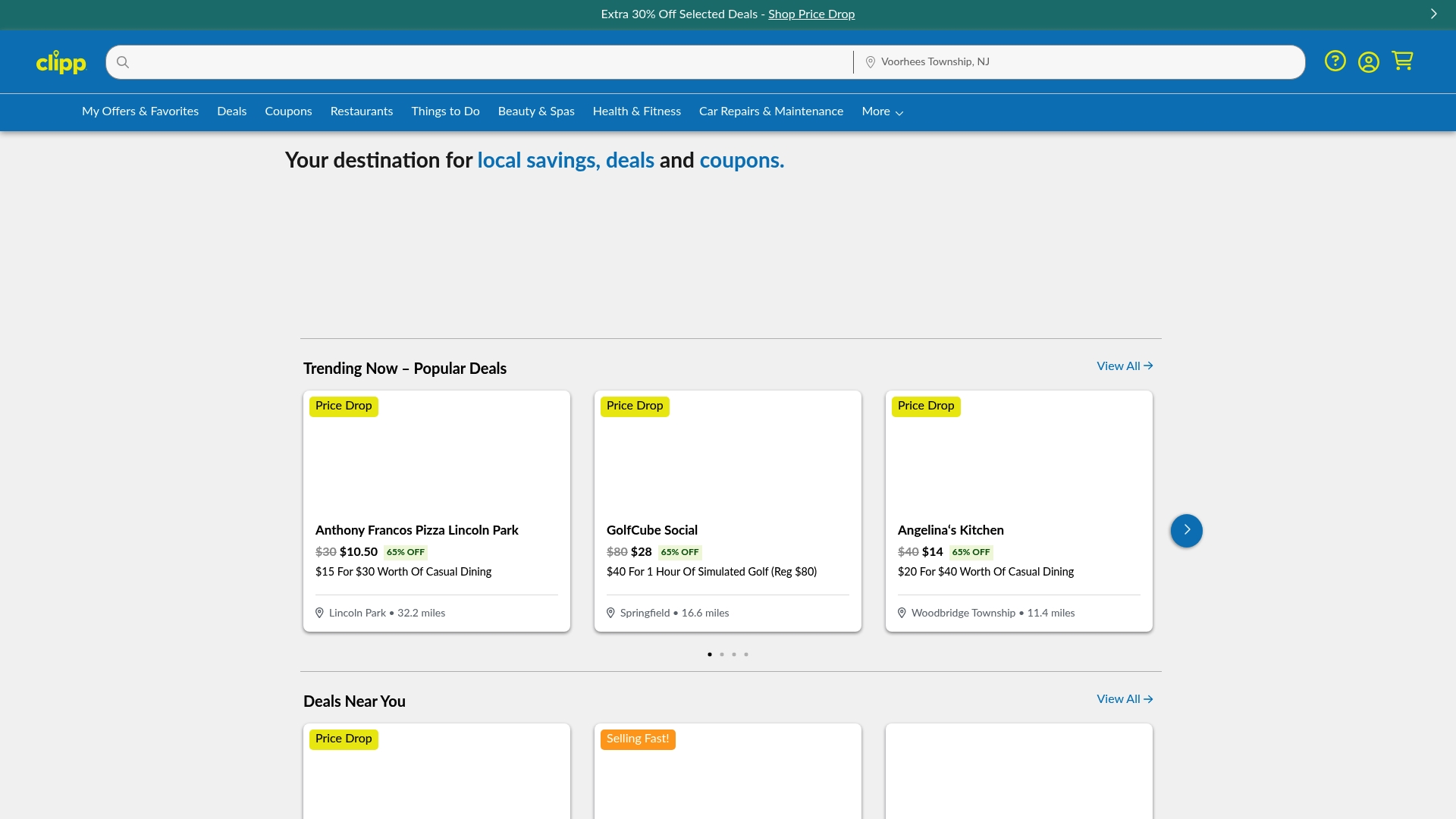
If you are building a real discount hunting process, you need a platform that does the sourcing work for you. Clipp connects you with verified, curated deals across dining, wellness, entertainment, home services, and more, all focused on your local area. Instead of searching across ten sites, you get one place where the deals are already screened and categorized.
The Clipp mobile app sends alerts when new deals appear near you, so you never miss a limited-time offer while you are already out. Whether you are in Texas, Virginia, Florida, or looking for local deals near you, Clipp's localized pages make it easy to find what is available in your neighborhood right now. Pair Clipp's curated offers with the systematic process in this article, and you have both the strategy and the source working together. Visit Clipp.com to start finding real savings today.
FAQ
What is the first step in the discount hunting process?
The first step is knowing your baseline price before you look for any discount. Without it, you cannot tell whether a deal is genuine.
Why do most coupon codes fail at checkout?
Most codes fail because of product category exclusions, minimum spend requirements, or customer eligibility restrictions written in the fine print.
How do I find real deals in local stores?
Check the store's weekly flyer before entering, then go directly to clearance and marked-down sections. Learning a store's color-tag markdown schedule helps you time visits for the deepest cuts.
When is the best time to buy electronics and appliances?
Major appliance deals peak around Memorial Day with discounts of 20 to 35 percent. Electronics drop sharply in November and during post-holiday clearance in January.
How do I avoid false savings traps?
Check the item's 90-day price history before buying, calculate total cost including shipping and taxes, and always verify that a coupon does not disable existing cashback or rewards before applying it.