

TL;DR:
- Not all discounts save money because genuine value depends on need, not just lower prices.
- Comparing unit prices and recognizing scams help ensure you make truly beneficial purchases.
Most people assume that buying on sale automatically saves money. It doesn't. You can spend more in a year chasing discounts than you would have buying things at full price, simply because you bought things you didn't need, bought too much, or fell for pricing tricks designed to feel like savings. Knowing how to choose best discounts means understanding what genuine value looks like before you ever click "buy" or hand over your card. This guide walks you through the preparation, strategies, and red flags that separate real deals from marketing theater.
Table of Contents
- Key takeaways
- How to choose best discounts: what to know first
- Step-by-step strategies for finding real deals
- How to spot and avoid discount scams
- Common mistakes that kill your discount savings
- My honest take on discount hunting
- Save smarter with Clipp's verified local deals
- FAQ
Key takeaways
| Point | Details |
|---|---|
| Not all discounts save money | A lower price only helps if you actually need the item and would have bought it anyway. |
| Unit pricing reveals true value | Comparing cost per ounce or gram shows which size or brand is actually cheaper. |
| Generic coupon codes work often | Codes like "WELCOME10" consistently deliver real discounts across many retailers. |
| Scam discounts share clear signals | Gift card payment requests and too-good prices on social ads are reliable warning signs. |
| Patience beats impulse buying | Waiting 48 hours before purchasing reduces regret and filters out manufactured urgency. |
How to choose best discounts: what to know first
Before you can evaluate any deal, you need a clear picture of the discount types you'll encounter. Not all discounts are structured the same way, and the format matters as much as the number.
Percentage discounts (like 30% off) sound large but can be misleading on cheap items. A 30% discount on a $5 product saves you $1.50. A 10% discount on a $200 product saves you $20. Dollar-off discounts are easier to assess at a glance. Bundle deals require the most scrutiny because you're often paying for items you wouldn't have bought separately.
Here's what to get straight before you shop:
- Set a shopping list and a budget first. If a deal isn't on your list, it's not a deal for you. It's an unplanned expense with a reduced price tag.
- Learn to read unit pricing. Many grocery stores display a cost per ounce or per unit on the shelf label. Unit pricing helps you avoid overpaying for a larger package that looks cheaper but costs more per use.
- Recognize psychological pricing tactics. Prices ending in .99, artificial "was/now" comparisons, and countdown timers are designed to push decisions before your brain can evaluate them.
- Know the difference between coupons and promo codes. Physical coupons, digital coupons, and promo codes each have their own rules about stacking, expiration, and eligible items. Understanding coupons vs. promo codes can save you from checkout surprises.
Pro Tip: Before you shop anywhere, check whether the store inflated the original price before applying the discount. A quick search of the product's price history on a browser extension like Honey or CamelCamelCamel takes about 30 seconds and can reveal if a "40% off" sale is actually a 5% dip from an inflated baseline.
Step-by-step strategies for finding real deals
Once you have the basics, you need a repeatable process for hunting down and verifying best-value deals across dining, entertainment, and everyday purchases.
-
Start with generic coupon codes. Before you pay for anything online, try codes like WELCOME10, SAVE20, or FREESHIP. Generic codes like WELCOME10 represent 3.11% of all working codes, making them the most reliably effective category across retailers.
-
Compare unit prices before buying in bulk. Annual savings from unit price comparisons can exceed $600 to $1,200 per household. That number adds up fast when you apply it consistently to groceries, cleaning products, and personal care items. Always make sure you're comparing the same unit type. Ounces to ounces, grams to grams.
-
Shop during proven sale cycles. Retailers follow predictable markdown schedules. Electronics drop in price around major holidays. Clothing goes on clearance at the end of each season. For dining and entertainment, weekday pricing is often lower than weekend rates. Booking flights mid-week with a layover can trim about 22% off airfare, and the same timing logic applies to local entertainment deals.
-
Use loyalty programs strategically. Sign up for programs at places you already frequent, not places you'll visit once. Points and rewards only pay off when you're spending money you'd spend anyway.
-
Leverage coupon platforms for local deals. General search engines surface national deals, but platforms focused on local businesses surface restaurant coupons and neighborhood services that you won't find in a standard Google search. This is especially valuable for dining and entertainment, where local deals are often the deepest.
-
Set price alerts. Most price tracking tools let you input a target price for a specific product. When the price hits your threshold, you get notified. This removes the temptation to buy too early.
-
Apply the 48-hour rule. If you see a deal on something not already on your list, wait 48 hours. If you still want it and the price holds, it's probably a legitimate purchase. Most impulse buys lose their appeal within a day.
Pro Tip: When evaluating entertainment offers like attraction tickets, look for discounted attraction tickets from verified partner sites rather than third-party resellers. The savings are often identical, but the purchase protection is significantly better.
How to spot and avoid discount scams
The best discount strategy in the world fails if you hand your money to a scammer. And scam discount offers are more sophisticated than most people realize.
Here are the clearest warning signs to watch for:
- Gift card or wire payment requests. The FTC has warned that robocalls offering 40% to 50% discounts on phone, TV, or internet services are almost always scams, especially when payment is requested via gift cards or cryptocurrency. No legitimate company accepts gift cards as standard payment.
- Unusually low prices on social media ads. Many bogus sites use stolen brand images and logos to advertise products at prices that aren't plausible. If a $200 product is listed for $35 in a sponsored post, that's a signal to walk away.
- Tampered gift cards at retail displays. Scammers steal card numbers by scratching off the PIN and replacing the sticker before the card is sold. Always inspect gift cards for tampered seals or exposed PINs before buying, and report damaged cards to store staff.
- No verifiable seller information. Legitimate businesses have traceable contact info, return policies, and real customer reviews on multiple independent platforms.
"If someone contacts you out of the blue offering a deal that requires unusual payment, assume it's a scam until proven otherwise." — Federal Trade Commission consumer guidance
When in doubt, pay with a credit card. Credit card payments give you the ability to dispute fraudulent charges and trigger investigations, protection that debit cards and gift cards simply don't offer.
Common mistakes that kill your discount savings
Even savvy shoppers fall into patterns that erase the value of a good deal. Here are the most common ones, along with what to do instead.
| Mistake | What it costs you | Better approach |
|---|---|---|
| Overbuying with bulk deals | Waste from spoilage or unused items | Calculate whether you'll realistically use the quantity before it expires |
| Accepting "was/now" pricing at face value | Paying for a fake markdown | Check the product's price history over the past 90 days |
| Prioritizing price over quality | Replacing cheap items more often | Factor in cost per use, not just sticker price |
| Ignoring expiration dates on coupons | Missing the window entirely | Set a calendar reminder when you clip or save a coupon |
| Buying only because it's on sale | Spending money you hadn't planned to spend | Stick to your pre-made shopping list strictly |
The bulk-buying trap deserves special attention. Bulk buying requires assessing storage space, expiration dates, and the upfront cash impact before assuming it's a win. Buying 10 jars of pasta sauce at 40% off doesn't save money if three of them go bad before you use them.

Misleading pricing is the other big one. Retailers often raise prices before a sale event so the discount looks more dramatic. A product marked "Was $80, Now $50" may have been $52 last month. Without checking price history, you have no way to verify whether you're getting a real discount or just paying the regular price with extra steps.
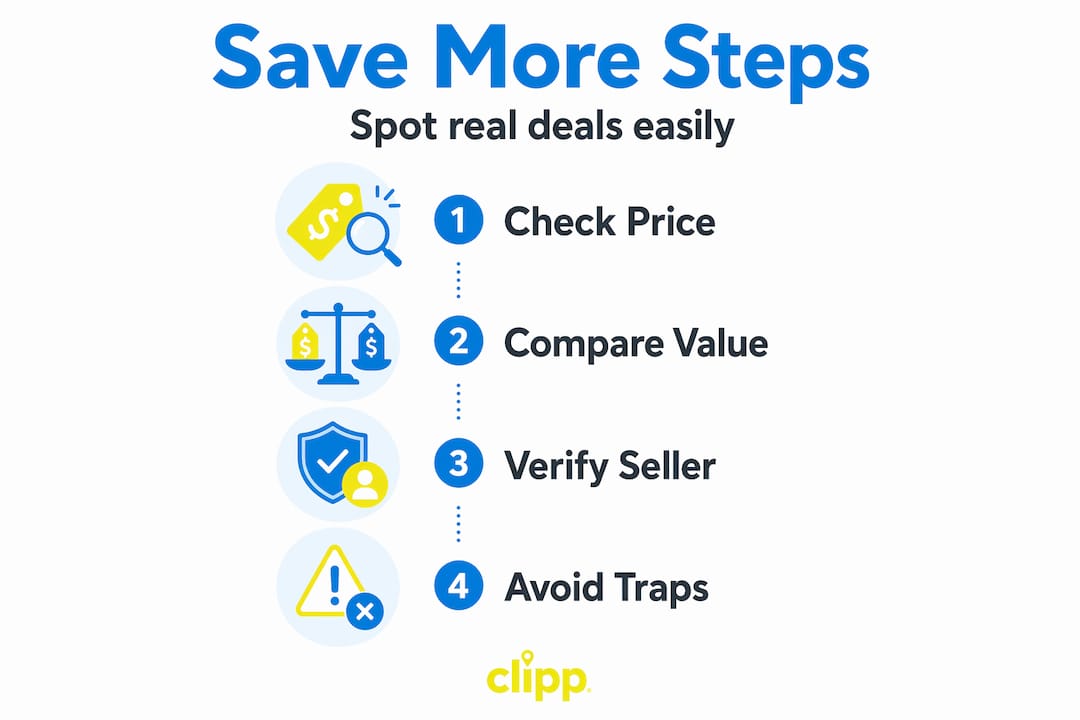
My honest take on discount hunting
I've spent years watching people save money the wrong way. They clip every coupon, stack every code, and walk out of the store feeling victorious while carrying three things they didn't need and one thing that expires in two weeks.
In my experience, the biggest shift in my own shopping came when I stopped asking "Is this a good deal?" and started asking "Would I buy this at full price?" If the answer is no, a discount doesn't make it worth buying. It just makes it cheaper to make a mistake.
The discipline of a pre-made shopping list is worth more than any coupon stack. Timing matters, too. I've found that the best deals show up when you're not urgently looking for them. Shoppers who wait, track prices, and buy when the moment is right consistently come out ahead of those who chase every flash sale.
What genuinely moves the needle is using reliable platforms for local deals, applying unit pricing consistently, and staying skeptical of anything that feels too urgent or too cheap. Patience and a short list beat enthusiasm every time.
— Mehmet
Save smarter with Clipp's verified local deals
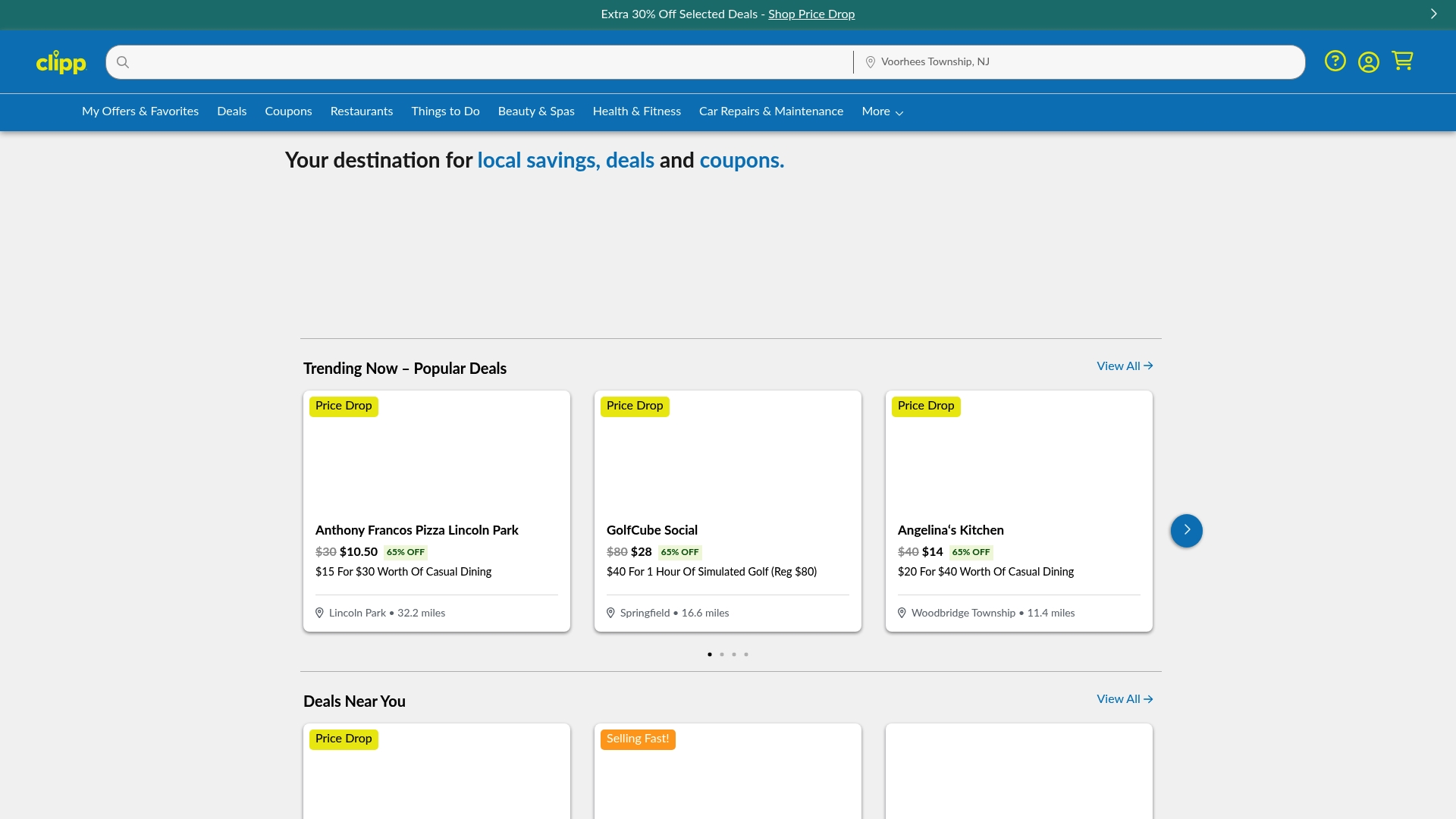
Finding real discounts shouldn't feel like detective work. Clipp connects you with verified, curated deals on dining, entertainment, wellness, and more right in your neighborhood. Whether you're searching for local dining deals with up to 50% off at nearby restaurants, or looking for entertainment and activity savings in your area, Clipp surfaces offers that are already vetted and ready to use. You can explore deals near you or browse by state to find regional savings that fit your actual lifestyle. For on-the-go access, the Clipp mobile app puts every offer in your pocket so you never miss a limited-time deal.
FAQ
What is a best-value deal?
A best-value deal is a discount that saves you money on something you genuinely need, where the quality meets your expectations and the price is verifiably lower than the standard market rate.
How do I evaluate discounts before buying?
Check the product's price history, compare unit prices across sizes and brands, and verify the seller's reputation. A real discount is lower than what the item typically sells for, not just lower than an inflated "original" price.
What are the best ways to find discounts on dining and entertainment?
Use local coupon platforms like Clipp, apply generic promo codes before checkout, and shop during weekday pricing windows when restaurants and entertainment venues often offer lower rates.
How can I tell if a discount offer is a scam?
The clearest red flags are requests for gift card or cryptocurrency payment, prices that are dramatically below market value, and sellers with no verifiable contact information or independent reviews. The FTC recommends treating any unsolicited discount offer requiring unusual payment as a scam.
Is buying in bulk always a good discount strategy?
Not always. Bulk deals only save money when you have the storage space, will use the product before it expires, and have the cash available without disrupting your budget. Always calculate the cost per unit and factor in realistic usage before committing.