

TL;DR:
- Deals in local commerce are powerful tools for building customer loyalty and encouraging repeat visits that generate greater revenue than one-time sales. Well-structured promotions create community-wide spending impacts, with real data showing high returns and increased transaction rates within just three months of implementation. Effective deal strategies focus on perceived value, loyalty programs, cross-promotions, and re-engagement tactics that foster lasting customer relationships and boost local economic health.
Most people think of deals as simple price cuts. You save a few dollars, a business moves some inventory, and everyone moves on. The real role of deals in local commerce runs much deeper than that. When structured well, promotions turn first-time visitors into regulars, and those regulars become the economic backbone of entire neighborhoods. This article breaks down what the latest data says about how deals actually shape spending behavior, why small businesses need to think beyond redemption counts, and how both consumers and merchants can get far more from local promotions than a one-time discount.
Table of Contents
- Key takeaways
- The role of deals in local commerce goes beyond the discount
- How local deals drive real economic impact
- Deal types that actually work in local marketing
- Practical steps for businesses and consumers
- My take on what most businesses get wrong about deals
- Find local deals that actually make a difference
- FAQ
Key takeaways
| Point | Details |
|---|---|
| Deals build loyalty, not just sales | Converting one-time buyers into regulars is the highest-value outcome of any local promotion. |
| Regular customers drive outsized revenue | Regular customers generate six times more annual revenue than one-time visitors for local businesses. |
| Community spending multiplies locally | Local deal programs can produce returns of over 600% on community investment by keeping dollars circulating nearby. |
| Transactions lift within three months | Businesses typically see a 5% increase in transactions within three months of launching a loyalty or marketing program. |
| Strategy beats discounting | Deals designed around tiered rewards and repeat visits outperform one-off coupons in long-term revenue impact. |
The role of deals in local commerce goes beyond the discount
The standard narrative frames promotions purely as price reductions. A restaurant offers 20% off on Tuesdays, a salon runs a half-price intro deal, and the expectation is a short-term spike in foot traffic. That model isn't wrong. It just stops short of what deals can actually accomplish.
The more useful lens is local promotional strategy, which is the recognized industry term for using offers to shape purchasing patterns and customer relationships over time. Under this framework, deals are tools for building a customer base, not just filling slow hours.
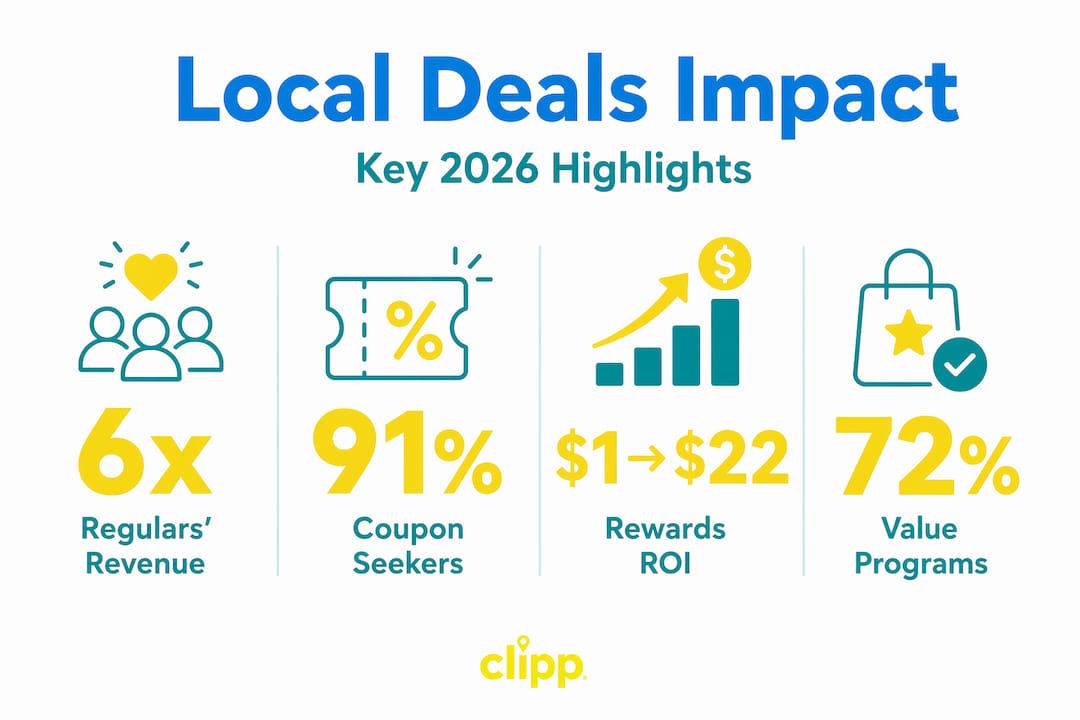
Here is why that distinction matters. Regular customers generate 6x more annual revenue for local businesses than one-time visitors, according to Square's 2026 Local Economy Report. Their spending growth also outpaced overall revenue growth, increasing 7.67% compared to 6.97% across all customers. A deal that turns three one-time visitors into regulars is worth far more than a deal that brings 30 people through the door once and never again.
This is where most small businesses leave money on the table. They measure a deal's success by how many coupons got clipped or how busy one Saturday was. The smarter metric is how many of those customers came back.
Why perceived value matters more than price
Deals that last are built on perceived value, not just the dollar amount saved. Tiered benefits and ongoing rewards drive more sustainable loyalty than a one-time coupon, according to Deloitte's loyalty research. When customers feel they are part of something, a rewards tier, a neighborhood program, a business they are recognized at, they spend more consistently and refer others.
Pro Tip: Design your first deal around a second visit, not just a first purchase. Offer something at checkout that only activates on return, like a free add-on with their next order, so the promotion creates a behavior instead of just a transaction.
The 91% of consumers who actively seek coupons before shopping are already primed to respond to deals. The question is whether the deal you offer builds a relationship or ends the interaction at checkout.
How local deals drive real economic impact
The economic case for local deal programs is no longer theoretical. Real campaigns with real numbers demonstrate just how much money stays in a community when merchants and residents engage with each other through structured promotions.
The clearest example comes from San Luis Obispo, California. The Buy Local Bonus campaign invested $100,000 in gift cards and distributed them as part of a month-long local shopping initiative. The result: $737,675 funneled into local businesses, representing a 642% return on the original investment. That is not a rounding error. That is a multiplier effect driven entirely by a well-designed deal program.
What makes that number possible is the network effect. When one business runs a deal and attracts a new customer, that customer often discovers adjacent merchants on the same trip. 32% of regular customers are shared between businesses in the same ZIP code. So the salon that introduced someone to the neighborhood also feeds foot traffic to the coffee shop next door and the florist down the street.
The numbers behind loyalty program ROI
| Metric | Data point | Source |
|---|---|---|
| Revenue multiplier from regulars | 6x more annual revenue vs. one-time visitors | Square 2026 |
| Shared customers in same ZIP | 32% of regulars visit multiple nearby businesses | Square 2026 |
| Buy Local Bonus ROI | 642% return on $100K investment | SLO Chamber 2025 |
| Transaction lift post-launch | 5% increase within 3 months | Square 2026 |
| Loyalty program spending impact | $5 to $22 per $1 of reward value | Oshi 2026 |
The Oshi 2026 analysis adds another layer: enrolled rewards members spend between $5 and $22 for every $1 in reward value offered. That means a $10 reward coupon can drive $50 to $220 in incremental spending. At that ratio, the question is not whether to offer deals. The question is why any local business would not.
Deals and consumer behavior in town also reflect a broader shift. According to Deloitte, 72% of consumers say loyalty programs make them more likely to spend with their preferred brand. The role of offers in community sales is not marginal. It is structural.
Deal types that actually work in local marketing
Not every promotion is built the same. The tactics you choose shape how customers respond and whether they come back. Here is a practical breakdown of the formats local merchants use most effectively.
Coupons and one-time discounts are the entry point. They lower the barrier for a first visit and work well for new businesses or seasonal pushes. Their weakness is that they train customers to wait for the next discount instead of buying at full price.
Loyalty rewards programs flip that dynamic. Instead of discounting the first purchase, they reward the third or fifth visit. Customers who earn points or perks feel invested in the business. A coffee subscription model, for example, locks in weekly visits while rewarding the loyalty of regular patrons far more sustainably than a free drink on the first visit.
Digital passports and check-in campaigns are among the most community-oriented formats available. Stafford County's Shop Small Stafford campaign used digital check-ins across participating merchants to create incentives for customers to visit multiple businesses. Community passport programs like this one directly encourage multipoint visits, spreading the economic benefit across dozens of local stores rather than concentrating it at one.
Geofence and geoconquesting promotions operate at the point of decision. When someone walks within a defined area near a competitor, a targeted deal notification can redirect that purchase. Geofence promotions capture customers at the exact moment they are deciding where to spend. For local businesses competing against chains, this tactic can level the playing field significantly.
Pro Tip: If you are running a local coupon campaign, pair it with a simple follow-up ask. A text or email after the first visit offering a small reward for returning within two weeks doubles down on that first investment without requiring a new customer acquisition cost.
The local coupon marketing guide framework reinforces this: deals tied to return visits outperform pure discount offers in long-term customer value, particularly in dining and service categories.
Practical steps for businesses and consumers
Getting the most out of local promotions takes more than putting up a sign or clipping a coupon. Here is what works in practice.
For small business owners:
- Track repeat visit rates, not just redemption counts. A coupon that drove 50 redemptions but zero return visits generated less value than one that brought 10 people back three times each.
- Set realistic expectations. Businesses see measurable gains approximately three months after launching a loyalty or marketing program, not overnight. Build your plan around that timeline.
- Design your deal to reward behavior, not just presence. "Earn a free service after five visits" beats "20% off today only" for building the customer relationship you actually want.
- Talk to neighboring businesses about cross-promotions. Shared regular customers already exist in your ZIP code. A joint offer between your business and the one next door gives both of you access to a larger loyal base.
For consumers:
- Look for deals that reward repeat visits, not just first-time purchases. These programs put more value in your pocket over time.
- Support local deal campaigns in your neighborhood intentionally. When you participate in a digital passport or shop-local initiative, your spending circulates through multiple businesses and strengthens the local economy.
- Use deal platforms to discover merchants you have not tried yet. A promotion is a low-risk way to test a new local business, and you may find a new regular spot in the process.
My take on what most businesses get wrong about deals
I have watched a lot of local businesses run promotions the same way. Print a coupon, hope for a crowd, count the sales, move on. What I have seen consistently is that this approach works once and then stops working. The businesses that build something lasting treat deals as community infrastructure, not sales events.
What I find most overlooked is the network effect described in the Square data. When 32% of your regulars are also regulars at nearby businesses, you are not just competing with those businesses. You are sharing a customer base. A deal that brings someone to your block for the first time has value that extends well beyond your own register.
The businesses I respect most design deals with a simple question: will this make someone feel like a regular? Not "will this clear my slow Tuesday" or "will this hit our quarterly promo target." Those are short-term questions with short-term answers. Feeling like a regular is what keeps people coming back without a discount in their hand.
The other thing I would push back on is the idea that deals cheapen a brand. That concern is usually about executing a blunt discount badly. A tiered loyalty program with clear benefits does not cheapen anything. It signals that you value the customer relationship enough to invest in it. Consumers feel that difference. You see it in the loyalty program data every time.
— Mehmet
Find local deals that actually make a difference
If you are a consumer looking to stretch your budget across dining, wellness, home services, and more, Clipp puts curated local offers in one place so you are not hunting across a dozen websites to find the best deal near you. Browse deals in your area or explore local coupons to see what is available right now.
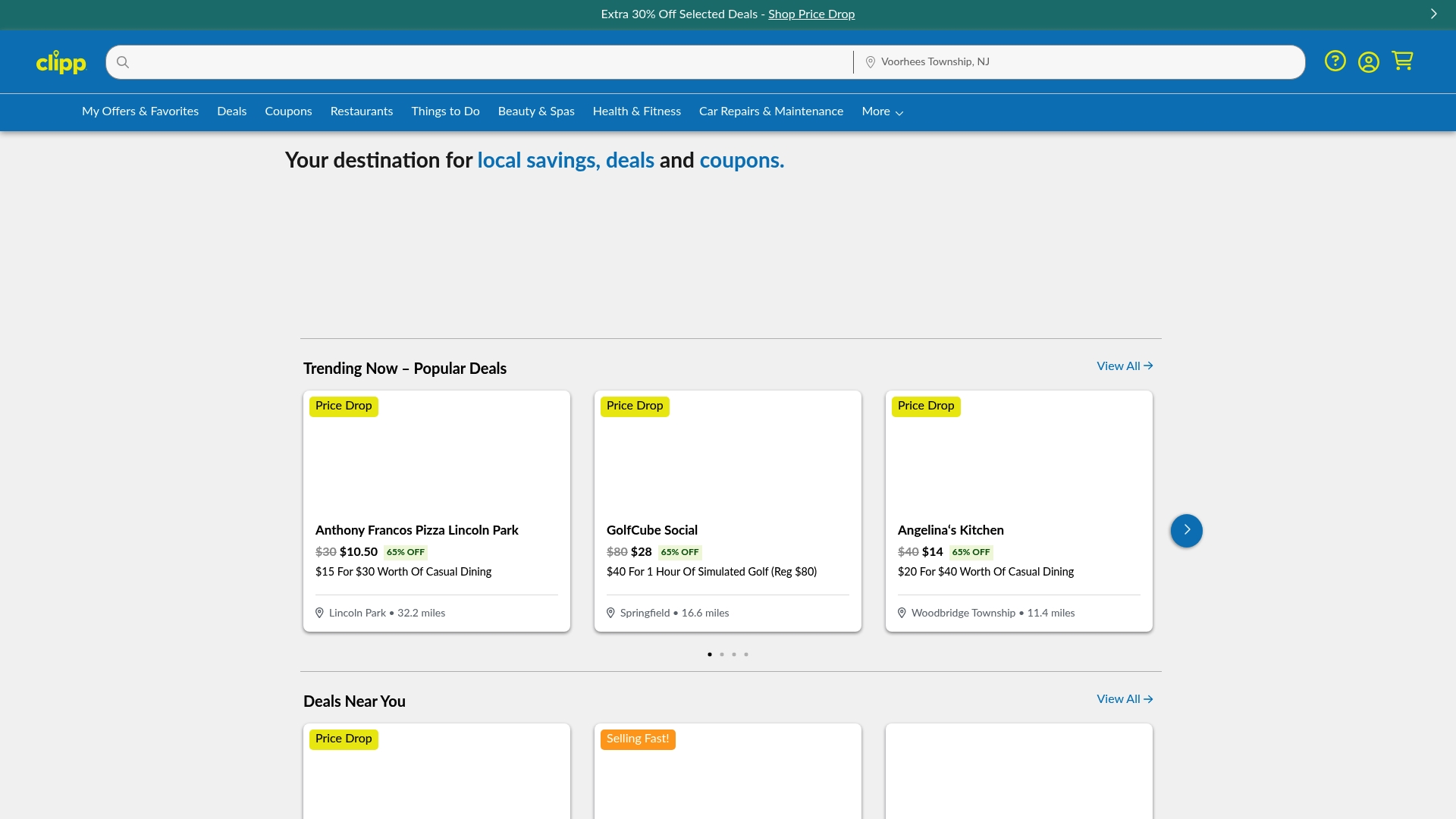
For business owners, Clipp connects your promotions directly to deal-seeking consumers in your neighborhood. Whether you are launching a first-time visitor offer or building out a repeat-visit rewards program, getting listed on a platform your customers already use is one of the fastest ways to put your deal in front of the right people at the right moment. The platform features trending offers, "Near You" browsing, and service-specific categories to match your promotion with shoppers who are already looking.
FAQ
What is the role of deals in local commerce?
Deals in local commerce go beyond simple discounts. They convert first-time buyers into loyal regulars, stimulate spending across multiple neighborhood businesses, and help keep dollars circulating within the community.
How much revenue do regular customers generate compared to one-time visitors?
Regular customers generate six times more annual revenue than one-time visitors, according to Square's 2026 Local Economy Report, making customer retention the primary financial argument for well-structured deal programs.
How long does it take to see results from a local loyalty program?
Most local businesses see a 5% lift in transactions within three months of launching a loyalty or marketing program, based on Square 2026 data. Consistency and deal design matter more than the launch itself.
What deal types work best for building community engagement?
Digital passport programs, check-in campaigns, and cross-merchant promotions are the most effective for community engagement. These formats encourage customers to visit multiple local businesses rather than concentrating spending at one location.
Are loyalty programs worth it for small businesses?
Yes. Research shows enrolled rewards members spend between $5 and $22 per $1 of reward value offered, and 72% of consumers say loyalty programs make them more likely to return. The ROI on well-designed programs is substantial for businesses of any size.