
TL;DR:
- Shopping locally recirculates nearly three times more money into the community than shopping at chains, boosting local economies.
- Using local deals and coupons makes purchasing decisions more affordable while supporting unique services and community projects.
Most people think shopping local means paying more. That assumption is costing you twice. Understanding why shop local deals actually matters goes deeper than a feel-good bumper sticker: when you spend at a local restaurant or neighborhood salon, 48% of that purchase recirculates through your community compared to less than 14% at national chains. Add local deals and coupons to the equation, and you get the rare combination of paying less while doing more good. This article breaks down exactly how that works and what you can do about it today.
Table of Contents
- Key takeaways
- Why shop local deals instead of chain stores
- More than a discount: the real value of local deals
- Breaking through barriers to local shopping
- How to find local deals across every category
- My take: why the price tag is the wrong place to start
- Start saving locally with Clipp
- FAQ
Key takeaways
| Point | Details |
|---|---|
| Local money stays local | Nearly half of every dollar spent at independent businesses recirculates in the community versus only 14% at chains. |
| Deals close the price gap | Local shopping discounts and coupons offset the cost difference, making local the smarter financial choice. |
| Service businesses maximize impact | Local electricians, cleaners, and contractors retain 60 to 80% of each dollar within your community. |
| Digital platforms simplify access | Apps and websites now make finding verified local deals faster and easier than driving to the store. |
| Small shifts create big ripple effects | Redirecting even a portion of your monthly spending locally funds jobs, schools, and neighborhood infrastructure. |
Why shop local deals instead of chain stores
The economic case for shopping locally is stronger than most people realize, and the numbers are specific enough to surprise you.
Independent businesses recirculate about 48 cents of every dollar you spend back into the local economy. National chain stores? Less than 14 cents. That gap isn't a rounding error. It represents taxes paid to local governments, salaries spent at nearby restaurants, inventory purchased from regional suppliers, and banking done at community institutions. Every dollar you spend has a second life, and where it lives matters.
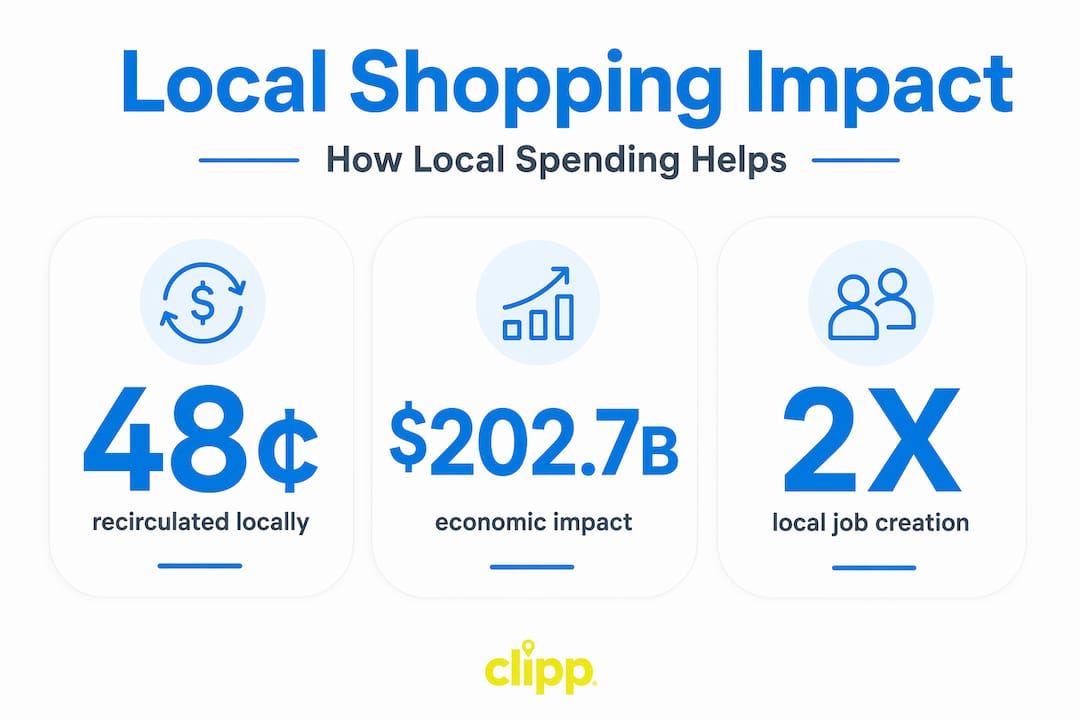
The scale of this effect is documented. Small business spending of $122.7 billion generated $202.7 billion in total economic output and supported more than 828,000 jobs. That is a 1.65x multiplier. In plain terms: local spending creates jobs that create more local spending, which creates more jobs.
Here is how the math looks when you compare it side by side:
| Spending type | Community recirculation | Per $100 spent locally |
|---|---|---|
| Local independent business | ~48% | $73 stays in community |
| National chain store | ~14% | $43 stays in community |
| Local service businesses | 60 to 80% | Highest community retention |
The per-$100 comparison is the one worth bookmarking. For every $100 you spend locally, $73 stays in your community. Spend that same $100 at a national chain, and only $43 remains. The $30 difference funds your neighbors' paychecks, your city's parks, and your local school district's tax base.
"Small businesses are more likely to buy from local suppliers, hire locally, and bank locally, keeping money circulating within communities." — Yahoo Finance
This is why the importance of local deals extends beyond your wallet. A coupon at your neighborhood gym or a discount at a local plumber does not just save you money. It amplifies a spending decision that already has outsized positive impact.
More than a discount: the real value of local deals
Price is the obvious reason to seek out local shopping discounts, but it is rarely the whole story. The community shopping benefits run deeper than what shows up in your monthly budget.

Local businesses offer something chains structurally cannot: a curated experience. Customers consistently value local businesses for unique products, personalized service, and genuine community involvement. You are not getting a scripted greeting from someone reading from a corporate training manual. You are getting the owner who actually knows what they carry and why, and who will remember you next time.
Here is what you get with local deals that you simply do not get with national coupon sites:
- Unique, hard-to-find products. Local retailers and restaurants source differently than chains. A deal at a neighborhood specialty food shop gives you access to things that do not exist in a big-box store.
- Personalized service that saves you time. When a local contractor knows your house, or a local salon knows your style, you waste less time explaining yourself and spend less money fixing mistakes.
- Real community loyalty benefits. Many local businesses reward repeat customers with better deals, advance notice of promotions, and unadvertised discounts that never hit any platform.
- Social impact you can actually see. The money you save and spend locally funds youth sports leagues, school fundraisers, and neighborhood events. The ROI is not just financial.
Millennials and Gen Z are increasingly choosing independent shops for exactly these reasons. Authenticity and community connection are driving shopping decisions in ways that surprise people who assumed younger consumers only care about price and convenience.
Pro Tip: Ask your favorite local businesses directly if they offer loyalty cards, referral discounts, or email-only promotions. Many do not advertise these publicly, and a single question can unlock savings that beat any national coupon site.
Breaking through barriers to local shopping
The three most common reasons people skip local deals are price, convenience, and awareness. All three are more solvable than you think.
The price objection
Many shoppers assume local automatically means expensive. Sometimes it does cost a bit more on the sticker, but that assumption ignores the deal layer entirely. Local shopping discounts on platforms like Clipp are designed to close exactly that gap. When a neighborhood HVAC company offers 30% off a tune-up through a local deal, you often end up paying less than you would at a franchise, with service from someone who cares about their local reputation.
Local service businesses like electricians, contractors, and cleaners already retain 60 to 80% of each dollar within the community. Stacking a local deal on top of that spending decision turns a good choice into a great one.
The convenience objection
Digital platforms have changed the game. Apps and websites centralize local deals, making it easier to find verified, current offers near you than it is to clip a paper coupon. Browsing local deals on your phone while waiting for coffee takes about the same effort as checking your social media feed.
The awareness objection
Most people simply do not know what is available in their neighborhood. This is the gap that local deal platforms exist to fill. One in three Americans already shops at small businesses at least once a week, but many of them are leaving deals unclaimed because they do not know where to look.
Here are four steps to change that:
- Search your zip code on a local deals platform before making any purchase over $25. Thirty seconds of searching can surface a discount you did not know existed.
- Follow local businesses on social media. Flash sales and limited offers often go to followers first, before they hit any aggregator site.
- Sign up for email lists from local favorites. This is where the best deals live. Business owners treat their email subscribers like VIPs.
- Check seasonal timing. Local restaurants often run the deepest discounts during slower weekday periods. Service businesses discount heavily in off-peak seasons.
Pro Tip: Stack a local deal with a cash-back credit card for maximum savings. The deal reduces the base price; your card rewards you on top of that. It is the easiest double-dip in personal finance.
How to find local deals across every category
Knowing why to shop local deals is only half the equation. The other half is knowing exactly where and how to find them efficiently.
The categories where local deals tend to offer the strongest savings include:
- Dining. Local restaurants offer some of the most aggressive deals because the margins on an empty table are zero. A 40% off dinner deal at a neighborhood spot is common and worth serious money over a month of dining out.
- Home services. Electricians, plumbers, landscapers, and cleaners regularly promote through local deal platforms to fill their schedules. These are services you need anyway.
- Wellness and fitness. Local gyms, yoga studios, and salons use introductory deals to build client bases. These offers are often dramatically lower than what a franchise charges.
- Pet care. Local groomers, veterinary clinics, and pet boarding services frequently run promotions that cost significantly less than national chains.
- Entertainment. Local theaters, escape rooms, and recreation centers often list deals that make nights out affordable without driving across town.
You can explore local deal categories to see which types of offers are available near you before you commit to a category. For dining specifically, dedicated platforms that aggregate restaurant coupons for local dining deals can surface options you have never heard of and would genuinely enjoy.
Timing is underrated. Deals rotate, expire, and refresh. Checking a local deals platform once a week instead of once a month means you catch limited-time offers before they disappear. The best deals often sell fast because the businesses cap redemptions to protect their margins.
The strategic shopper's approach: Plan your recurring monthly purchases (haircuts, oil changes, gym membership, dining out) at the start of the month. Before booking or buying any of them, spend five minutes searching for deals in each category. This single habit, applied consistently, can yield savings up to 70% on services you were going to buy anyway.
My take: why the price tag is the wrong place to start
I have watched consumer behavior shift in interesting ways over the past several years, and the conventional wisdom about local shopping still gets it wrong in one key way. Most people frame the choice as: local versus affordable. That framing is the problem.
In my experience, the people who get the most out of local deals are not the ones who are most budget-conscious. They are the ones who think about spending as an investment in the place they actually live. When you shop a deal at a local contractor or restaurant, you are funding the ecosystem that makes your neighborhood worth living in. That is not sentimentality. It is strategy.
I have also seen how the local multiplier effect plays out in practical terms. Communities that shop locally tend to have better-maintained public spaces, lower commercial vacancy rates, and stronger neighborhood identity. Those things show up in property values and quality of life. The deal you clipped for $15 off a local spa visit is connected to all of that, even if the connection is invisible.
My honest recommendation: commit 30% of your monthly discretionary spending to local businesses and use deals to make it cost-neutral. You will not notice the budget difference, but your community will notice the impact.
— Mehmet
Start saving locally with Clipp
If you have been meaning to shop more locally but never quite knew where to start, Clipp makes the first step easy.
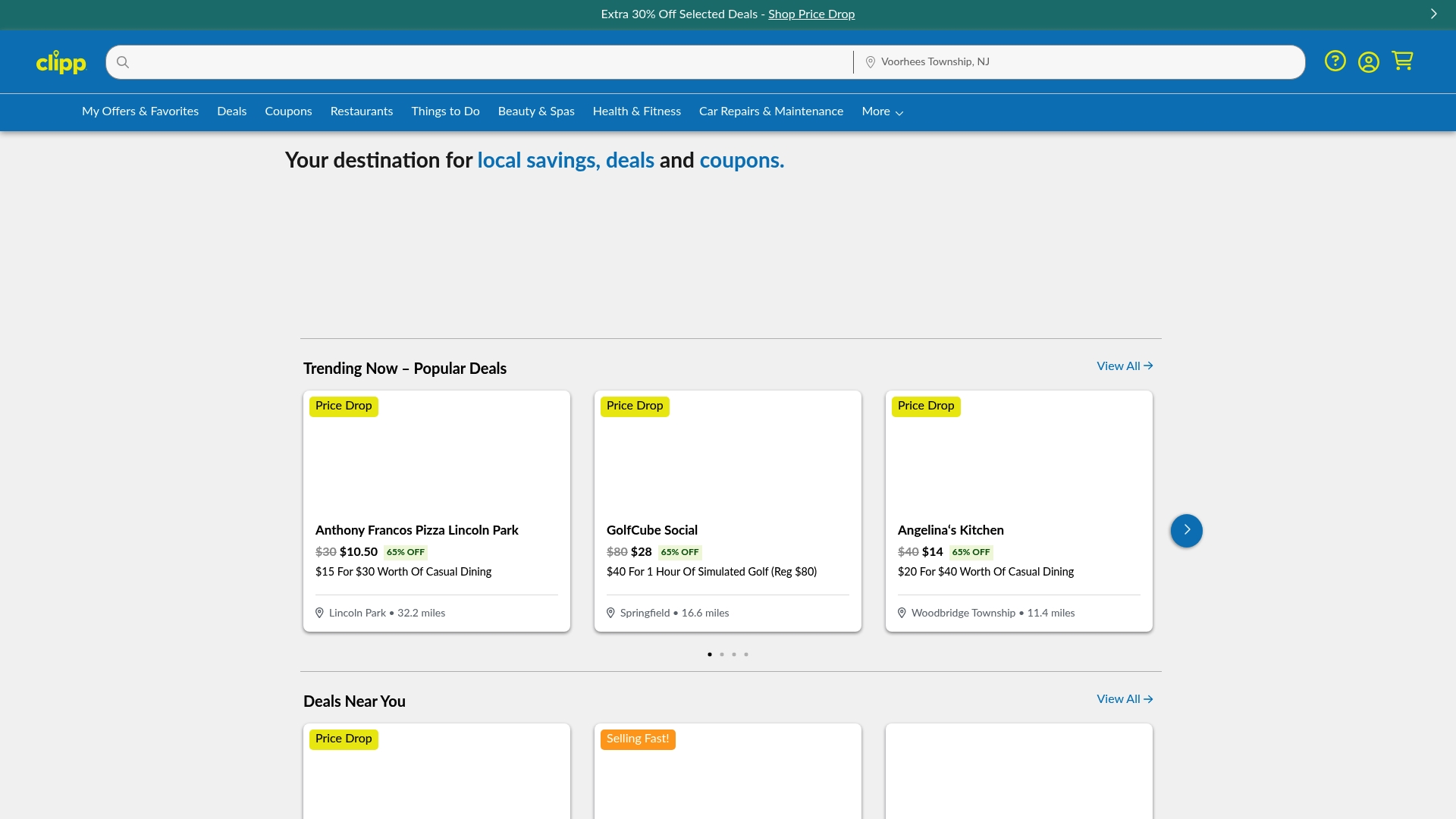
Clipp connects you with exclusive local deals across dining, home services, wellness, pet care, and entertainment in your neighborhood. The platform is built for real deal seekers: browse trending offers, search by category, and redeem verified coupons without hunting through expired listings or unverified sites. Whether you are looking for local deals near you or browsing local coupons for your next purchase, Clipp keeps local savings in one place. The best local offers move fast. Start browsing today and see what is available in your area right now.
FAQ
Why do local deals save more money than national coupons?
Local deals often feature deeper discounts because independent businesses use promotions to build loyal customers rather than compete on mass volume. Combined with the fact that local businesses frequently offer personalized service that prevents costly errors or returns, the total value often exceeds what national coupon programs offer.
How much money stays in my community when I shop local?
For every $100 spent at a local independent business, approximately $73 stays in the community compared to only $43 when spent at a national chain, a $30 difference per transaction.
What types of local deals are available near me?
Local deals typically cover dining, home services, wellness and fitness, pet care, and entertainment. Platforms like Clipp aggregate verified offers by neighborhood so you can browse deals across all categories in one place.
Are local businesses more expensive than chains?
Local businesses can sometimes have higher base prices, but local shopping discounts and coupons routinely close that gap. When you factor in personalized service, unique products, and the community economic benefit, the overall value often favors local shopping.
How do I find the best local deals quickly?
Search a local deals platform by your zip code before any purchase over $25, follow neighborhood businesses on social media for flash sales, and sign up for email lists to access deals near you before they are publicly advertised.