

TL;DR:
- Consumers actively seek coupons and promotions to discover local entertainment options and save money.
- Industry deals influence what content is created and how creators are paid, shaping the entire entertainment pipeline.
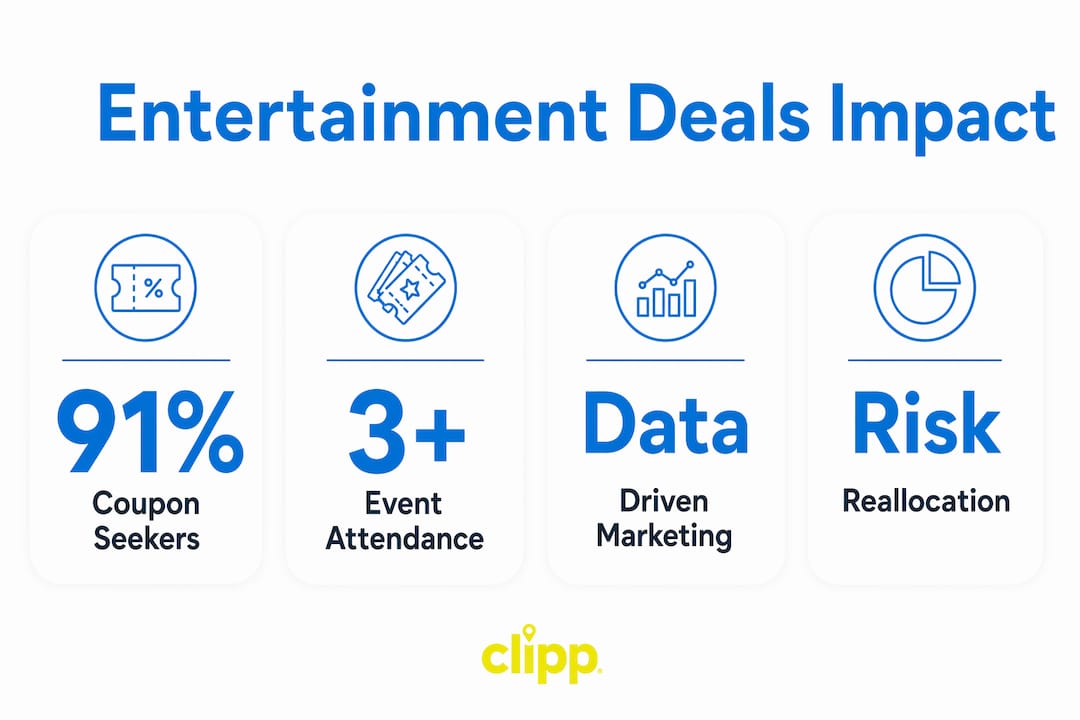
Deals drive entertainment in two directions at once. For fans, 91% of consumers actively seek coupons and promotions before spending on local entertainment — meaning a flash sale or free trial often determines what you watch, attend, or try first. For studios, streamers, and creators, commercial agreements like first-look and overall deals control who develops what, who gets paid how, and who owns the result. Platforms like Clipp exist precisely at that first intersection: connecting fans with curated local entertainment savings before the decision is made.
At a glance:
- Fans: Deals increase discovery and trial, create urgency, and shift perceived value
- Creators/studios: Contract deals allocate risk, set compensation structures, and shape content pipelines
- Practical takeaway: Knowing how both types of deals work helps you spend smarter and understand why certain content exists at all
Table of Contents
- What does "deals" actually mean in entertainment?
- How promotions shape what fans choose, try, and remember
- How commercial deals change what gets made and who gets paid
- Where can you find and evaluate entertainment deals?
- How organizers can design deals that actually grow audiences
- What legal and ethical risks come with entertainment deals?
- Key Takeaways
- Deals matter more than most fans realize
- Clipp puts local entertainment deals in one place
- Useful sources
What does "deals" actually mean in entertainment?
The word covers two very different things, and conflating them causes real confusion.
Consumer-facing promotions are what most fans think of first:
- Discounts and price drops (movie tickets, concert presales)
- Bundle offers (streaming + music subscription packages)
- Free trials (30-day streaming access)
- Loyalty offers and promo codes for repeat customers
- Flash sales on local attractions and venue tickets
Commercial/contract deals are the business agreements that determine what gets made:
- First-look deals: A studio gets first right to review a producer's new projects — no exclusivity, but priority access
- Overall deals: Full exclusivity for 2–3 years with overhead payments and guaranteed development funds
- Output deals: A creator commits a set number of projects to one buyer
- Distribution pacts: Agreements governing where and how content reaches audiences
- Backend participation: A share of profits after recoupment, often tied to IP ownership
Both senses matter to fans. Consumer promos change what you experience. Commercial deals change what exists to experience.
How promotions shape what fans choose, try, and remember
Deals don't just save money. They actively redirect attention. A discounted ticket to a local comedy show introduces a venue you'd never have paid full price to try. A streaming free trial locks in a habit before you've evaluated whether the content is worth the monthly fee.
The behavioral mechanics work in a few distinct ways. Discovery happens when a deal surfaces something algorithmically or socially — a Groupon-style offer or a Clipp "Near You" listing puts a local attraction in front of someone who wasn't searching for it. Trial conversion follows: a reduced barrier to entry means more first-time customers, which is why streaming free trials reliably spike short-term viewership even when long-term retention doesn't follow. Urgency is the third lever — limited-time offers compress decision-making, which is why concert flash sales sell out faster than standard on-sales at the same price point.
The tradeoff is real, though. Repeated discounting trains audiences to wait for a deal rather than pay full price, which erodes perceived value over time. A venue that runs flash sales every weekend eventually struggles to sell tickets at standard rates.
Key metrics that tell the real story:
- Redemption rate: What percentage of deal-holders actually show up or use the offer
- Incremental revenue: Did the deal bring in new spending, or just discount existing customers?
- Short-term retention: Did trial users convert to paying customers after the promo ended?
91% of consumers seek coupons before spending on local services and entertainment — making deal discovery a primary driver of where fans spend their money.
Pro Tip: Before redeeming any entertainment deal, check three things: the true discount versus the regular price (not an inflated "original" price), any blackout dates or restrictions, and whether hidden fees close the gap on your savings. A "50% off" ticket with a $12 service fee on a $20 ticket isn't much of a deal.
How commercial deals change what gets made and who gets paid
At the industry level, deals reallocate risk and control pipeline visibility. A studio signing a producer to an overall deal is essentially preloading its development slate — paying overhead in exchange for first access to that producer's ideas before anyone else sees them. The tradeoff for the producer is creative constraint: you're exclusive, which means you can't pitch elsewhere even if a better opportunity appears.

Misaligned incentives between talent and studios are the biggest source of negotiation friction. Above-the-line compensation (upfront fees) is straightforward. Backend participation — a share of profits after the studio recoups costs — is where disputes concentrate. Hollywood's "creative accounting" practices mean a film can gross hundreds of millions and still technically show no net profit on paper, leaving backend participants with nothing.
The market has contracted sharply, with a significant decline in active overall and first-look deal positions between 2019 and May 2026. Fewer deals means more producers competing without formal studio backing, pitching against attached, near-finished projects rather than raw ideas.
Business metrics that matter here:
- CAC (customer acquisition cost): What a streamer spends to acquire one subscriber via a free trial or bundle
- Churn: How many trial users cancel after the promotional period ends
- LTV (lifetime value): Whether a deal-acquired customer generates enough long-term revenue to justify the acquisition cost
- Backend share: The percentage of profits a creator actually receives after recoupment
Studios now judge major talent pacts by global subscriber impact data rather than prestige alone — a shift that changes which creators get deals and which projects get greenlit.
Where can you find and evaluate entertainment deals?
The most reliable approach combines aggregator platforms, official venue channels, and social-only codes — then verifies the fine print before committing.
- Check aggregator platforms first. Clipp's "Trending Deals," "Near You," and "Coupons" sections surface local entertainment discounts curated by category and location. This is faster than hunting venue by venue.
- Sign up for official venue newsletters. Presale codes and member-only discounts often appear there 24–48 hours before public release.
- Follow social channels for flash codes. Many venues and promoters drop promo codes exclusively on Instagram or X with short expiration windows.
- Use loyalty apps where you attend regularly. Repeat-visit rewards compound faster than one-off deals for venues you already like.
- Verify the math. Compare the deal price against the venue's own website, not just the "original price" listed on the deal page.
Pro Tip: Season passes beat single-event discounts when you'll attend three or more times. The math flips quickly — a pass at 2x a single ticket price pays off by the third visit, and the scarcity framing on flash single-event sales is often manufactured urgency rather than genuine limited supply.
How organizers can design deals that actually grow audiences
Well-designed promotions balance acquisition, retention, and margin protection; for event organizers, understanding the voorwaarden om studenten in te schakelen in de horeca can be key for staffing hospitality-related promotions effectively. A flash sale that fills seats once but trains the audience to never pay full price is a net loss.
Design principles that work:
- Set a clear goal before launching: trial acquisition, retention of lapsed customers, or off-peak fill rates — each requires a different structure
- Cap redemptions to preserve scarcity and margin
- Use bundles and experiential add-ons (early entry, meet-and-greets) instead of straight discounts when possible
- Measure incremental lift, not just total redemptions
| Metric | What it measures | Target signal |
|---|---|---|
| Redemption rate | Deal-holders who actually use the offer | High rate = strong offer design |
| Incremental revenue | New spend vs. discounted existing spend | Positive = deal is acquiring, not just discounting |
| Retention lift | Trial users who return at full price | Positive = deal built a habit |
| CAC | Cost to acquire one new customer via the deal | Should be below LTV |
| Break-even discount depth | Maximum discount before margin goes negative | Know this before you set the price |
For venues and local partners, exclusive discount campaigns tied to membership or loyalty tiers tend to outperform open flash sales on retention metrics because they reward existing customers rather than training new ones to wait for a discount.
Pro Tip: Treat every deal campaign as a data-collection opportunity. Track which offer type, timing, and channel drives the highest retention — not just the highest redemption. That data refines your LTV model and tells you which customers are actually worth acquiring at a discount.
What legal and ethical risks come with entertainment deals?
Entertainment deals carry IP, exclusivity, and long-term financial consequences that standard business contracts simply don't address. A work-for-hire clause, for example, transfers copyright entirely to the buyer — the creator retains no ownership, no royalties, and no reversion rights. That's a career-level decision buried in standard-looking contract language.
Key legal risks to watch:
- Work-for-hire vs. license: Work-for-hire strips all ownership; a license retains it with defined usage terms
- Exclusivity scope: Overly broad non-compete clauses can block a creator from working in adjacent categories for years
- IP reversion windows: If a studio doesn't develop a project within a set period, does the IP revert to the creator? Many contracts omit this entirely
- Backend accounting traps: "Creative accounting" practices can eliminate net profit on paper even when a project earns hundreds of millions
- Master ownership obligations: When artists gain ownership of masters, they inherit the administrative burden of paying all profit participants — songwriters, producers, and others — which demands real infrastructure
On the consumer side, ethical risks are quieter but real. Hidden fees on "free" trials, auto-renewal terms buried in fine print, and blackout dates that make a "discount" nearly unusable all erode trust. Deal fatigue — the point where audiences tune out promotions entirely because they've been burned too many times — is a genuine threat to venues that over-rely on discounting.
Guild bargaining adds another layer. The WGA and other guilds have shifted toward bespoke agreements that address specific member needs rather than pattern bargaining, reflecting how streaming has fractured the old compensation models. Georgetown labor experts note that residual structures built for reruns and syndication simply don't translate to on-demand streaming — which is why those negotiations remain contentious.
This article is general information, not legal advice. Consult a qualified entertainment attorney for guidance specific to your contracts and situation.
Key Takeaways
Deals shape entertainment at every level — from the local concert ticket you buy at half price to the studio contract that determines whether a show gets made at all.
| Point | Details |
|---|---|
| Deals drive fan discovery | 91% of consumers seek coupons before spending on local entertainment, making promotions a primary discovery channel. |
| Commercial deals control pipelines | First-look and overall deals pre-load studio slates; active deal positions dropped roughly 38% between 2019 and May 2026. |
| Measure incremental lift, not just redemptions | Redemption rate, retention lift, and CAC together reveal whether a deal acquired new customers or just discounted existing ones. |
| IP and exclusivity carry long-term risk | Work-for-hire clauses, broad non-competes, and backend accounting traps require specialized entertainment counsel before signing. |
| Clipp for local entertainment deals | Clipp's Trending Deals, Near You, and Coupons sections surface curated local entertainment savings faster than searching venue by venue. |
Deals matter more than most fans realize
The conventional take is that deals are just a marketing tactic — a way to fill seats or move subscriptions. That framing misses something. The deal structure upstream (who owns the IP, how backend is calculated, whether a creator is exclusive) directly determines the range of content that reaches fans downstream. When overall deal positions contract by 38%, fewer independent producers have studio backing, which narrows the creative pipeline. When streaming platforms pay large upfront fees but eliminate backend participation, creators hedge toward safer projects rather than ambitious ones.
For fans, the practical implication is this: the entertainment you have access to is partly a function of deal structures you never see. And the deals you do see — the flash sale, the free trial, the promo code — are designed to shape your behavior as precisely as any contract clause shapes a creator's.
Clipp puts local entertainment deals in one place
Spending less on entertainment doesn't mean settling for less. Clipp connects fans with curated local deals across dining, attractions, events, and more — without the time spent hunting across a dozen venue websites.
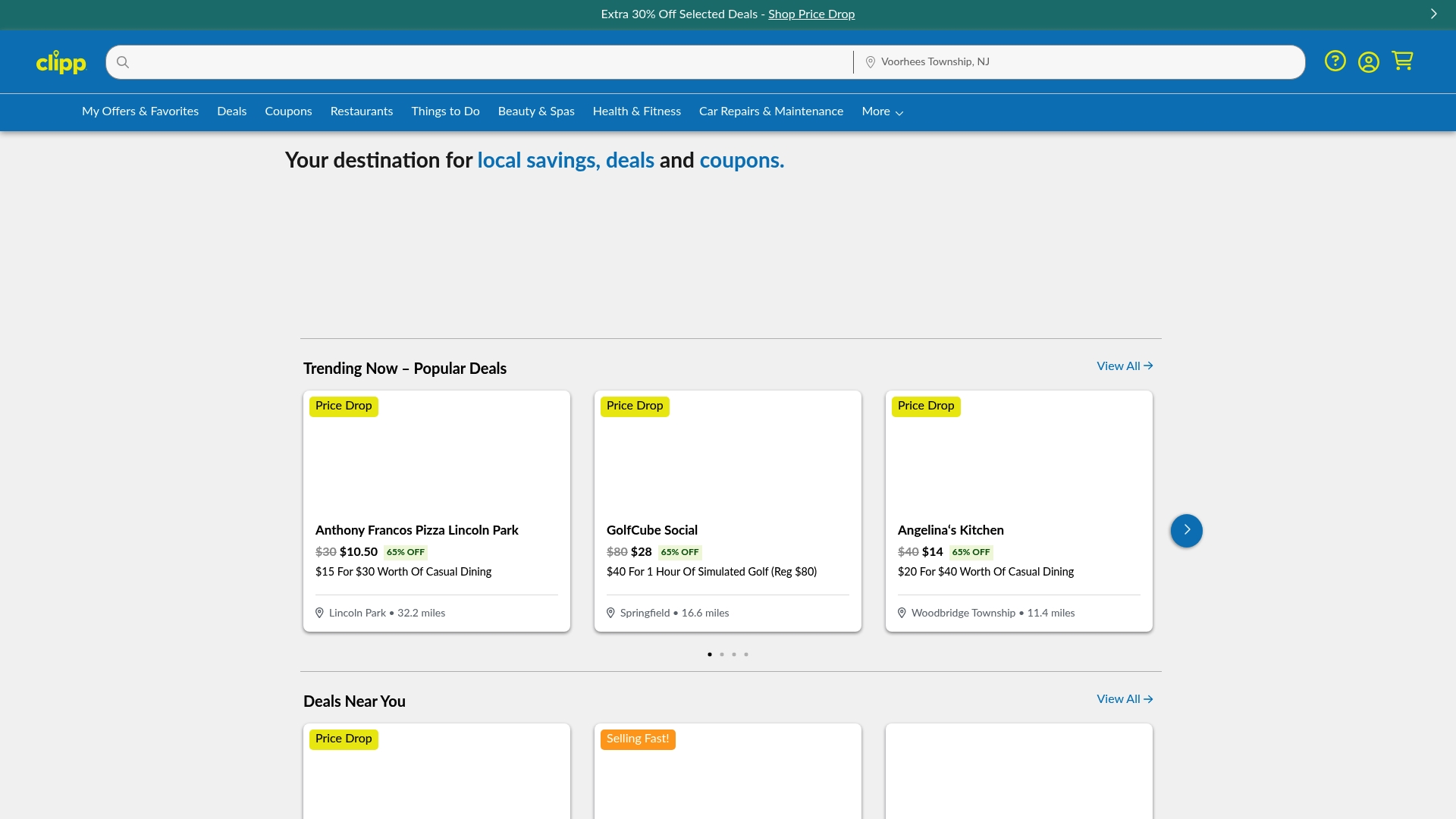
Clipp's "Trending Deals" and "Near You" sections surface the highest-value local offers in real time, and the Coupons section covers everything from movie tickets to local experiences. State-specific pages make it easy to find what's available where you actually live: Texas deals, Florida deals, Virginia deals, and Louisiana deals are all live and updated regularly. Prefer browsing on the go? The Clipp mobile app delivers deal alerts and one-tap redemption. Browse what's near you today and start saving on the entertainment you already want.
Useful sources
- How deals engage consumers — Clipp blog: Clipp's research on coupon-seeking behavior and how curated local deals drive consumer discovery and spending.
- First-Look & Overall Deals In 2026 — Vitrina.ai: Practical breakdown of first-look vs. overall deal structures, overhead terms, and how studios use them to manage development pipelines.
- The overall and first-look film & TV producers deal report — The Business of Entertainment: Tracker data on the contraction from 902 to 556 active deal positions and what it means for producers without formal studio backing.
- Entertainment dealmaking — USC Gould School of Law: Industry practitioner perspective on above-the-line compensation, backend participation, and how misaligned incentives create negotiation friction.
- How Are Entertainment Contracts Different From Standard Business Contracts? — Lopes Law LLC: Plain-language explanation of why IP ownership, exclusivity, and reversion rights require specialized entertainment counsel.
- Hollywood Strikes Explained by a Labor Negotiations Expert — Georgetown University: Expert analysis of WGA and SAG-AFTRA bargaining leverage, residual disputes, and how streaming fractured traditional compensation models.
- Big Screen or Bust? — Cardozo Journal of Conflict Resolution: Academic analysis of how streaming has disrupted profit-participation contracts and what talent attorneys should negotiate for in the SVOD era.
- How music attorneys help artists navigate record contracts — Variety: Reporting on the administrative and financial obligations artists take on when they gain master ownership.
- A new kind of contract for a new kind of entertainment industry — Harvard Journal of Sports and Entertainment Law: Scholarly look at how guilds like the WGA are moving away from pattern bargaining toward bespoke agreements suited to the streaming era.