

TL;DR:
- Deals are primarily tools for sellers to move inventory and improve cash flow, not always for consumer savings. Understanding deal types and seller motivations helps shoppers avoid overspending and recognize genuine value. Consistent, strategic deal-hunting on necessary expenses builds long-term budget health and savings.
Not every deal saves you money. That sounds backward, but the role of deals in saving money is more nuanced than most shoppers realize. Businesses design promotions to serve their own goals first. Consumers who understand that dynamic can spot genuine value and sidestep traps. Whether you clip coupons, chase flash sales, or wait for seasonal markdowns, knowing how deals actually work puts you in control of your budget rather than a retailer's revenue strategy.
Table of Contents
- Key takeaways
- How deals save money — and why sellers offer them
- Deal types and their real impact on your wallet
- Strategies for evaluating deals before you buy
- How deals build long-term budget health
- My take on deals: patience beats urgency every time
- Find real deals that actually fit your life
- FAQ
Key takeaways
| Point | Details |
|---|---|
| Deals serve sellers first | Businesses use discounts to move inventory and stimulate demand, not purely to benefit shoppers. |
| Rebates are easy to miss | Only 38% to 80% of consumers actually redeem rebates, so immediate discounts often deliver more reliable savings. |
| Bundles require math | A bundle only saves money when its total price is less than buying each item separately at its best available price. |
| Planned purchases win | Starting from what you already need before browsing deals prevents overspending disguised as saving. |
| Recurring deals compound | Small percentage savings on subscriptions and utilities build up significantly over months and years. |
How deals save money — and why sellers offer them
Most shoppers see a "40% off" tag and assume the retailer is doing them a favor. The truth is more interesting. Discounts are business tools designed to stimulate demand, clear inventory, and improve cash flow. A clothing store marking down last season's coats needs that shelf space more than it needs full-margin profit on slow-moving stock. A restaurant offering a Tuesday lunch special needs to fill seats during a historically slow window.
Understanding seller motivations changes how you read any promotion. Here is what businesses are actually solving when they put a deal in front of you:
- Inventory pressure. Perishable goods, seasonal products, and overstocked items need to move. The deal benefits you, but the urgency is theirs.
- Cash flow needs. A discount today beats waiting months for a full-price sale that might not happen.
- New customer acquisition. Introductory deals are often priced below profitability to get you in the door and convert you into a regular buyer.
- Competitive positioning. Price cuts can be a reaction to a competitor's promotion rather than a genuine markdown from fair value.
There is an important caveat here. Frequent discounting resets price expectations over time. Consumers who only buy a brand on sale eventually stop seeing the full price as legitimate. That matters because it means some "deals" are simply the market correcting an inflated baseline price.
Pro Tip: Before you act on any discount, ask yourself: would I want this item at its regular price? If the answer is no, the deal is the only reason you're buying it — and that's rarely a savings win.
Deal types and their real impact on your wallet
The financial benefits of discounts vary dramatically depending on what kind of deal you are using. Not all promotions work the same way, and the format matters as much as the percentage off.
Immediate discounts
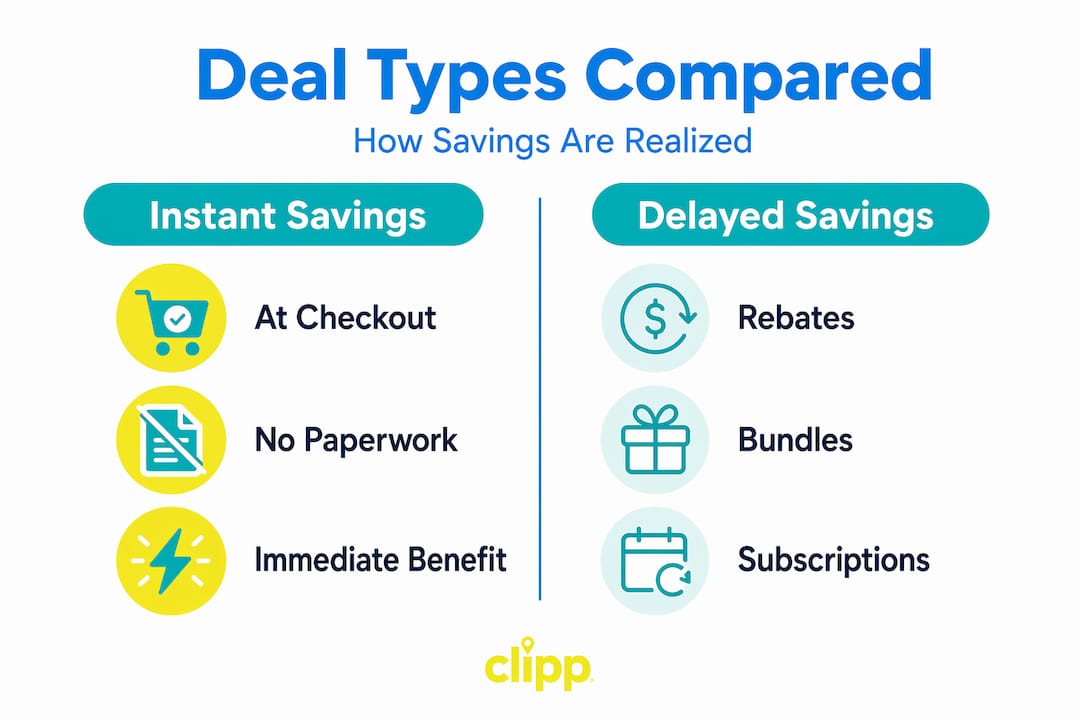
These are the most straightforward. The price is lower at the register and you capture the savings instantly. No follow-up required. For everyday purchases, immediate discounts are the most reliable format.
Rebates
Rebates look like discounts but function differently. You pay full price upfront and submit a claim afterward to receive money back. The problem is that only 38% to 80% of consumers redeem rebates, which means a large share of shoppers never see the savings they were counting on. The claim process is intentionally designed to create friction. Deadlines, mailed forms, and account registration all reduce redemption rates, which is exactly what the offering company is banking on.
Bundles
Bundles feel like great value because the per-item price seems lower. But bundles only save money when the total price is less than buying each item separately. If a bundle pairs something you need with something you would never buy alone, you are not saving on the extra item. You are spending money you would not have spent otherwise.
| Deal type | How savings are realized | Main risk |
|---|---|---|
| Immediate discount | Savings applied at checkout automatically | May encourage impulse purchases |
| Rebate | Savings returned after claim submission | High non-redemption rate reduces actual savings |
| Bundle | Lower total price vs. buying items separately | May include items you do not need |
| Subscription deal | Locked-in rate on recurring purchase | Forgotten subscriptions negate all savings |
| Limited-time offer | Urgency pushes decision speed | Panic buying on items you do not actually need |
Subscriptions and recurring services
This is where the role of coupons in savings and ongoing promotions gets genuinely powerful. Recurring expenses compound savings over time because the discount applies every billing cycle. A 20% reduction on a $50 monthly service saves $120 per year without any additional effort after the first negotiation. The key is auditing regularly. Many households carry three to five subscriptions they no longer use, which silently drain the budget every month.

Pro Tip: Set a calendar reminder every 90 days to review your active subscriptions. Cancel anything you have not used in the past month and check whether a better promotional rate exists for the ones you keep.
Strategies for evaluating deals before you buy
Knowing the importance of discounts is one thing. Using them without falling into common traps requires a specific workflow. The best money-saving deals are not the ones with the largest headline percentage. They are the ones that deliver real savings on things you were already going to buy.
Here is a practical process that separates genuine savings from marketing theater:
-
Start with your purchase list, not the deal page. Identify what you actually need before browsing promotions. This single habit prevents the most common source of deal-related overspending.
-
Calculate total cost, not just the discount. Factor in shipping, required minimum purchase, rebate claim requirements, and any membership fees attached to accessing the deal. A $20 savings that requires a $50 annual membership is not a $20 savings until year two.
-
Run the bundle math manually. Compare bundle prices against individual item costs by looking up each product sold separately. Many bundle deals are genuinely good. Some are not. You will not know unless you check.
-
Treat "limited time" claims with healthy skepticism. Many deals return on predictable schedules tied to business cycles and inventory management. Time-limited deals often serve seller business cycles rather than representing a one-time price event. If you miss the window, wait and watch.
-
Set up deal alerts on items you have already decided to buy. This flips the dynamic entirely. Instead of deals driving your purchases, your purchases drive your deal-hunting. Tools like deal alert features on platforms such as Clipp let you track specific categories and get notified when relevant offers appear.
-
Claim rebates immediately, not later. If a rebate is part of your savings calculation, submit it the same day you make the purchase. Waiting introduces the exact friction that causes most rebate savings to evaporate.
Pro Tip: Keep a simple spreadsheet or notes app entry listing your planned big purchases for the next 90 days. Review it every time you browse deals. If the deal does not match something on your list, the default answer is no.
How deals build long-term budget health
Shopping deals for saving money work best when treated as a financial habit rather than a one-off score. The impact of deals on your budget compounds significantly when applied consistently across the categories where you spend the most.
Here is where the financial benefits of discounts extend beyond individual transactions:
- Freed-up budget for savings goals. Every dollar you do not spend on full-price dining, entertainment, or services is a dollar that can move toward an emergency fund or debt payoff. That redirection requires intentionality, not just deal-hunting.
- Lower recurring costs. Using promotions to negotiate or access discounted rates on utilities, insurance renewals, and membership services builds permanent budget room.
- Reduced reliance on credit. When everyday purchases cost less through promotions, you are less likely to overspend against credit that generates interest charges.
- Better financial awareness overall. People who actively seek ways to save with promotions tend to track spending more carefully, which improves financial decision-making across the board.
The perceived value of a deal matters beyond just price. In the restaurant sector, 67% of consumer value perception is explained by price, but the remaining 33% comes from non-price factors. The same principle applies everywhere. A deal that feels like a genuine win increases satisfaction and builds positive financial habits. A deal that makes you feel manipulated does the opposite. You can read more about building smart daily deal habits to see how consistent deal use supports long-term savings goals.
My take on deals: patience beats urgency every time
I have spent years watching consumers make two opposite mistakes. The first group ignores deals entirely, convinced that hunting for discounts is not worth their time. The second group treats every "limited time offer" as a financial emergency and buys things they would never have purchased otherwise.
What I have learned is that the most effective deal users share one trait. They are patient. They know what they want to spend money on, and they wait for the price to meet their expectations rather than letting the price determine their behavior. I have seen people save hundreds of dollars on home improvement services simply by waiting four to six weeks for a seasonal promotion to appear. That same work would have cost full price the day before.
The other thing I have seen repeatedly is that headline discounts distort thinking. A 60% markdown on something you would not otherwise buy is not a 60% savings. It is a 100% unnecessary purchase. The smartest deal seekers I know are almost bored by the percentage. They care about the final price relative to their baseline budget for that category.
My practical advice: get selective. Find three to five categories where you spend consistently and focus your deal-hunting energy there. Dining, local services, and entertainment tend to offer the strongest and most frequent promotions. Build the habit in those areas first and let it spread naturally from there.
— Mehmet
Find real deals that actually fit your life
Ready to stop leaving money on the table? Clipp makes it straightforward to find the best money-saving deals on dining, wellness, home services, and local entertainment near you without sifting through irrelevant national promotions.
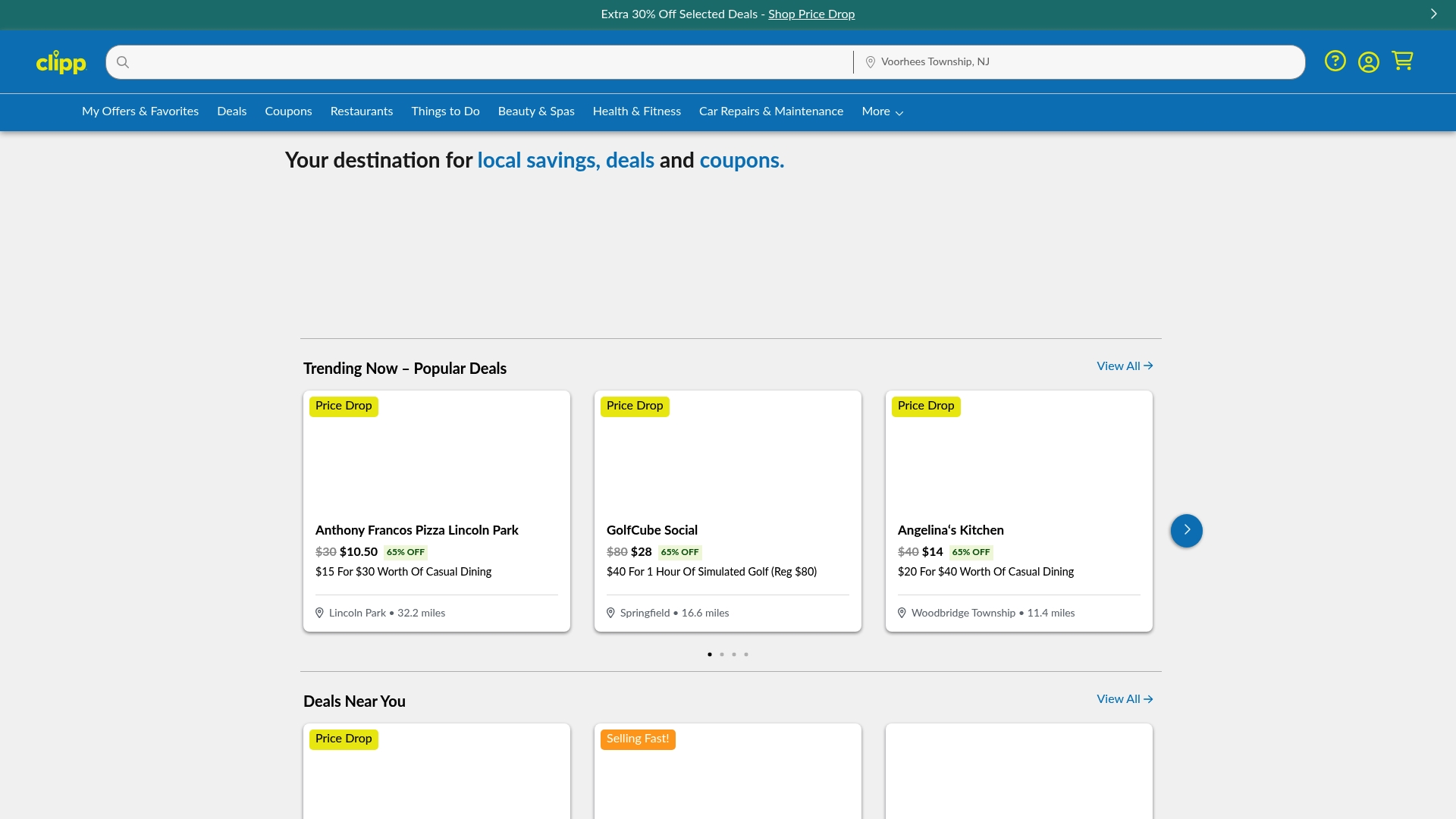
Browse local deals in Ashburn, VA or explore coupons near you to see what is available today. Clipp organizes offers by category and location so you can filter for exactly what fits your planned purchases. The platform highlights trending deals and fast-moving offers, which helps you act on genuine value before it expires. Download the Clipp mobile app to get deal alerts delivered directly to your phone so the right savings come to you instead of you having to search for them.
FAQ
What is the role of deals in saving money?
Deals reduce the price you pay on planned purchases, freeing budget for other financial goals. Their effectiveness depends on deal type, your actual need for the item, and whether you account for conditions like rebates or shipping.
How do rebates compare to immediate discounts?
Immediate discounts apply savings at checkout with no follow-up needed. Rebates require a claim process, and only 38% to 80% of consumers complete the redemption steps, making instant discounts more reliable for most shoppers.
Are bundle deals always worth it?
Not always. A bundle saves money only when its total price is less than purchasing each included item separately. If the bundle includes items you do not need, the extra spending outweighs the discount.
How can I find the best money-saving deals without overspending?
Start from a list of purchases you have already planned, then search for deals that match those items. This approach keeps promotions working for your budget instead of against it. Platforms like Clipp let you filter by category to stay focused.
Do deals have a long-term impact on my budget?
Yes. When applied consistently to recurring expenses like subscriptions, dining, and services, deal savings compound over time. Canceling unused subscriptions and negotiating better rates can produce significant monthly budget room with minimal ongoing effort.