

TL;DR:
- A price drop promotion is a temporary, scheduled discount intended to boost sales or clear inventory without changing regular prices. It differs from permanent discounts and markdowns because it reverts to the original price after the campaign ends, helping maintain price integrity. Effective implementation involves setting triggers, protecting margins, and targeting specific customer segments for measurable success.
A price drop promotion is a temporary, time-bound reduction from list price designed to achieve a measurable business outcome, such as increased sales volume or inventory clearance, without permanently altering your pricing structure. The industry term for this tactic is "promotional pricing," and understanding the distinction matters. Defining price drop promotions correctly separates businesses that use them as a growth tool from those that accidentally train customers to wait for sales. This guide covers how promotional pricing differs from permanent discounts, how to implement it without eroding margins, and how to measure whether it worked.
What are price drop promotions and how do they differ from discounts?
A price drop promotion is specifically defined as a temporary reduction from list price with a defined start and end date, after which the price reverts. That reversion is the defining feature. A permanent discount changes your baseline price. A markdown, in retail terms, is a permanent or semi-permanent reduction applied to slow-moving inventory. A price drop promotion is none of those things. It is a campaign with a clock.
Promotional pricing is short-term discounting tied to a specific event or campaign objective, with the price returning to its original level when the campaign ends. This structure protects your price integrity. Customers who buy at full price before the promotion do not feel deceived, and customers who buy during it feel rewarded rather than entitled.
The table below clarifies the key differences between the three most common pricing reduction strategies.
| Type | Intent | Duration | Price reverts? |
|---|---|---|---|
| Price drop promotion | Drive volume, clear inventory, acquire customers | Days to weeks | Yes |
| Markdown | Reduce overstock permanently or seasonally | Weeks to months | Rarely |
| Permanent discount | Reposition price point or match competition | Indefinite | No |
The practical implication is significant. A business that runs a 20% off weekend promotion maintains its full price anchor. A business that marks down a product permanently loses that anchor forever. Knowing which tool fits your goal is the first decision in any price reduction strategy.
How do businesses implement price drop promotions effectively?
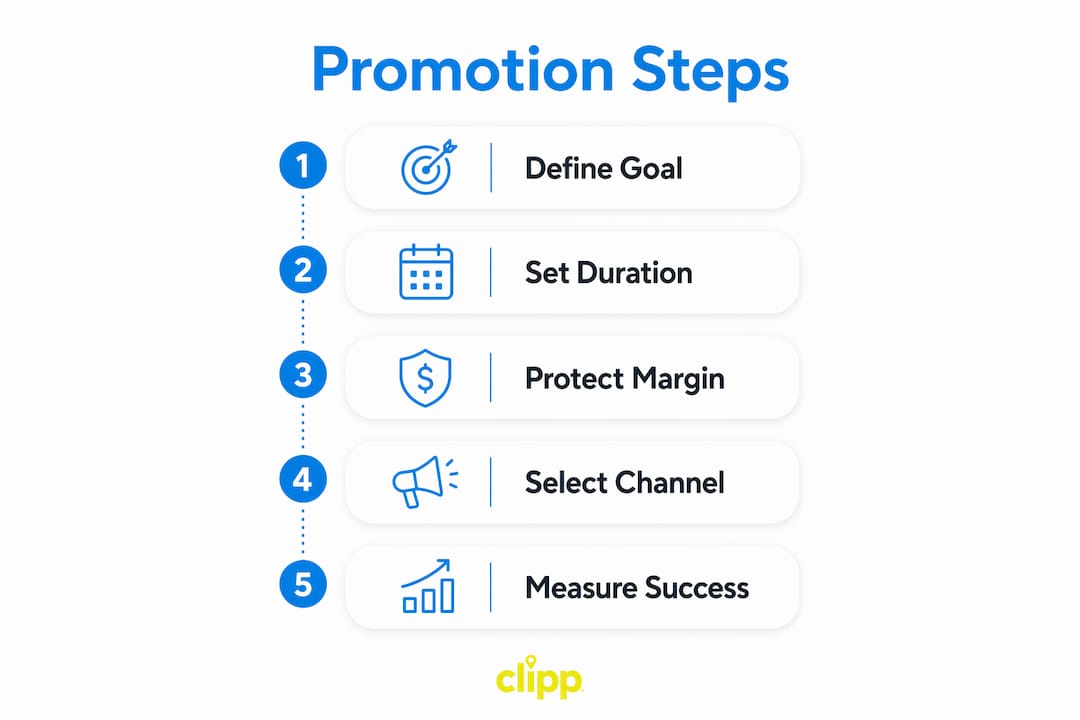
Effective implementation starts before the promotion launches. The most common failure is designing a price drop reactively, after sales slow, rather than proactively, as part of a planned product lifecycle.
Here is a four-step framework for implementing price drops with margin protection built in.
-
Set objective triggers. Define the conditions that activate a price drop before the product hits the shelf. Trigger-based markdowns like 20% off after 30 days on shelf, or a discount when sell-through falls below 40% at week 8 of a selling season, remove emotion from the decision. You act on data, not panic.
-
Build a tiered discount structure. Start with a modest reduction, say 10–15%, and escalate only if the trigger threshold is not met. Predefining a staged tiered discount approach maximizes margin recovery and inventory clearance without signaling desperation to customers.
-
Establish a markdown floor. Calculate your breakeven cost: COGS plus holding costs plus fulfillment. Setting a margin floor prevents price drops from becoming net losses. For example, if your COGS is $18, holding costs add $2, and fulfillment adds $3, your breakeven is $23. A 10% margin floor means your price never drops below $25.30.
-
Apply segmentation, targeting, and positioning (STP). Segmented promotions that target individual customers or specific customer groups outperform blanket discounts. A loyalty member discount, a first-time buyer offer, or a geographic promotion each reach a defined audience with a relevant message. Blanket discounts train everyone to wait for the next sale.
Pro Tip: Never launch a price drop promotion without a defined end date visible to the customer. Urgency is the mechanism that converts browsers into buyers. An open-ended "sale" removes that urgency entirely.
Margin protection and segmentation are not optional refinements. They are the difference between a promotion that builds your business and one that quietly erodes it. For a deeper look at structuring these decisions, the role of discounts for businesses covers margin considerations in detail.

What channels and messaging work best for price drop advertising?
The channel you choose shapes how customers perceive the promotion. Price drop advertising works best when the message reaches the right person at the right moment with a credible reason for the discount.
- Email marketing is the highest-precision channel for promotional pricing. You control the audience, the timing, and the message. A segmented email to lapsed customers offering 15% off their next visit performs better than a sitewide announcement because it feels personal, not desperate.
- Social media and paid digital ads create urgency at scale. Countdown timers, limited-quantity language, and "today only" framing all increase conversion rates. These channels work best for broad awareness promotions tied to seasonal events or product launches.
- On-platform deal listings through local deal aggregators like Clipp put your promotion in front of cost-conscious customers who are actively searching for savings in your category. This channel is particularly effective for local service businesses like restaurants, salons, and gyms.
Framing matters as much as the discount itself. Pairing a promotional price with a credible reason, such as a seasonal clearance, a loyalty reward, or a new product launch, frames the promotion as a moment rather than a signal that your regular price was inflated. "End of summer clearance: 25% off" reads differently than "25% off, this week only." The first has context. The second raises questions.
Percent-off framing works better for high-ticket items where the dollar figure is large and visible. Dollar-off framing works better for lower-priced products where the percentage would look small. A $50 discount on a $200 service is more compelling than "25% off."
Pro Tip: Limit promotional announcements to a predictable cadence. If you run price drop promotions every two weeks, customers learn to wait. Quarterly or event-driven promotions preserve the sense of occasion that makes them effective.
For practical guidance on structuring campaigns, the step-by-step deal promotion guide for local businesses covers execution from setup to launch.
How do you measure whether a price drop promotion succeeded?
A price drop promotion without predefined success criteria is just a discount. Measurement starts before launch, not after.
The five metrics that matter most are sales volume lift, margin impact, inventory turnover rate, customer acquisition count, and customer retention rate. Each one answers a different question about what the promotion actually did.
| Metric | What it measures | Why it matters |
|---|---|---|
| Sales volume lift | Units sold during promotion vs. baseline | Shows whether the price drop drove incremental demand |
| Margin impact | Revenue minus COGS during promotion period | Confirms whether the promotion was profitable |
| Inventory turnover | Units cleared as a percentage of opening stock | Measures clearance efficiency |
| Customer acquisition | New customers who purchased during the promotion | Quantifies growth beyond existing buyers |
| Customer retention | Repeat purchase rate post-promotion | Indicates whether the promotion built loyalty |
Set your target for each metric before the promotion launches. If your goal is inventory clearance, a 70% sell-through rate in two weeks is a concrete target. If your goal is customer acquisition, define how many new buyers justify the margin trade.
Point-of-sale data and your CRM are the primary sources for tracking these metrics. Most modern POS systems, including Square and Shopify, allow you to tag transactions to a specific promotion code, making attribution straightforward.
One legal consideration deserves attention. Misleading pricing claims can arise when "was/now" pricing uses artificially inflated reference prices. Legal frameworks in the U.S. and Australia require genuine price history to support any "was" price claim. The ACCC v Coles case is a well-documented example of this risk. Your reference price must reflect a real, sustained selling price, not a temporary spike created to make the discount look larger.
Key Takeaways
Price drop promotions work when they are temporary, trigger-based, margin-protected, and tied to a specific measurable outcome from the start.
| Point | Details |
|---|---|
| Define the promotion type | Price drop promotions are temporary and price-reverting, unlike markdowns or permanent discounts. |
| Set triggers before launch | Use objective criteria like sell-through rates or days on shelf to activate discounts automatically. |
| Protect your margin floor | Calculate COGS plus holding and fulfillment costs, then add a minimum margin before setting any floor price. |
| Match channel to audience | Email targets known customers; deal platforms like Clipp reach new cost-conscious buyers actively searching for savings. |
| Measure against preset goals | Define sales lift, margin impact, and acquisition targets before the promotion launches, not after. |
The discount mindset shift that most marketers miss
Rafi Mohammed at Harvard Business Review makes a point that most marketing teams resist: discounting is not a concession. It is a deliberate trade of margin for a measurable outcome. The businesses that treat it as a concession run promotions reactively, without triggers, without floors, and without measurement. They discount when they are scared, not when the data says to.
The businesses I have seen execute this well share one habit. They design the promotion exit before they design the promotion. They know exactly when the price goes back up, exactly what sell-through rate ends the campaign early, and exactly what margin floor stops the discount from going deeper. That discipline is what separates a promotion from a price collapse.
The other mistake I see constantly is front-loading the deepest discount. A 40% off launch promotion trains your best customers to expect 40% off forever. A 10% introductory discount that escalates only if needed protects your price anchor and gives you room to move. Start shallow. Escalate on data.
Strategic discounting should be treated as a growth tactic, not an admission of failure. That reframe changes everything about how you design, time, and measure a promotion. It also changes how your team talks about it internally, which matters more than most marketers realize.
— Mehmet
How Clipp fits into your price drop promotion plan
Local businesses running price drop promotions need more than a good discount. They need visibility in front of customers who are already looking to save.
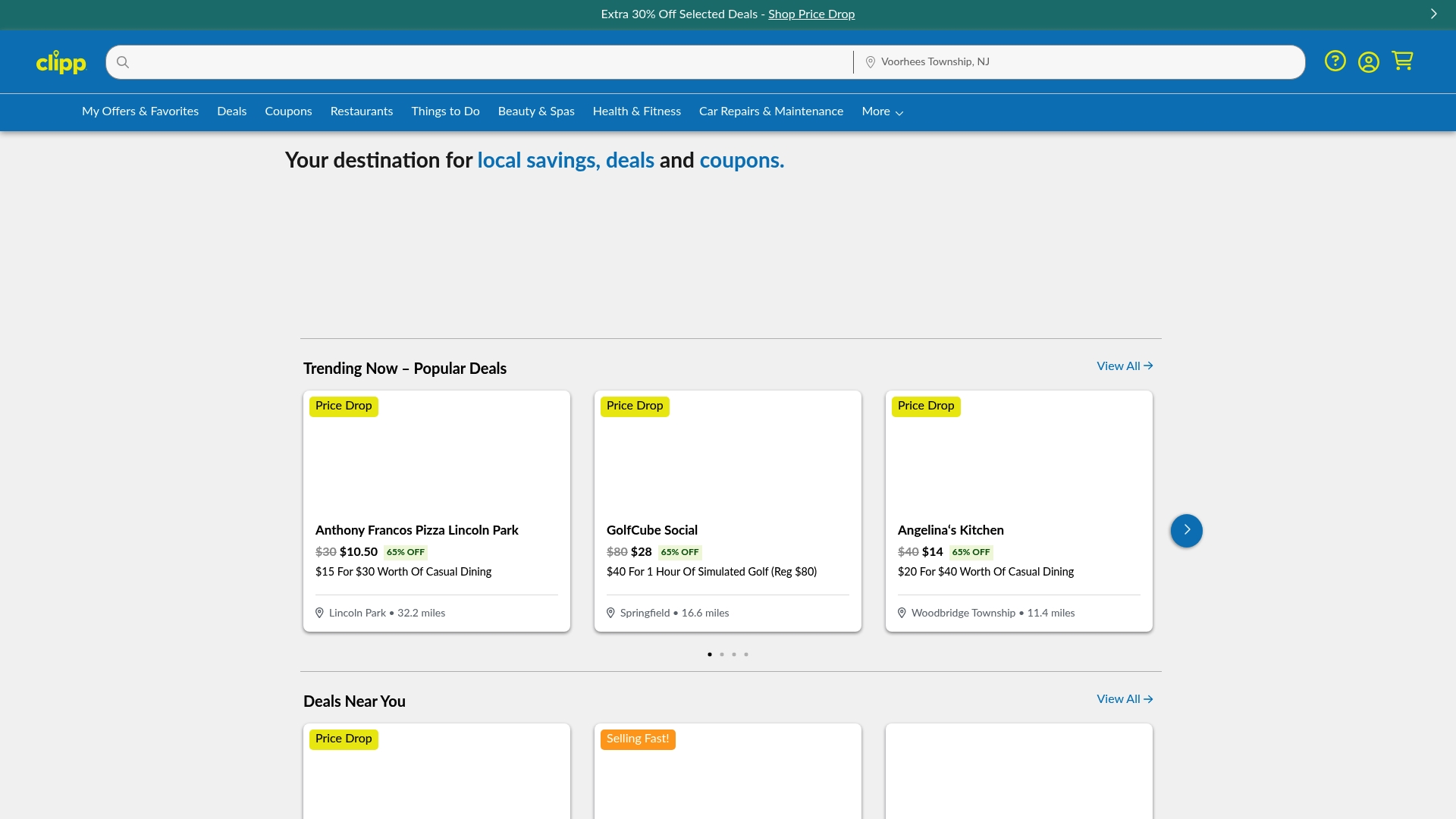
Clipp is a local deals and coupon platform that connects cost-conscious customers with businesses offering limited-time promotions across dining, wellness, home improvement, and more. Listing a price drop promotion on Clipp puts it in front of an audience that is actively searching for savings in your category, not passively scrolling past an ad. For local service businesses, that intent-driven audience is far more valuable than broad reach. Clipp also highlights fast-selling and trending deals, which adds urgency to your promotion without any extra effort on your part. If you are ready to reach buyers who are already looking, browse local deals to see how businesses in your area are structuring their promotions right now.
FAQ
What is the definition of a price drop promotion?
A price drop promotion is a temporary, time-bound reduction from a product's list price designed to achieve a specific business outcome, such as increased sales volume or inventory clearance. The price reverts to its original level when the promotion ends.
How is a price drop promotion different from a markdown?
A price drop promotion is temporary and price-reverting, while a markdown is typically a permanent or semi-permanent reduction applied to slow-moving inventory. Markdowns rarely revert; promotions always should.
What triggers should I use to start a price drop promotion?
Effective triggers include a set number of days on shelf, a sell-through rate falling below a defined threshold, or a seasonal calendar event. Defining triggers before launch removes reactive decision-making from the process.
How do I avoid losing money on a price drop promotion?
Calculate your breakeven cost by adding COGS, holding costs, and fulfillment costs, then set a margin floor above that number. Never discount below your margin floor, regardless of how much inventory remains.
What metrics measure a successful price drop promotion?
The five core metrics are sales volume lift, margin impact, inventory turnover rate, customer acquisition count, and post-promotion retention rate. Set targets for each metric before the promotion launches to evaluate results objectively.