

TL;DR:
- Understanding how local savings programs work and their mechanics allows you to significantly reduce your weekly expenses on food, entertainment, and services.
- By evaluating programs based on discount size, ease of redemption, merchant participation, and transparent terms, you can prioritize those that offer genuine value and convenience.
- Layering multiple deals, registering early, and using combined discounts effectively maximize savings, making neighborhood discounts a powerful financial tool.
Finding real savings in your own neighborhood should be simple, but the sheer number of apps, cards, memberships, and coupon books out there makes it feel anything but. One offer promises 20% off, another requires three steps at checkout, and a third turns out to apply only to locations three towns away. The good news is that once you understand how local savings programs actually work, which ones deliver genuine value, and how to combine them smartly, you can cut meaningful dollars from your weekly spending on food, fun, and everyday services without any guesswork.
Table of Contents
- How to evaluate local savings programs
- Top local savings options you should try
- Comparing local dining and service deals: Which offer the best value?
- Insider strategies to maximize your local savings
- When local discounts don't work like you expect
- Why stacking local savings is the future (and what most people miss)
- Ready to start saving locally? Discover top deals near you
- Frequently asked questions
Key Takeaways
| Point | Details |
|---|---|
| Prioritize real discounts | Choose programs that offer meaningful savings and easy redemption for the best results. |
| Stack offers smartly | Combining apps, coupons, and rewards can multiply your local savings if platform terms permit. |
| Know the deal details | Always check a deal’s restrictions, merchant participation, and setup steps to avoid missing discounts. |
| Actively use your programs | Register cards and accounts early, and regularly check for new deals to maximize value. |
| Not all offers change habits | Some savings may not alter your routine—focus on options that truly fit your daily life. |
How to evaluate local savings programs
To start saving, first know what to look for in a great program.
Not every discount is created equal. Some programs hand you real money off your bill, while others bury the savings under so many conditions that you barely notice a difference. Before signing up for anything, it pays to measure each option against a short checklist of criteria.
What makes a local savings program worth your time:
- Discount size. A 5% discount rarely changes your spending habits. Look for programs that consistently offer 15% or more on categories you already buy.
- Ease of redemption. If using a deal requires printing a page, remembering a code, or hunting for a manager, you will skip it most of the time. The best programs work in seconds.
- Merchant participation. A huge list of brands means nothing if your favorite neighborhood spots are missing. Check whether the restaurants, gyms, or salons you actually use are included.
- Account setup requirements. Some platforms require nothing more than a download. Others ask you to link a credit card, verify your employer, or wait for approval. Know what you are committing to upfront.
- Transparent terms. If the fine print is longer than the deal description, that is a red flag.
Programs deliver savings through one of three basic mechanics. As university discount programs illustrate, some simply ask you to present a membership ID at the counter. Others use barcode technology or a registered payment card that triggers the discount automatically at checkout. A third type involves purchasing a time-limited coupon or experience in advance, then scheduling your visit and redeeming a voucher. Each has its strengths, but the instant redemption model wins for everyday convenience.
Pro Tip: Stick with platforms that list their participating merchants publicly before you sign up. If you have to create an account just to see the deals, you may end up locked into something that does not serve you.
For a clearer picture of the full landscape, the guide on types of local deals breaks down the major categories and what to expect from each.
Top local savings options you should try
Now that you know how to judge a program, here are the main types of local savings to explore.
The market for local discounts has grown significantly, and today's consumers have more options than ever. The challenge is choosing the right mix rather than chasing every opportunity.
The main categories worth exploring:
- App-based discount platforms connect you with nearby restaurants, salons, gyms, and service providers through your smartphone. Deals update frequently, and many let you redeem with a single tap.
- Membership and ID-based savings are tied to a community institution, employer, or club. As research on savings anchoring shows, institution-based programs may have narrower eligibility but often deliver stronger merchant alignment within a local community, while employer-based networks can scale more broadly with standardized checkout mechanics.
- Time-limited coupons and experiences give you a set discount window. These work best for planned outings rather than spontaneous spending.
- Cashback and card-linked rewards run quietly in the background once you register. You spend as usual and collect savings automatically.
How to pick the right combination:
- Start with one app-based platform that covers your most-used dining and service categories.
- Check whether your employer, university, or credit union offers any member savings perks you are not currently using.
- Add a cashback or card-linked program to capture rewards on purchases you would make anyway.
- Use time-limited coupons selectively for planned dinners out, fitness sessions, or entertainment.
Dining is one of the fastest ways to recover value. Learning how to get restaurant coupons is a smart starting point since food spending is consistent and the discounts tend to be substantial. Pairing that with local savings apps gives you mobile access to deals on demand.
Pro Tip: When you can layer an app coupon with a card-linked cashback offer at the same restaurant, you essentially stack two separate discounts. Many platforms allow this and it is the single fastest way to increase your effective savings rate.

A broader look at saving on dining and fun covers entertainment and services categories beyond food if you want to extend your savings routine. Interestingly, restaurants themselves benefit too, since restaurant brand awareness research shows that coupon-driven traffic consistently converts first-time visitors into loyal regulars.
Comparing local dining and service deals: Which offer the best value?
With the main types covered, let's compare their value side by side so you can pick your best bets.
Dining consistently ranks as the strongest category for local discount programs. The numbers support this clearly.
| Category | Typical discount range | Common restrictions | Redemption method |
|---|---|---|---|
| Dining | 15% to 40%+ | Dine-in only at some locations | App, barcode, or voucher |
| Entertainment | 10% to 30% | Advance booking often required | Voucher or scheduled ticket |
| Wellness/fitness | 10% to 25% | New customers only, time-limited | App or membership card |
| Home services | 10% to 20% | Single-use, often seasonal | Printed or digital coupon |
| Grocery/retail | 5% to 15% | Specific SKUs or brands only | Card-linked or loyalty app |
Dining discounts "ranging from 15% to over 40%" represent a meaningfully higher savings floor than most other local categories. That means even a modest dining habit of eating out twice a week can generate hundreds of dollars in real savings annually.
"Not all discounts are equal. A 30% off dining deal you use every Friday is worth far more than a 40% off spa offer you redeem once a year."
Entertainment and wellness deals can be compelling, but they tend to carry more restrictions. Many fitness and spa promotions apply only to new customers, which limits their long-term value. Home service coupons are often seasonal and single-use, making them useful but not a core savings strategy.
What to look for when comparing deals:
- Prefer programs where the discount applies automatically rather than requiring a separate voucher presentation.
- Check whether takeout and delivery qualify, since some dining deals now extend beyond dine-in.
- Prioritize flexibility. Platforms that allow direct app booking for dining or entertainment are more likely to be used consistently.
The guides on restaurant coupon types and top 5 dining coupons go deeper on specific deal structures worth targeting. If you want to find active offers right now, the roundup of restaurant coupons near me is a practical place to start.
Insider strategies to maximize your local savings
Knowing who offers what is powerful, but real savings come from the right strategies and insider know-how.
Understanding the full range of programs is only half the battle. The other half is using them in the right sequence and with the right habits in place.
Step-by-step approach to getting the most out of every program:
- Register accounts before you need them. Set up your dining rewards and card-linked accounts on a slow Tuesday, not five minutes before sitting down to order. Established reward programs typically require you to link a credit card at registration, then earn points automatically when you pay at participating restaurants using that same card. Takeout and delivery often count too.
- Use your registered payment method every time. This sounds obvious but it is the most commonly missed step. Paying with a non-linked card means walking away from rewards you already qualified for.
- Stack when the terms allow. Use your coupon platform deal first, then pay with your linked rewards card. Two separate savings running simultaneously is entirely legitimate on most platforms.
- Confirm eligibility before you go. Call ahead or check the app to verify the location you plan to visit still participates. Franchise locations sometimes opt out even when the parent brand is listed.
"The highest-value strategy is not finding the single best deal. It is using three modest deals simultaneously that all apply to the same purchase."
One important caveat worth knowing: research from the Federal Reserve Bank of Atlanta found that cash discounts were received by only 4.8% of in-person cash payments, and critically, these discounts did not change the likelihood that card-preferring consumers would switch to cash. In short, a discount only changes behavior when it fits naturally into how you already pay. Pick programs that work with your current payment habits rather than against them.
Pro Tip: If you prefer paying by credit card, prioritize card-linked programs over cash-back cash incentives. You will actually use them, and consistent use is what builds real savings over time.
The guide on coupon platforms for savings breaks down how to pick the right platform based on your spending patterns. For families in particular, the article on dining coupon examples shows how the right deal structure can lower a family dinner bill significantly. Smart merchants use customer retention strategies that often include deal programs specifically designed to reward returning visitors.
When local discounts don't work like you expect
No savings strategy is perfect. Here's how you can spot the landmines and make smarter decisions.
Even the best programs can disappoint if you go in without realistic expectations. Understanding why discounts sometimes fail to deliver helps you avoid wasted effort and frustration.
Common reasons a deal falls short:
- User inertia. The Atlanta Fed research is clear on this point. Cash discounts applied at 4.8% of in-person cash payments rarely shifted card-preferring consumers to use cash. If a deal requires you to change a deeply ingrained habit, you probably will not use it enough to matter.
- Merchant exceptions. A program may list a restaurant chain, but individual franchise owners can opt out. Always verify participation for your specific location.
- Complex restrictions. Some deals exclude certain days, menu categories, or minimum spending thresholds. A "$10 off" offer that only applies to orders over $60 with dine-in on weekdays is far less useful than it first appears.
- Overestimated savings. A 10% discount at a moderately priced restaurant might save you $3 on a typical visit. That is better than nothing, but it is not a meaningful change to your monthly budget unless you dine there often.
"A deal you cannot actually use is worth exactly zero, no matter how impressive the stated percentage looks."
The solution is not to give up on discount programs entirely. It is to be selective. Read the terms before committing, favor programs that match your lifestyle, and combine offers from multiple sources to turn modest individual discounts into genuinely significant savings. Restaurants and service businesses that build smart event and marketing strategies around deal programs often structure offers that are easier to redeem, making them the better bet.
Why stacking local savings is the future (and what most people miss)
Let's step back for a moment and rethink what truly adds up when it comes to local savings.
Most people pick one savings app, use it occasionally, and feel like they are doing enough. They are leaving real money behind. The honest truth is that a single discount source almost never represents your best possible outcome. The consumers who consistently save the most are the ones who treat their savings approach as a layered system rather than a single tool.
Think of it like this: a loyalty program earns you 2% back, a coupon cuts 20% off the bill, and your linked rewards card adds another 1.5%. Used together on a $50 dinner, you might recover $12 or more from a meal you were going to buy anyway. Used separately or only one at a time, each of those programs feels modest. Together, they change your financial picture over a year.
The objection most people raise is that managing multiple programs sounds exhausting. But the reality is that once your accounts are registered and your card is linked, most of the heavy lifting is automatic. The only active effort is picking the right app coupon before you sit down to order, which takes about thirty seconds.
The other thing most people miss is that terms change. A platform that banned stacking last year may have updated its policy. Merchants that were excluded may have joined. Checking in regularly, even briefly, keeps your savings strategy current. Exploring the full range of local deals available periodically ensures you are not missing newer, better options that have appeared since you last looked.
Double-dipping is not always permitted, and some platforms do explicitly prohibit combining offers. But in practice, many card-linked rewards programs run independently of coupon platforms and operate in parallel without any conflict. The key is reading terms once carefully, then letting the system run.
Ready to start saving locally? Discover top deals near you
To put these strategies to use, it helps to know where to start. Here's how to find the best local savings now.
Clipp.com is built for exactly this purpose: connecting you with real, redeemable deals for dining, entertainment, and services in your neighborhood, all in one place. You can browse Ashburn coupons to find active offers near you right now, or check Ashburn services deals if you are looking for savings on salons, fitness, home care, and more.
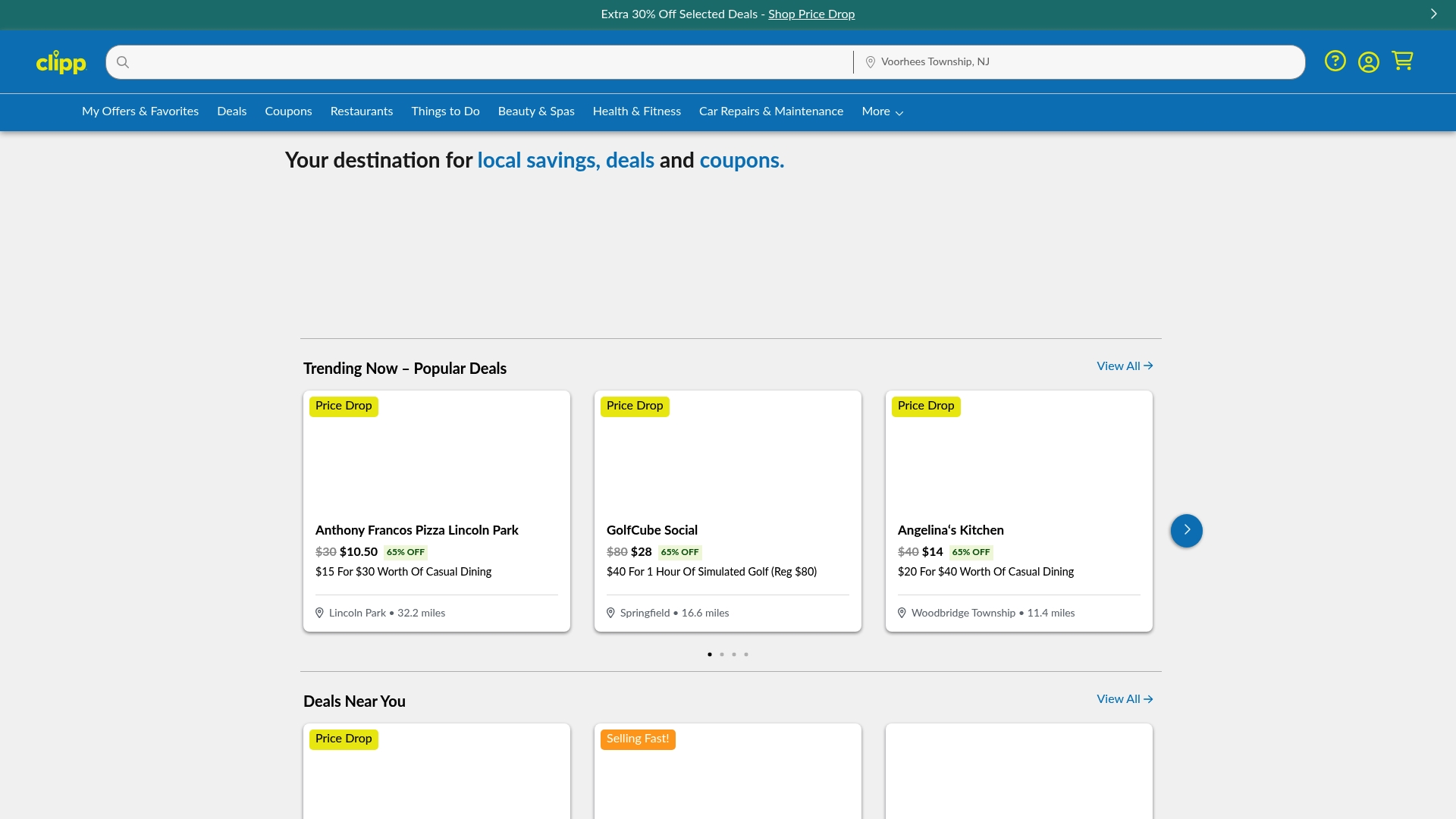
The platform is designed for mobile use, which means you can pull up a deal seconds before you walk through a restaurant door or book a service appointment. Trending offers are surfaced automatically so you never have to dig. If you want a full view of what is available across all categories, the Ashburn deals page gives you everything in one spot. Dining, fun, wellness, and local services are all there, ready to save you money starting today.
Frequently asked questions
How do I find active local savings programs in my area?
Look for local coupon apps, check community institutions like universities or employers, and browse platforms focused on your location for frequently updated discounts. Filtering by category and distance helps you surface relevant offers quickly.
Are restaurant discounts better than service coupons?
Dining deals often deliver the deepest savings, with discounts ranging from 15% to over 40%, but the best value always depends on how often you use the service and whether the specific merchant you prefer participates.
Why do some savings programs require linking a payment card?
Linking a card automates your rewards so you earn points or discounts without having to remember a coupon every time. Established programs use this model because it increases consistent usage and eliminates redemption friction at checkout.
Can I use multiple discounts for bigger savings?
In many cases, yes. Combining a card-linked offer with an app coupon at the same restaurant can meaningfully increase your total savings, but always check each platform's terms first since some explicitly restrict combining offers.
What happens if the discount isn't applied at checkout?
Registration steps, wrong payment methods, or merchant opt-outs are the most common culprits. Federal Reserve research confirms that discount mechanics at the point of sale can fail to trigger under certain conditions, so verifying merchant participation and confirming your registered payment method before ordering prevents most issues.