

TL;DR:
- Online coupon listings quickly increase local foot traffic by targeting deal seekers on popular platforms.
- Preparing clear goals, compelling offers, and assets is essential for successful coupon marketing across channels.
- Consistent, timed distribution across multiple platforms with proper tracking drives measurable customer acquisition results.
Getting new customers through your door is one of the hardest parts of running a local business. Paid ads are expensive, word-of-mouth is slow, and standing out in a crowded neighborhood feels nearly impossible some days. Online coupon listings change that equation fast. When you place a well-crafted offer on the right platforms, you show up exactly where deal seekers are already looking. This guide walks you through the tools, step-by-step processes, and critical mistakes to sidestep so your coupons actually drive foot traffic and measurable results.
Table of Contents
- What to prepare before listing your business coupons
- Step-by-step: List coupons on Google Business Profile
- Promote coupons via Facebook and social platforms
- Broaden exposure with coupon aggregators and multi-channel strategy
- Troubleshooting, measuring results, and optimizing your coupon strategy
- Our take: Common pitfalls and what actually drives results
- Ready to get more customers? Start listing with Clipp
- Frequently asked questions
Key Takeaways
| Point | Details |
|---|---|
| Checklist matters | Having strong offer details, images, and the right channels is key to coupon success. |
| Google and Facebook first | Start with Google Business Profile and Facebook for fastest, widest local coupon reach. |
| Don't forget aggregators | Listing on sites like 8coupons expands your audience without extra work. |
| Track and optimize | Monitor redemptions and tweak your offers to maximize ROI each time. |
What to prepare before listing your business coupons
Now that you recognize the value of coupon listings, let's cover the essentials you'll need before starting the process.
The first step is knowing why you're running a coupon. Are you trying to pull in first-time customers, reward loyal regulars, or push traffic during a slow season? Your goal shapes everything from the discount size to the redemption window. Picking the wrong objective wastes money and attracts the wrong crowd.
Next, nail down your discount type. The most common options are:
- Percentage off (e.g., 20% off your first visit)
- Fixed dollar amount (e.g., $10 off orders over $40)
- Buy-one-get-one (BOGO)
- Free item with purchase
- Bundle deal (two services for one price)
Not every format fits every business. A salon might do well with a BOGO blow-dry, while a restaurant benefits more from a fixed-dollar dinner discount. For a deeper breakdown, restaurant coupon types offers useful comparisons by business model.
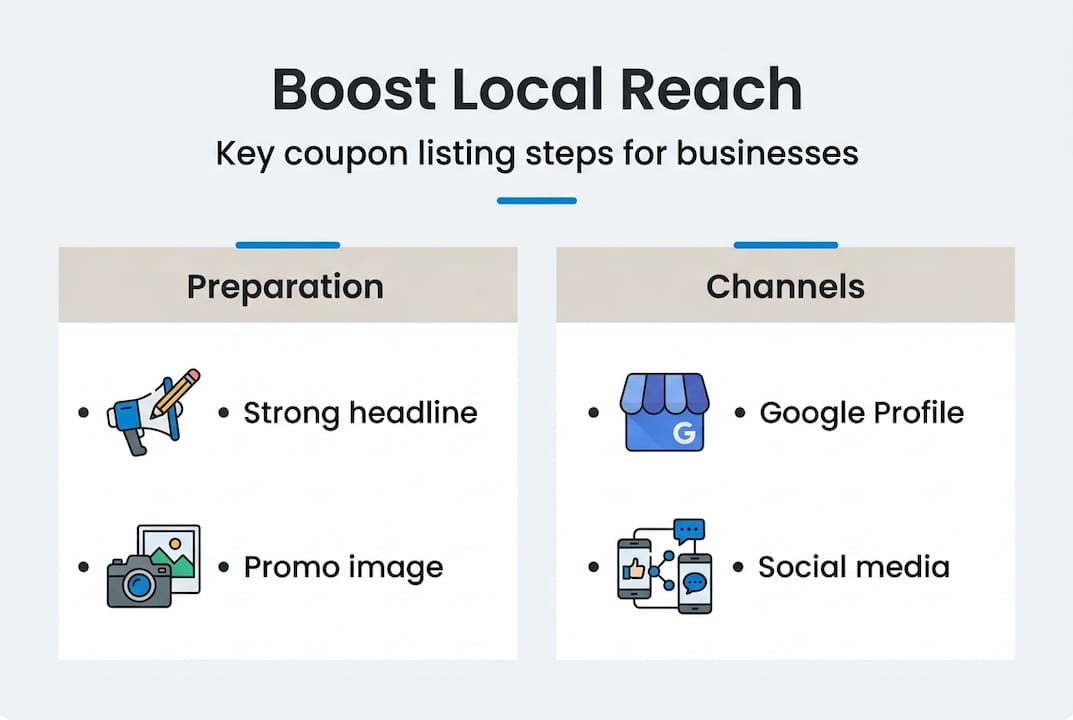
Once you've chosen your offer, gather these assets before you open a single platform:
| Asset | Details needed |
|---|---|
| Offer headline | Short, benefit-driven (under 60 characters) |
| Promo image | High-resolution, platform-specific dimensions |
| Coupon code | Unique, easy to type or scan |
| Start and end dates | Create urgency with a tight window |
| Fine print | Exclusions, limits, and redemption rules |
Finally, choose your platforms.
appear directly in local search results, making them one of the highest-visibility free options available. Facebook, email newsletters, coupon aggregators, and your own website each serve different audience segments. A solid coupon marketing guide can help you decide which mix fits your budget and goals.Pro Tip: Always read each platform's image size requirements before uploading. A blurry or cropped image kills trust and reduces click-through rates instantly.
Step-by-step: List coupons on Google Business Profile
With your assets ready, here's exactly how to get your offer live on Google Business Profile for local visibility.
Google Business Profile (GBP) is arguably the most powerful free tool for local coupon visibility. Your offer shows up when someone searches for your business or nearby services, which means zero wasted impressions. Here's how to create one:
- Log into your GBP dashboard at business.google.com.
- Click "Add update" or navigate to the Posts tab.
- Select "Add Offer" from the post type options.
- Fill in the offer headline. Keep it punchy: "20% off this weekend only" beats "Special promotional discount offer."
- Add discount details in the description field: what's included, how to redeem, and any exclusions.
- Set start and end dates. Shorter windows (3-7 days) tend to drive faster action.
- Upload your promo image. Use a 1200x900px photo showing the actual product or service.
- Add a redemption link or coupon code so customers know exactly what to do.
- Select a CTA button ("Get offer," "Learn more," or "Order online").
- Click Publish and review your live post within 1-4 hours.
According to GBP flash sale visibility data, offers on established profiles become visible in search within 1 to 4 hours. New or incomplete profiles may take longer or get flagged.
The most common mistake businesses make on GBP offers is skipping the fine print. If customers show up and your staff doesn't know the terms, you lose the sale and the review.
Check your GBP Insights weekly after posting. You'll see impressions, clicks, and CTA actions, which tells you whether your headline or image needs adjusting. Strong coupon strategies often come down to testing one variable at a time.

Pro Tip: Schedule your GBP offer to launch Thursday morning. Research shows consumer deal activity peaks Thursday through Sunday, meaning your offer gets maximum eyes during peak buying hours.
Promote coupons via Facebook and social platforms
Beyond Google, social and deal-hunting users discover coupons on platforms like Facebook. Here's how to maximize your reach.
Facebook remains one of the most cost-effective ways to put a coupon in front of a targeted local audience. You can create Facebook coupon promotions in several formats including percentage off, fixed amount off, free shipping, or custom promo codes attached to boosted posts or organic offers.
Here's how to set up a Facebook Offer through Ads Manager:
- Open Ads Manager and click "Create."
- Choose "Engagement" as your campaign objective.
- At the ad set level, select "Offer" as the ad type.
- Set your audience using location targeting (choose your city or a radius around your address).
- Upload your offer image and write a headline under 40 characters.
- Enter the discount details, expiration date, and promo code or URL.
- Set a daily budget (even $5-$10/day works for hyper-local campaigns).
- Review and publish. Ads typically go live within minutes after approval.
Here's a quick comparison of Facebook coupon formats:
| Format | Best for | Cost |
|---|---|---|
| Boosted post with code | Quick reach, brand awareness | Low |
| Facebook Offer (Ads Manager) | Trackable redemptions | Medium |
| Story with swipe-up code | Younger, mobile-first audience | Low |
| Giveaway/contest post | Building followers and buzz | Low |
For restaurant coupon promotion, contests work especially well. Ask followers to tag a friend for a chance to win a free meal, and you'll organically multiply your reach without raising your ad spend.
Track performance inside Facebook's native analytics. Look at offer claims, link clicks, and reach. If claims are low but reach is high, your offer isn't compelling enough. If reach is low, your budget or targeting needs work.
Broaden exposure with coupon aggregators and multi-channel strategy
To amplify the results of your coupon posts, it's smart to reach beyond your own audience and connect with new customers through more channels.
Coupon aggregators are websites that collect deals from many businesses in one place, so deal seekers can find you without ever searching your business by name. That's new customer discovery you didn't earn through ads or SEO. The 8coupons platform is one example: 8coupons aggregates listings through partners like Yext, meaning your special offers can appear there simply by keeping your business profiles complete and accurate.
To get listed on aggregators, you have three main paths:
- Direct submission to platforms that accept merchant applications
- Listing management tools like Yext, which push your offer data to dozens of directories at once
- Managed coupon services that handle distribution for a flat fee
The biggest risk with aggregators is letting offers go stale. An expired coupon that still appears online damages trust and creates angry customers. Review your listings monthly and pull outdated offers immediately.
For a broader digital coupon tips approach, use a multi-channel distribution checklist:
- Sync your GBP offer with your email newsletter launch date
- Add a website banner linking to the same landing page
- Post the deal to your social accounts on the same day
- Print a QR code for in-store signage that links to the online offer
- Explore coupon aggregator alternatives if major platforms don't fit your niche
Pro Tip: Use UTM parameters (tracking tags added to your URLs) on every coupon link. This lets Google Analytics show you exactly which channel drove the most redemptions, so you know where to invest next time.
| Channel | Effort level | Audience type |
|---|---|---|
| Google Business Profile | Low | High-intent local searchers |
| Facebook Offers | Medium | Social browsers, deal seekers |
| Email newsletter | Low | Loyal existing customers |
| Coupon aggregators | Low to medium | New, deal-motivated shoppers |
| In-store QR code | Very low | Walk-in traffic |
Troubleshooting, measuring results, and optimizing your coupon strategy
Once your coupons are live across channels, the real work begins: making sure they're working and getting better each time.
Measuring coupon performance is simpler than most business owners think. Start with three core numbers: redemption rate (how many people used it), cost per acquisition (what you spent to get each new customer), and average order value from coupon users versus non-coupon customers. If any number looks off, you have a clear signal of where to fix things.
Here's a numbered troubleshooting checklist for the most common coupon issues:
- Coupon not appearing on Google: Check that your GBP profile is fully verified and that the post didn't violate content policies.
- Low redemption rate: Your offer may not be compelling enough. Test a stronger discount or a tighter expiration date.
- Staff not honoring the deal: Distribute written redemption rules to every team member before the campaign launches.
- Expired codes still circulating: Audit all platforms monthly and deactivate old codes immediately.
- No way to track which channel worked: Add unique codes per platform (e.g., GOOG20 for Google, FB20 for Facebook) to isolate performance.
- Duplicate listings with conflicting terms: Use a listing management tool to keep all platforms synced.
For broader exposure without direct daily management, syncing offers across aggregators like 8coupons alongside your social and email channels keeps your reach wide without multiplying your workload.
A/B test one element per campaign cycle. Change only the headline, or only the discount amount, never both at once. That's how you build real knowledge about what your specific customers respond to.
Review results after every campaign and document what changed. Over three or four cycles, patterns emerge. You'll notice certain offer types outperform others, certain days drive more redemptions, and certain channels consistently deliver cheaper acquisitions. Use those patterns to inform your local coupon strategies going forward.
Our take: Common pitfalls and what actually drives results
With plenty of tactical options available, here's what our experience and industry results reveal about what actually works.
The biggest mistake we see is channel dependency. A business posts one offer on Facebook, gets mediocre results, and concludes that coupons don't work for them. In reality, the offer was fine. The reach was just too narrow. Businesses that consistently grow through coupon marketing treat it like a system, not a one-off experiment.
Weak discounts are the second failure point. A 5% off coupon doesn't excite anyone. Customers need to feel the deal is genuinely worth their effort to redeem it. That means 20% or more for most service businesses, or a compelling BOGO that feels like a real win.
What actually drives results is simple: a strong, time-limited offer distributed across at least three channels, tracked rigorously, and refined each quarter. Our advice is to focus on one strategic offer per quarter rather than scattering weak promotions constantly. Maximize distribution using Google, Facebook, email, and aggregators simultaneously. Then review the data honestly and double down on the channel and format that outperformed. For businesses ready to go deeper, detailed coupon marketing approaches cover advanced segmentation and offer sequencing that scale this system further.
Ready to get more customers? Start listing with Clipp
If you're eager to put these strategies into action, here's how Clipp can help power your next successful offer.
Clipp makes it straightforward for local businesses to list coupons and get discovered by customers already searching for deals in their area. You don't need a marketing team or a big budget to get started.
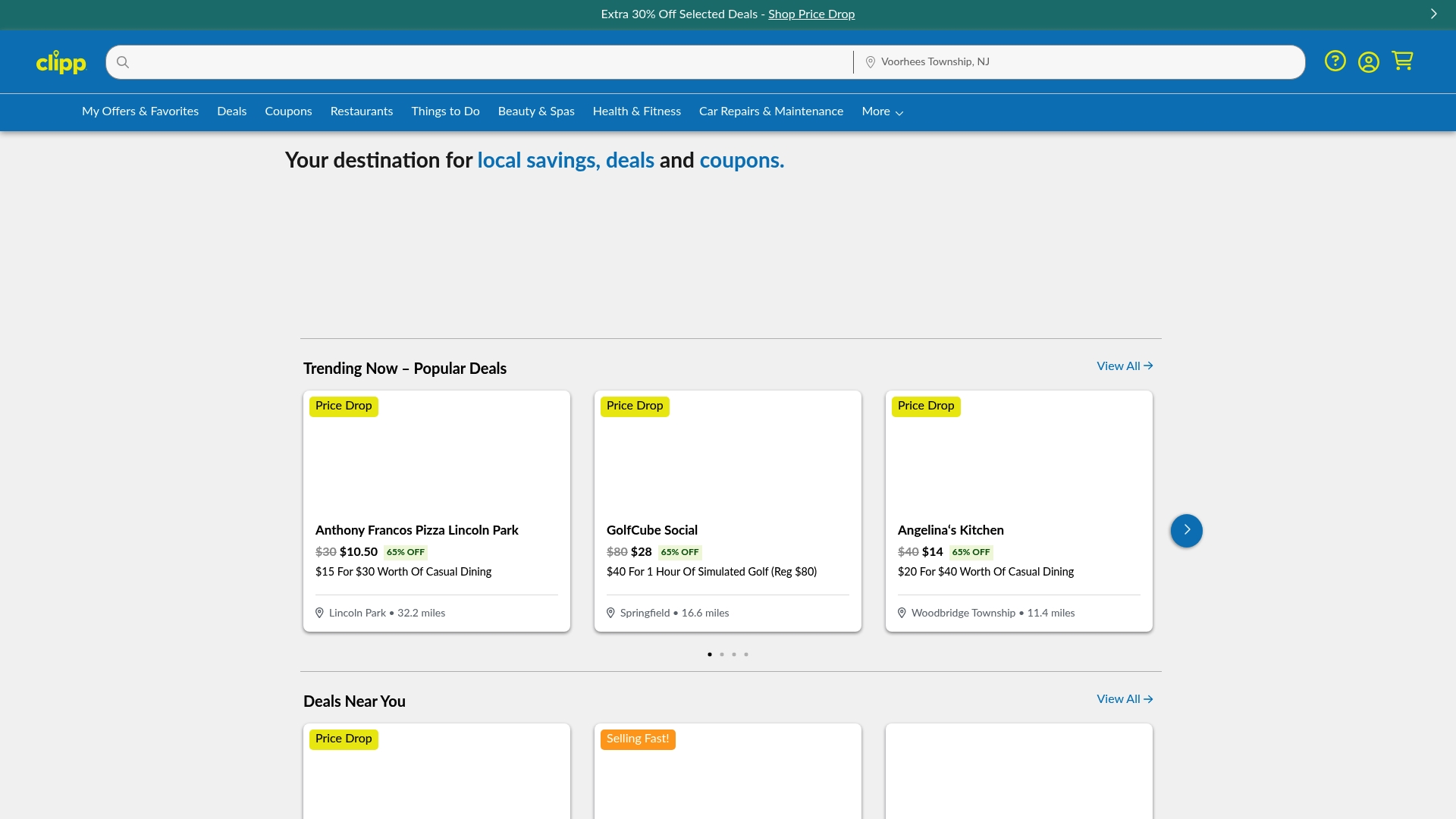
Whether you run a salon in Dallas or a gym in Austin, local savings in Texas shows how businesses near you are already driving traffic with targeted promotions. Create a compelling deal, set your dates, and track every redemption from one place. Customers browsing Clipp are deal-motivated and ready to act. And with Clipp mobile solutions, your offers reach shoppers on the go, right when they're deciding where to spend. List your deal today and give your local foot traffic a real boost.
Frequently asked questions
Where do business coupons appear when listed on Google?
Coupons on Google Business Profile show in local search results and on Maps, making them visible to nearby customers actively searching for services like yours.
How long does a coupon take to go live on Google or Facebook?
GBP offers go live within 1 to 4 hours for established profiles; on Facebook, boosted coupons can appear almost instantly after ad approval.
Can I use the same coupon code across multiple platforms?
Yes, but use platform-specific codes when possible so you can track which channel drives the most redemptions, as multi-channel syncing works best with clear attribution.
What are the most effective coupon types for attracting new customers?
Short-term discounts of 20% or more, BOGO offers, and exclusive social deals consistently outperform small percentage discounts for first-time customer acquisition.
Recommended
- Advertising Inquiries
- Local coupon marketing guide: attract customers and save big
- Proven coupon strategies: save more on local deals
- Why use coupon platforms? Boost local savings fast
- Référencement local sur wordpress : stratégies gagnantes pour booster votre visibilité locale - The First Blossom Marketing digital