

The best coupons.com alternatives for neighborhood shoppers combine local-first listings, real-time code verification, and cashback in one workflow. Start with a local voucher marketplace, layer in a community-vetted deal board for social proof, then add a cashback or browser-extension tool to capture every discount layer on a single purchase.
Here's the short version:
- Local voucher marketplaces (Clipp): Curated deals for restaurants, salons, gyms, and neighborhood services with a "Near You" filter built for in-person redemption.
- Community-vetted deal boards: User votes and comments validate whether a deal actually works before you drive across town.
- Cashback portals: Earn a percentage back on purchases at partner retailers; best for online shopping and some in-store chains.
- Browser-extension code checkers: Auto-test promo codes at checkout; strongest for e-commerce, weaker for local service deals.
- Daily-deal marketplaces: Discounted vouchers for experiences, dining, and services; good for planned outings, less useful for spontaneous neighborhood errands.
Table of Contents
- How do the best coupons.com alternatives compare?
- What does each alternative category actually offer?
- How do you pick the right coupon site for your neighborhood?
- How to use coupon sites without wasting time
- How we picked and compared these alternatives
- What do cashback sites actually cost, and when do you get paid?
- How does the user experience differ across platforms?
- What kind of support do these platforms offer?
- Do community features actually help you save more?
- How often do deals and codes get updated?
- Key Takeaways
- Why local-first platforms change how you actually save
- Clipp puts local deals where you actually shop
- Further reading and sources
How do the best coupons.com alternatives compare?
| Category | Best for | Types of savings | Code freshness | Local coverage | Ease of use | Fees/payout | Trust signals |
|---|---|---|---|---|---|---|---|
| Local voucher marketplace (Clipp) | Restaurant, salon, service deals | Printable, in-store voucher, online code | Merchant-verified, curated | Strong: neighborhood-first | App + website | Free to use | Merchant partnerships, curated listings |
| Community-vetted deal boards | Online codes, community-sourced deals | Online promo codes, some in-store | User-reported freshness | Moderate: national skew | Website, app | Free | Community votes, comments |
| Cashback portals | Online retail, some in-store chains | Cashback, rebate | Portal-verified | Low: mostly national chains | Website, browser extension | Free; payout minimums apply | Merchant partnerships, payout history |
| Browser-extension code checkers | E-commerce checkout | Online promo codes | Real-time auto-test | Low: online-only | Browser extension | Free | Automated verification |
| Daily-deal marketplaces | Experiences, dining, services | Discounted vouchers | Merchant-set expiry | Moderate: city-level | App + website | Free to buy; refund policies vary | Merchant ratings, user reviews |
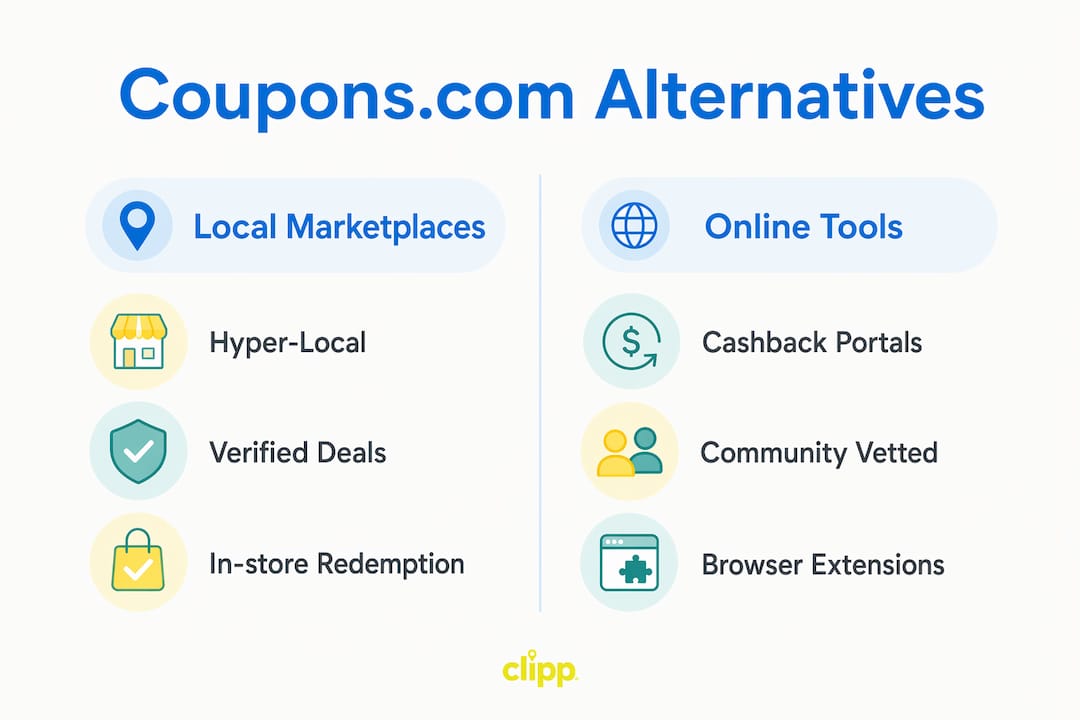
Best pick for local deals: Local voucher marketplaces, specifically Clipp, because they index neighborhood merchants directly and filter by your location. Community-vetted deal boards add social proof that's especially useful for service deals, but their local coverage is thinner. Browser extensions are excellent for online checkout codes and nearly useless for the salon around the corner.
What does each alternative category actually offer?
Clipp: the local-first option
Clipp is built specifically for neighborhood shoppers. Its "Near You" and "Trending Deals" sections surface restaurant vouchers, salon discounts, gym memberships, pet care, and home services within your ZIP code. Deals are curated through merchant partnerships rather than scraped from the open web, which keeps listings fresher and more reliable than generic aggregators. You can browse on the website or through the mobile app and redeem most offers in-store.

Pros: Hyper-local coverage; merchant-verified deals; easy in-store redemption. Con: Inventory varies by city; smaller markets may have fewer listings than major metros. Best use case: Same-day restaurant or salon deal in your neighborhood.
Community-vetted deal boards
These platforms let users upvote, comment on, and flag deals. The community layer is genuinely useful: user votes and comments help you know whether a code still works before you waste time at checkout. Coverage skews toward national retailers and online codes rather than local services.
Pros: Real-time social validation; broad code library; active user base. Con: Thin local service coverage; quality depends on community activity in your area. Best use case: Verifying a promo code for a national retailer before buying online.
Cashback portals
Cashback portals pay you a percentage of your purchase back after you shop through their link. They work best for online retail and some in-store chains. Minimum payout thresholds and processing delays (sometimes weeks) are the main friction points. NerdWallet's roundup highlights these for grocery rebates and online shopping; local service coverage is limited.
Pros: Passive earnings on purchases you'd make anyway; wide retailer network. Con: Payout minimums and delays; weak local service coverage. Best use case: Online retail purchases at major chains where cashback rates are highest.
Browser-extension code checkers
These auto-apply promo codes at checkout without any manual searching. They're the lowest-effort tool for online shopping. The tradeoff: they do nothing for in-store or service-based deals, and they occasionally surface expired codes that fail at the last second.
Pros: Zero effort at checkout; real-time code testing. Con: Online-only; can slow checkout pages; no local service coverage. Best use case: E-commerce purchases where you want automatic code testing.
Daily-deal marketplaces
These sell discounted vouchers for dining, entertainment, and local experiences at city-level scale. They're useful for planned outings but less practical for spontaneous neighborhood errands. Refund policies and voucher expiry dates vary by merchant, so read the fine print.
Pros: Deep discounts on experiences; city-level local coverage. Con: Vouchers expire; refund policies inconsistent; less useful for everyday services. Best use case: Planned dining or entertainment outing in a nearby city.
How do you pick the right coupon site for your neighborhood?
Run through these questions before committing to any platform:
- Do you need local service deals or online codes? If you're looking for a haircut discount or a restaurant voucher, a local voucher marketplace beats a browser extension every time.
- Do you want cashback? Cashback portals are worth adding as a second layer, not a primary tool for neighborhood shopping.
- Do you need real-time code verification? Prioritize platforms that verify code freshness rather than hosting long lists of stale codes.
- Is there a minimum payout before you see your money? Some cashback portals hold earnings until you hit a threshold.
- Does the platform have merchant partnerships near you? Traffic numbers don't equal local coverage; regional merchant partnerships matter more for neighborhood savings.
Red flags to skip past:
- Platforms with no community validation or freshness indicators on codes.
- Cashback portals with opaque payout rules or no stated minimum.
- Sites that list hundreds of codes with no timestamp or verification status.
- Any platform asking for payment card details before showing you deals.
How to use coupon sites without wasting time
Pro Tip: Stack tools in layers: local voucher first, store loyalty second, cashback or extension third. Each layer adds savings the others miss, and the setup takes under two minutes once you know the sequence.
Here's how a typical neighborhood purchase plays out:
- Find the local deal. Open Clipp (or your preferred local voucher marketplace) and search by category or "Near You." Confirm the deal is active and check the expiry date.
- Verify the code or voucher. For online codes, run them through a community-vetted board or browser extension to confirm they work. For in-store vouchers, check the merchant's own page — a quick look at restaurant coupon pages can confirm whether a deal is live.
- Apply loyalty or cashback. If the merchant has a loyalty program, log in before you pay. If a cashback portal covers the merchant, activate the deal there first.
- Redeem in-store or online. Show the voucher on your phone or enter the code at checkout. Keep the confirmation until the transaction clears.
Combining a local voucher with a store loyalty discount and a cashback layer is the highest-yield savings approach available to neighborhood shoppers. Savings strategists consistently find that stacking store-specific loyalty apps with rebate tools produces larger practical savings than any single platform alone.
Safety note: Never enter payment details on a coupon site to "unlock" deals. Legitimate platforms show deals for free. Check that the URL is the platform's official domain before clicking through, and treat any site demanding account creation before showing local listings with skepticism.
How we picked and compared these alternatives
Selection criteria for this shortlist:
- Local coverage: Does the platform surface neighborhood restaurants, salons, gyms, and services, not just national chains?
- Code verification frequency: Does it test or timestamp codes, or just aggregate whatever it finds?
- Community signals: Are there user votes, comments, or ratings that validate deals before redemption?
- App and extension availability: Can you use it on mobile for in-store redemption?
- Fees and payout transparency: Are cashback rules and minimums clearly stated?
- Merchant partnerships: Are deals sourced directly from local businesses?
Primary sources used: publisher roundups from U.S. News and NerdWallet, market-traffic tools like SEMrush for competitive context, community platform data from SaaSHub's alternatives directory, and Clipp's own platform positioning. Regional coverage varies; always check local listings in your ZIP code before relying on any platform's availability claims.
What do cashback sites actually cost, and when do you get paid?
Cashback portals are free to join. The cost is indirect: you shop through their links, they earn a referral commission from the retailer, and they share a portion with you. The practical friction is the payout minimum. Most portals require you to accumulate a set threshold before transferring earnings to PayPal, a bank account, or a gift card. Processing can take days to weeks after a purchase qualifies. Some portals also exclude certain product categories or cap cashback rates on sale items. Read the terms for any portal before assuming a rate applies to your specific purchase.
How does the user experience differ across platforms?
Local voucher marketplaces like Clipp prioritize browsability: category filters, location-based sorting, and visual deal cards make it fast to find something nearby. Community-vetted deal boards are text-heavy and search-driven; they reward users who know what they're looking for. Cashback portals are functional but transactional: you activate a deal, shop, and wait. Browser extensions are nearly invisible until checkout, which is their strength. Daily-deal marketplaces sit somewhere between a marketplace and a magazine, with editorial-style deal curation that's good for discovery but slower for quick neighborhood searches.
Mobile apps matter most for in-store redemption. If you're redeeming a voucher at a restaurant or salon, you need the deal on your phone, not a desktop browser.
What kind of support do these platforms offer?
Support quality varies sharply by platform type. Merchant-partnership platforms like Clipp can escalate disputes directly with the local business. Daily-deal marketplaces typically offer email support and a formal refund request process, though resolution times vary. Community-vetted boards offer little formal support; the community itself flags bad deals. Cashback portals have the most structured dispute processes because money is involved, but response times can stretch to several business days. Browser extensions offer FAQ-based self-service with limited human support. For any platform, document your purchase confirmation before redeeming, especially for vouchers with expiry dates.
Do community features actually help you save more?
Yes, when the community is active. Community votes and comments provide social proof that automated scrapers can't replicate. A code with 200 upvotes and a recent "worked for me" comment is far more trustworthy than a code with no activity timestamp. For local service deals specifically, user reviews tell you whether the merchant honored the voucher without friction. The limitation: community quality depends on user density in your area. A platform with millions of national users may have almost no activity for your specific city or neighborhood.
How often do deals and codes get updated?
Merchant-partnership platforms update when merchants push new offers, which can be daily for active local businesses. Community-vetted boards update continuously as users post and vote. Browser extensions pull codes in real time at checkout. Cashback portals update rates when retailer contracts change, which can happen without notice. Daily-deal marketplaces typically rotate inventory weekly or monthly. The practical takeaway: for local service deals, check the deal's posted date and expiry before you leave the house. For online codes, a browser extension or community board gives you the freshest signal at the moment of purchase. Stale codes are the single biggest source of frustration across all platform types, which is why freshness testing matters more than raw code volume.
Key Takeaways
Local-first platforms like Clipp, combined with a community-vetted deal board and one cashback or extension tool, give neighborhood shoppers the most reliable and complete savings coverage available.
| Point | Details |
|---|---|
| Start local | Use a local voucher marketplace like Clipp to find neighborhood restaurant, salon, and service deals first. |
| Verify before you go | Check code freshness via community boards or browser extensions; stale codes are the top frustration across all platforms. |
| Stack for maximum savings | Combine a local voucher, store loyalty discount, and cashback tool on a single purchase for the highest total savings. |
| Match the tool to the task | Browser extensions work for online checkout; local voucher platforms work for in-store service deals. Using the wrong tool for the job wastes time. |
| Try Clipp for neighborhood deals | Clipp's "Near You" filter and merchant-curated listings make it the most direct route to local service coupons in your ZIP code. |
Why local-first platforms change how you actually save
Most coupon guides treat all platforms as interchangeable. They're not. National code aggregators are built for e-commerce: they scrape thousands of codes, surface the ones with the most traffic, and let you sort through the rest. That works fine when you're buying something online from a major retailer. It fails completely when you want a discount at the Thai place two blocks away.
Local-first platforms operate on a different model. They build merchant relationships directly, which means the deals they surface are real, current, and redeemable in person. That distinction matters most for services: a haircut, a gym class, a pet grooming appointment. You can't apply a browser extension at the front desk.
Consider a common scenario: you want dinner out on a Tuesday night. A national code aggregator shows you nothing useful for local restaurants. A community board might have a chain deal. But a local voucher marketplace shows you three restaurants within a mile, each with a verified discount you can show on your phone. That's the gap local-first platforms fill, and it's why local deals platforms consistently outperform national aggregators for neighborhood shoppers. Pair that with a loyalty card at your favorite spot and a cashback portal if the restaurant participates, and you've stacked three savings layers on one meal. Test Clipp's local deals in your ZIP code and see what's actually available near you.
Clipp puts local deals where you actually shop
If the alternatives above cover the full spectrum of coupon tools, Clipp is the one built specifically for the way neighborhood shoppers actually spend money: in person, at local businesses, on everyday needs.
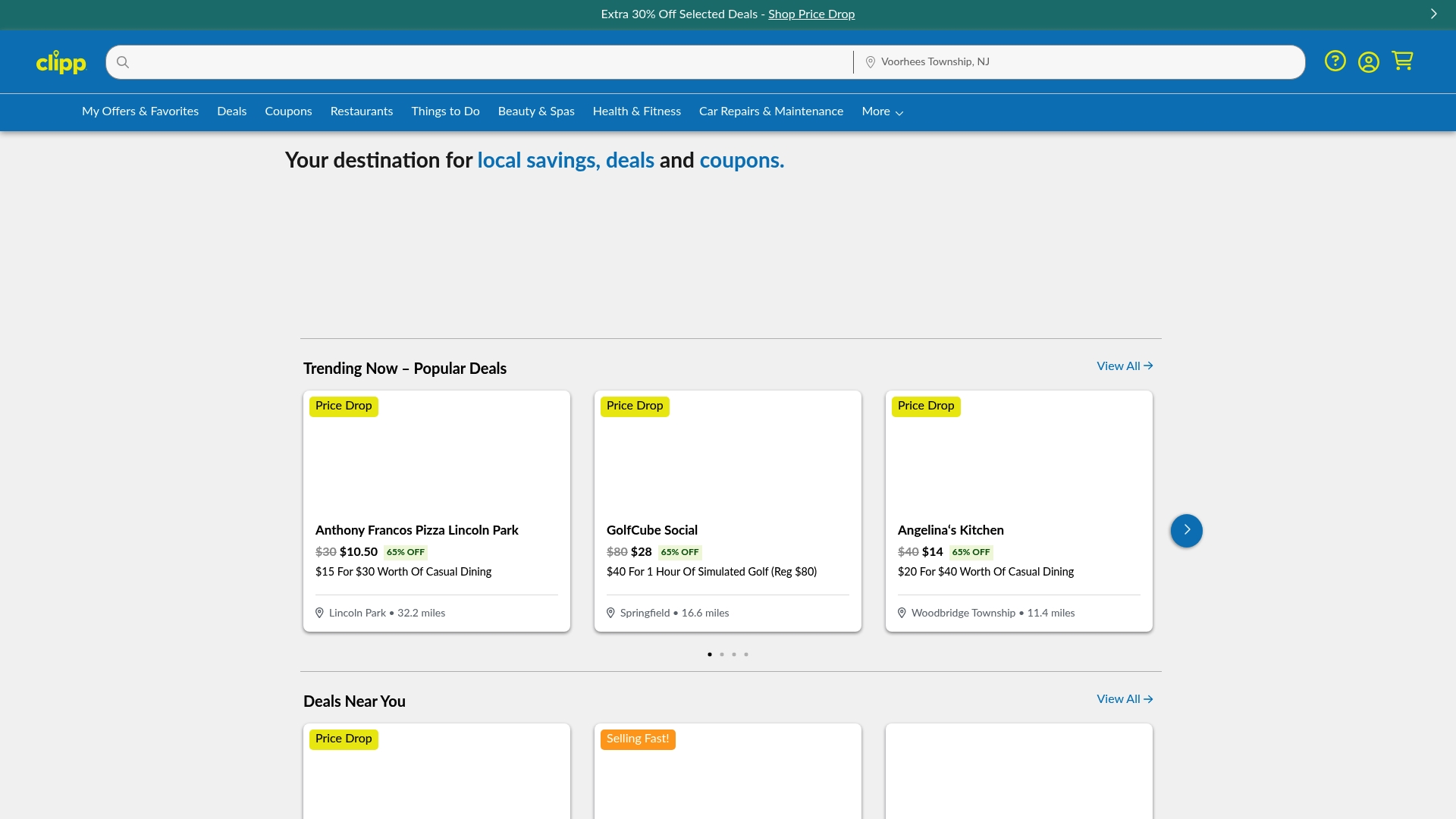
Browse local deals near you across dining, wellness, home services, and more. Clipp's merchant-curated listings mean you're seeing real, active offers, not a scraped list of expired codes.
- Nearby restaurant vouchers you can redeem tonight, not next week.
- Service coupons for salons, gyms, and pet care within your ZIP code.
- Easy in-store redemption from your phone, no printing required.
Check coupons in your area now and find what's available near you.
Further reading and sources
- 8 Best Coupon Sites, Browser Extensions and Apps — U.S. News & World Report: publisher roundup covering code verification and community validation.
- 8 of the Best Free Coupon Apps of 2026 — NerdWallet: use-case-driven breakdown of grocery, cashback, and local savings apps.
- Top coupons.com Alternatives & Competitors — SEMrush: traffic-based market context for the coupon platform category.
- Coupons.com Alternatives & Competitors — SaaSHub: community-categorized directory of alternatives by feature set.
- Digital coupons: benefits, risks, and smart savings tips — Clipp Blog: covers stale-code risks and verification habits for neighborhood shoppers.
- How digital coupon aggregators unlock major local savings — Clipp Blog: explains how local-first aggregators differ from national scrapers.
- Top deal websites for local dining and family savings — Clipp Blog: curated list of sites that work well for family and neighborhood saving scenarios.
Regional availability varies by platform. Always verify local merchant listings in your ZIP code before relying on any platform's coverage claims.