

TL;DR:
- A dining deal is a promotion that offers discounts through coupons, prepaid vouchers, or bundled meal offers to reduce restaurant costs. These deals require active redemption, such as presenting a code or voucher, and can save diners up to 40 percent when used correctly. Understanding how to find, purchase, and redeem these offers ensures maximum savings across casual, fine dining, and fast-food establishments.
A dining deal is a promotion that lowers the cost of eating out through coupons, prepaid vouchers, or bundled meal offers. These promotions are the standard industry term for what most people call "restaurant discounts" or "dining promotions," and they work across casual diners, fine dining, and fast food alike. Programs like AAA Dining Deals offer prepaid digital gift cards with savings up to 40%, while platforms like Clipp connect you with local restaurant coupons in minutes. Whether you're a frequent diner or an occasional treat-yourself type, understanding how these promotions work means you never leave money on the table.
What is a dining deal and how does it work?
A dining deal is defined as any price-reducing promotion applied to a restaurant purchase, either at checkout or through advance redemption. The discount does not always apply automatically. You often need to take a specific step, like entering a promo code, scanning a barcode, or presenting a digital voucher, before the savings kick in.
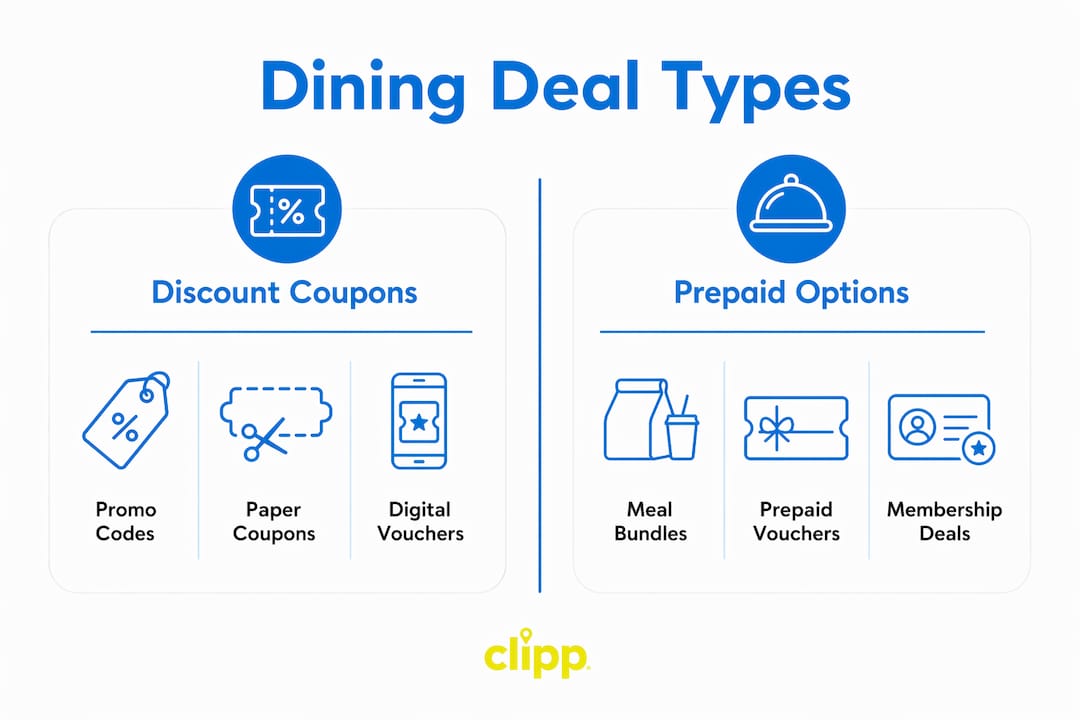
Three core mechanisms power most dining promotions:
- Coupons and promo codes: You present a code or printed coupon at checkout, and the restaurant deducts a fixed dollar amount or percentage from your bill. These are the most familiar format and require no advance purchase.
- Prepaid vouchers and digital gift cards: You buy the voucher online before your visit, often at a discount, then redeem it in the restaurant by showing a QR code or barcode on your phone. If your bill exceeds the voucher value, you pay the difference.
- Bundle or meal deals: A fixed price covers a set combination of items, such as an entrée and a beverage. Meal deals provide pricing certainty, so you know your total before you order.
Here is a quick comparison of the three main types:
| Deal Type | How You Get It | When Discount Applies | Best For |
|---|---|---|---|
| Coupon / Promo Code | Online, app, or print | At checkout | Flexible ordering |
| Prepaid Voucher | Purchase in advance | On redemption | Planned dining trips |
| Meal Bundle | Menu selection | Fixed at ordering | Budget-conscious diners |

Pro Tip: Save your digital voucher or QR code to your phone's wallet app before you leave home. Searching for a confirmation email at the table slows down service and risks losing the discount.
What benefits and pitfalls come with dining deals?
The clearest benefit of dining promotions is direct savings. The AAA Dining Deals program, for example, offers discounts up to 40% at thousands of restaurant locations nationwide. That is a meaningful reduction on a $60 dinner for two.
Beyond the dollar savings, meal bundle deals give you financial predictability. You know your cost before you sit down, which makes dining out easier to plan around a weekly budget. Coupons and vouchers, by contrast, give you more flexibility in what you order but introduce some variability in your final bill.
The pitfalls are real, though. Here are the most common mistakes diners make:
- Assuming the deal applies automatically. Most prepaid vouchers and coupons require active redemption. Forgetting to present your code means you pay full price.
- Skipping the fine print. Many deals exclude alcohol, apply only to specific menu items, or require a minimum purchase.
- Buying a voucher for the wrong location. Some programs are location-specific. Verify the participating restaurant before you purchase.
- Letting vouchers expire. Prepaid dining vouchers often carry expiration dates. Check the terms at purchase and use them before the deadline.
Pro Tip: Screenshot your voucher or barcode and store it in a dedicated folder on your phone. This takes ten seconds and prevents the most common redemption failure.
Understanding deal mechanics before you arrive is the single most effective way to avoid surprises and actually pocket the savings you were promised.
How to find and redeem dining deals effectively
Finding strong dining promotions takes less effort than most people expect. The best sources are dedicated deal platforms, membership programs, and restaurant apps. Here is a practical process that works:
- Choose your source. Platforms like Clipp aggregate local dining coupons by neighborhood, making it easy to browse by cuisine or discount level. AAA Dining Deals lets members filter offers by location and restaurant type before purchasing.
- Filter by what matters to you. Sort by cuisine, distance, or discount percentage. Prioritize deals at restaurants you already like rather than chasing discounts at unfamiliar places.
- Read the redemption terms. Before you buy a prepaid voucher, confirm the participating location, expiration date, and any excluded menu items.
- Purchase and store your deal. Digital gift cards are delivered instantly to your email or app. Save the code to your phone's wallet or a screenshot folder.
- Redeem at the restaurant. For vouchers, show the barcode or QR code on your mobile device to the server before the check is processed. For coupons, enter the promo code or hand over the printed version at checkout.
- Check your balance. If your bill exceeds the voucher value, pay the difference with your preferred payment method.
The AAA Dining Deals program stores purchased vouchers directly in your account, accessible from any mobile device. That structure removes the risk of losing a paper coupon and makes in-restaurant redemption straightforward. Clipp takes a similar approach, organizing your saved deals in one place so you can pull them up quickly.
For the best results, explore different coupon types across multiple platforms. No single source covers every restaurant in your area, so using two or three deal sources gives you the widest selection.
How do dining deals differ from meal plans?
Dining deals and meal plans are not the same thing, and confusing them leads to real frustration. A dining deal is a discount applied to a regular restaurant visit. A meal plan is a prepaid credit system that bundles meals and beverages into a fixed package, typically tied to a specific venue or travel experience.
The Disney Dining Plan is the most widely known example. It lets resort guests prepay for set meals and beverages across Walt Disney World restaurants, operating on a credit system rather than a percentage discount. Great Wolf Lodge uses a similar model with meal credits redeemable only at their on-site dining locations.
| Feature | Dining Deal | Meal Plan |
|---|---|---|
| Purchase timing | Before or at visit | In advance, often with booking |
| Flexibility | High (any eligible menu item) | Low (set credits or bundles) |
| Best for | Everyday diners | Resort or theme park visitors |
| Discount type | Percentage or fixed amount | Fixed prepaid value |
| Location | Any participating restaurant | Specific venue only |
Meal plans differ substantially from dining deals in structure and purpose. They serve a niche travel market where convenience and all-inclusive pricing matter more than maximum savings. If you are dining locally and want to cut your bill, a dining deal is the right tool. If you are planning a resort stay and want predictable food costs, a meal plan may make more sense.
The best choice depends on whether you prioritize flexible savings or predictable spending. Everyday diners benefit most from coupons and prepaid vouchers. Travelers locked into a single resort benefit most from meal plans.
Key takeaways
Dining deals are the most practical tool for reducing restaurant costs, and the right type depends entirely on how you prefer to dine and budget.
| Point | Details |
|---|---|
| Three core deal types | Coupons, prepaid vouchers, and meal bundles each work differently and suit different dining habits. |
| Active redemption required | Most dining deals do not apply automatically; you must present a code, barcode, or voucher at the restaurant. |
| Savings up to 40% | Programs like AAA Dining Deals offer significant discounts, but only when vouchers are purchased and redeemed correctly. |
| Meal plans are not dining deals | Meal plans like Disney Dining Plan use fixed credits at specific venues, not percentage discounts at open restaurants. |
| Platform variety matters | Using multiple sources like Clipp and membership programs gives you the widest range of local dining promotions. |
Why most people miss out on dining deals (and how to stop)
I have spent years watching people leave real savings on the table, not because dining deals are complicated, but because most diners assume the discount will handle itself. It will not. The single biggest misconception I see is that buying a voucher is enough. It is not. You still have to show up with the right code, at the right location, before the expiration date.
The shift to digital redemption has made this easier in practice. Mobile wallet compatibility and QR code scanning have replaced the awkward moment of digging through a wallet for a paper coupon. Programs like AAA Dining Deals and platforms like Clipp have built their systems around mobile-first redemption, which removes most of the friction that used to make dining deals feel like more trouble than they were worth.
What I find genuinely useful is treating dining deals like a pre-dinner ritual. Before you leave home, pull up your voucher, confirm the address, and check the terms. That two-minute habit is the difference between a 40% discount and a full-price bill. I also recommend saving on dining across categories rather than hunting for one perfect deal. Stacking a restaurant coupon with a loyalty program reward, for example, compounds your savings without extra effort.
The diners who get the most value from these promotions are not the ones who find the biggest discount. They are the ones who understand the mechanics well enough to use deals consistently and correctly.
— Mehmet
Find local dining deals on Clipp right now
Clipp makes it easy to find restaurant promotions near you without sorting through irrelevant offers. The platform curates local dining deals by neighborhood, covering casual spots and sit-down restaurants across multiple cities. Every offer is organized for quick browsing, so you can filter by discount level or cuisine type and get to the checkout in under a minute.
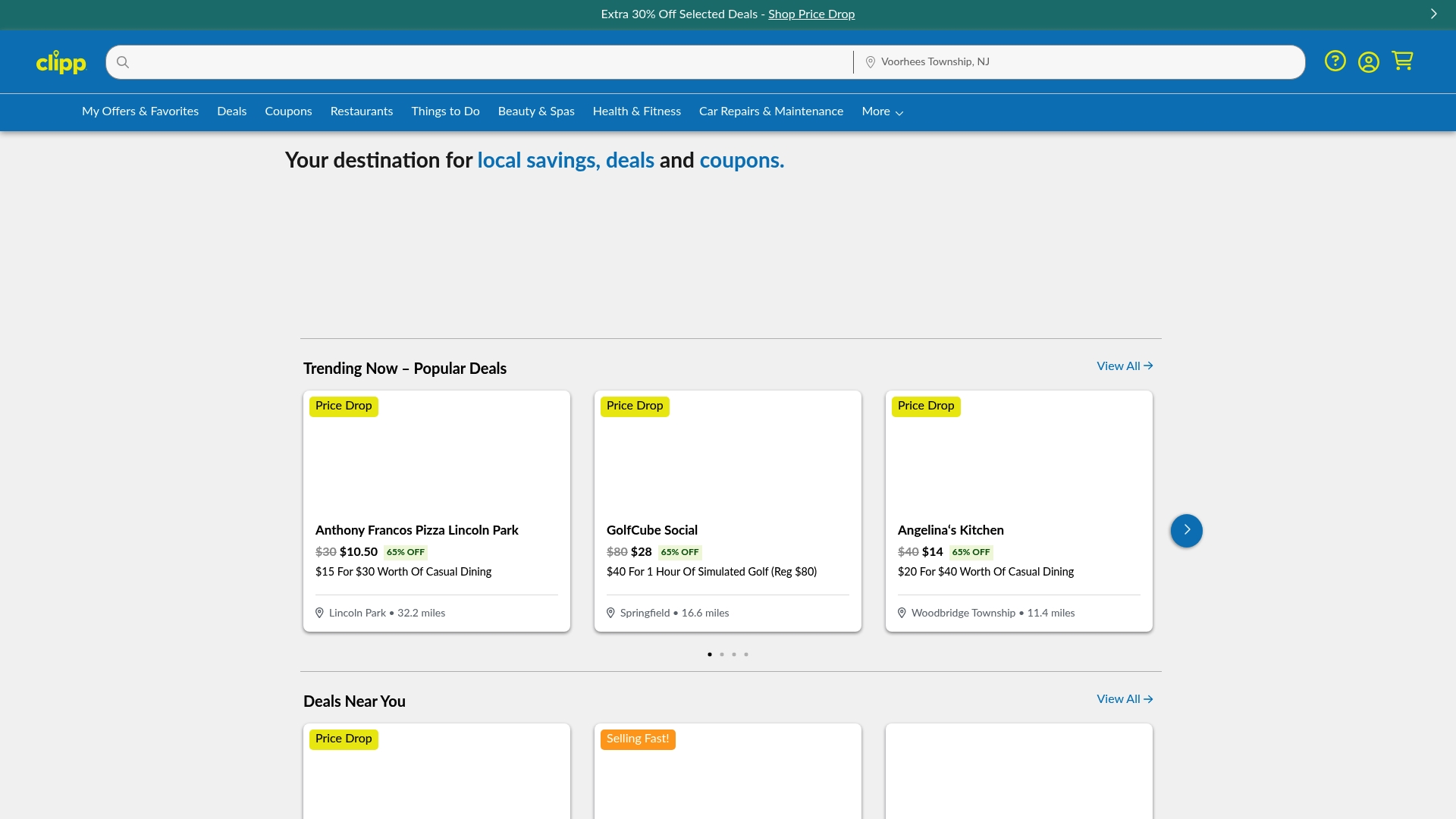
Clipp's mobile-friendly design means your deal is always accessible on your phone, ready to scan or present the moment your server asks. New offers rotate regularly, so checking back weekly keeps your options fresh. Browse current dining coupons on Clipp and start saving on your next meal out.
FAQ
What is a dining deal, exactly?
A dining deal is a promotion that reduces the cost of a restaurant meal through a coupon, prepaid voucher, digital gift card, or bundled offer. The discount applies when you redeem the deal at the restaurant, not automatically.
How do i find dining deals near me?
Platforms like Clipp list local restaurant promotions organized by location and cuisine. Membership programs like AAA Dining Deals also offer searchable databases of participating restaurants with filterable offers.
Do dining deals apply automatically at checkout?
No. Most dining deals require active redemption. You must present a promo code, barcode, or QR code at the time of payment for the discount to apply.
What is the difference between a coupon and a prepaid voucher?
A coupon reduces your bill at checkout without any advance purchase. A prepaid voucher is bought in advance at a discounted price and redeemed by showing a unique code or barcode at the restaurant.
Are meal plans the same as dining deals?
No. Meal plans like the Disney Dining Plan use fixed prepaid credits at specific venues. Dining deals are percentage or dollar discounts applied at any participating restaurant, offering more flexibility for everyday diners.