

The fastest way to cut a restaurant bill is to combine three moves: check Clipp for local coupons before you leave the house, pick a Monday or Tuesday to visit, and skip the drinks. Done right, that alone can shave 10–30% off most meals. Americans spend over $4,000 a year on food away from home, so even trimming 20% adds up to real money fast.
Start with these right now:
- Pull up Clipp and search your neighborhood for restaurant coupons before booking.
- Target Monday or Tuesday visits when restaurants push all-day specials to fill slow nights.
- Order water instead of cocktails or wine to noticeably reduce your beverage costs.
- Check the menu online before you arrive so you walk in with a plan, not a panic order.
Table of Contents
- What are the best single-meal tactics to save money dining out?
- How do you set a monthly dining budget that actually sticks?
- Where do you find reliable local restaurant deals and coupons?
- What are the rules for using coupons and stacking offers?
- What savings can you realistically expect from these strategies?
- How do you decide if a specific deal is actually worth using?
- How do you negotiate with restaurants for special occasions or repeat visits?
- How do seasonal events and promotions lower your dining costs?
- Key Takeaways
- The habit that actually moves the needle
- Find local restaurant deals on Clipp right now
- Useful sources and further reading
What are the best single-meal tactics to save money dining out?
Eight moves, each one usable tonight; learn how restaurants boost local visibility to attract diners and fill tables efficiently.
1. Dine midweek. Mondays and Tuesdays are when restaurants run all-day promotions to fill empty tables. You get the same food, fewer crowds, and a lower check.
2. Hit happy hour. Happy hour and lunch menus consistently offer lower price points and half-priced appetizers. Eat at the bar during happy hour and you often get a full meal for the price of a couple of apps.
3. Review the menu before you go. Personal-finance experts recommend pre-checking menus to plan your order and avoid the expensive impulse pick when hunger hits at the table.
4. Box half your meal immediately. Ask for a to-go box when the food arrives and pack away half right then. You get portion control and a free lunch tomorrow. Waiting until the end usually means less food makes it home.
5. Skip alcohol at the restaurant. Drinks are the single biggest markup on any check. Order water and save the wine for home.
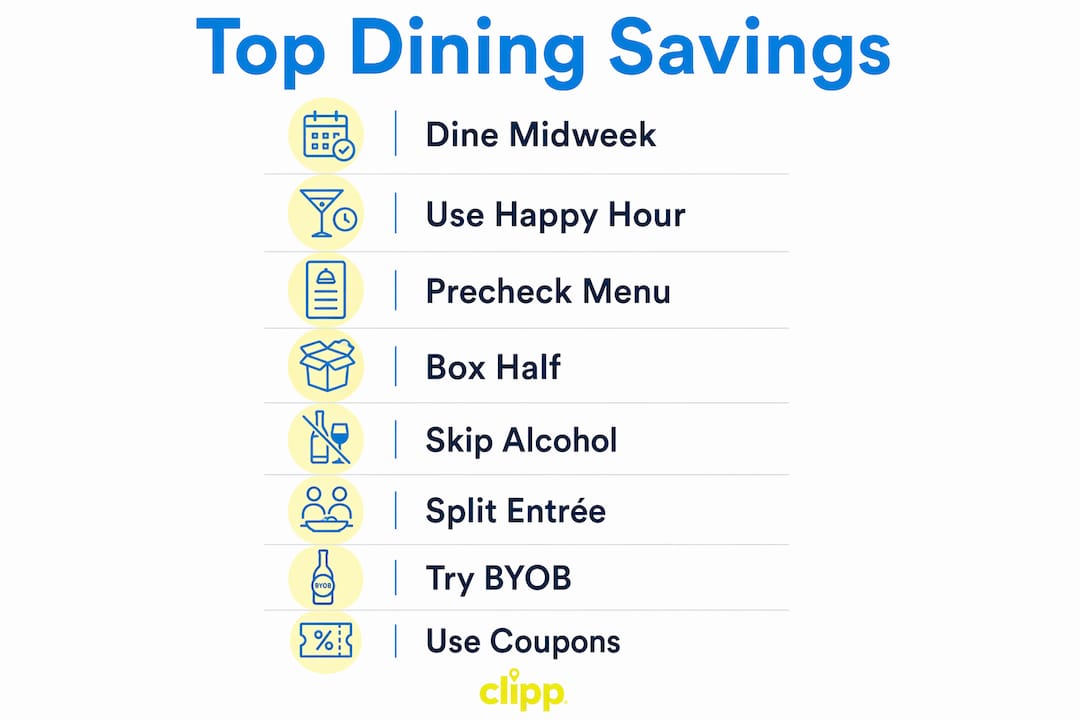
6. Split an entrée. Large portions are the norm at most American restaurants. One entrée split two ways, plus a shared appetizer, often equals two full meals for the price of one.
7. Try BYOB where it's allowed. Some restaurants let you bring your own bottle. The savings on markup are real, but always call ahead to confirm the policy and any corkage fee before you show up with a bottle.
8. Use a coupon or loyalty app. Clipp, restaurant loyalty programs, and cashback apps all deliver discounts that stack. Check top coupon types before you book.
Pro Tip: Build a three-minute pre-visit checklist: (1) pull up the menu online, (2) check Clipp for a local coupon, (3) confirm happy-hour hours. Three minutes before you leave saves more than any single tactic at the table.
How do you set a monthly dining budget that actually sticks?
Financial experts are consistent on this: separating your dining money from your grocery budget is the single most effective move to control what you spend eating out. When the two pools mix, restaurant trips feel like "food spending" and the mental accounting never works.
Here's a simple setup:
- Look back 60 days. Add up every restaurant charge. That's your baseline.
- Set a monthly cap. Pick a number 20–30% below your baseline as your target.
- Create a separate budget line. Label it "dining out" in your budgeting app or spreadsheet, completely apart from groceries.
- Set a per-visit spending limit. Divide your monthly cap by the number of planned meals out. That per-visit number is your guardrail.
- Schedule a weekly check-in. A five-minute calendar reminder on Sunday keeps you from hitting the cap by the 20th.
Sample monthly calculation: Say you currently spend $400 a month eating out. Cutting two dinners and applying a coupon to two others saves roughly $80–$120 per month, depending on the discount. Over a year, that's close to $1,000 back in your pocket without giving up the habit entirely.
Where do you find reliable local restaurant deals and coupons?
Every source below has a different strength. Knowing which to check first saves time.
| Source | Best for | Typical discount | Effort |
|---|---|---|---|
| Clipp.com | Local neighborhood coupons, curated deals | 20–50% | Low |
| Restaurant loyalty apps | Repeat visits, birthday perks | 10–20% | Low |
| Email newsletters | Welcome coupons, recurring specials | 10–25% | Very low |
| Discounted gift cards | Any restaurant that sells them online | 10% | Low |
| Cashback apps | Passive savings on any purchase | 1–5% | Very low |
| Reservation/rewards platforms | Fine dining, special occasions | Varies | Medium |
| Social media & neighborhood groups | Flash deals, local pop-ups | Varies | Medium |
The two to check first: Clipp for curated local coupons and your restaurant's own loyalty app. Those two cover the majority of available savings with the least effort. Restaurant email lists are worth signing up for too — restaurants routinely send a welcome coupon the moment you subscribe, and those offers never appear on public menus.
For family dining deals specifically, Clipp's neighborhood browsing makes it easy to filter by category and find offers near you.
What are the rules for using coupons and stacking offers?
Getting a discount denied at the table is avoidable. A few ground rules:
- Read the full terms before you order. Exclusions for alcohol, takeout, or specific days are common. Ordering a bottle of wine and expecting the coupon to cover it is a fast way to get surprised.
- Ask about stacking before you sit down. Some restaurants allow combining a loyalty reward with a coupon; many do not. A quick question to the host or server before ordering saves an awkward moment at checkout.
- Confirm BYOB policies by phone. Corkage fees range widely. Knowing the fee in advance lets you calculate whether bringing your own bottle actually saves money.
- Present coupons early. Tell your server at the start of the meal, not after the check arrives. Servers appreciate the heads-up, and it avoids any confusion about what's covered.
- Tip on the pre-discount total. This is standard etiquette. The server did the same work regardless of your coupon.
- Don't combine offers that explicitly say "one per table." Attempting to split a check to use two coupons on the same meal is bad form and usually caught.
Pro Tip: To save on alcohol without awkwardness, order one drink at the restaurant and bring a bottle for home. You enjoy the experience, tip fairly, and still cut the beverage line on your check.
What savings can you realistically expect from these strategies?
Basic coupon use saves most diners 10–30% per meal. Active stacking pushes that to 20–50% on family meals. Here's how the numbers break down by strategy:
| Strategy | Typical savings |
|---|---|
| Loyalty program alone | 10–20% |
| Coupon aggregator (e.g., Clipp) | 20–50% |
| Discounted gift card | 10% |
| Cashback app alone | 1–5% |
| Full stacking (all of the above) | 20–50%+ |
Sample monthly math: A family spending $300 a month dining out applies a 25% coupon to three of four meals out. That's roughly $56 saved in a single month, or about $675 over a year, without changing where they eat or how often.
How do you decide if a specific deal is actually worth using?
Not every coupon saves you money. Run through this checklist before committing:
- Check the minimum spend. Does the deal require you to order more than you normally would? If a $20-off certificate requires a $60 minimum and your usual bill is $35, you're spending extra to "save."
- Confirm exclusions. Alcohol, takeout, and holiday dates are the most common carve-outs. Read the fine print.
- Factor in travel time. A 20% discount at a restaurant 30 minutes away may not beat a 10% discount at the place around the corner.
- Check whether stacking is allowed. A coupon you can combine with a loyalty reward is worth more than one you can't.
- Note the expiration. A deal expiring in three days creates pressure to dine out when you hadn't planned to. That's not savings; that's a spending trigger.
- Apply it to a planned meal, not an impulse one. The best deals are ones you use on a dinner you were already going to have.
Two quick examples: A family-dinner certificate with a $50 minimum works well if your normal family bill hits $55 anyway. A BOGO entrée from a loyalty app is straightforward value with no minimum spend trap. When in doubt, see how different coupon types stack up before deciding.
How do you negotiate with restaurants for special occasions or repeat visits?
Restaurants have more flexibility than most diners realize, especially for groups and regulars.
For special occasions, call ahead rather than showing up and hoping. Ask the manager directly whether they can accommodate a set menu, a prix-fixe option, or a private area for a group. Many restaurants will negotiate a per-head price for parties of eight or more, which often comes in below ordering à la carte. Mentioning a birthday or anniversary upfront frequently unlocks a complimentary dessert or a small discount, particularly at independent restaurants where the owner is on-site.
Repeat customers have real leverage too. If you visit a neighborhood spot regularly, introduce yourself to the owner or manager. Regulars often get unadvertised perks: a free appetizer, a better table, or advance notice of promotions. Restaurants want to keep loyal customers, and a simple conversation goes further than most people expect.
How do seasonal events and promotions lower your dining costs?
Restaurants tie their best promotions to the calendar, and knowing the pattern lets you plan around it.
Restaurant Week events, held in most major U.S. cities, typically run in January and July when dining traffic is slow. A three-course prix-fixe at a normally expensive restaurant for $35–$55 is standard. Sign up for your city's Restaurant Week mailing list and you'll get dates and participating venues weeks in advance.
Valentine's Day, Mother's Day, and New Year's Eve are the opposite: restaurants charge premium prices and rarely discount. Shift those celebrations by one or two days and you often get the same experience at regular menu prices. A Saturday-night Valentine's dinner costs more than the same meal on February 13th at most restaurants.
Summer and fall bring seasonal menus built around cheaper local produce, which often means lower prices on specials. Following a restaurant on social media is the easiest way to catch these limited-time offers before they sell out. Local restaurants also tend to run promotions around community events, sports seasons, and holidays like Cinco de Mayo or St. Patrick's Day. Checking Clipp's local deals page around those dates is a reliable way to catch time-sensitive offers.
Key Takeaways
Combining a dedicated dining budget with local coupons from Clipp and midweek timing is the most reliable way to cut 10–30% off your monthly restaurant spending.
| Point | Details |
|---|---|
| Set a separate dining budget | Track restaurant spending apart from groceries to keep dining intentional and measurable. |
| Use midweek timing | Monday and Tuesday visits increase your chances of catching all-day promotions and specials. |
| Stack your savings | Combine a Clipp coupon, a loyalty reward, and a cashback app to reach 20–50% savings per meal. |
| Evaluate every deal | Check minimum spend, exclusions, and stacking rules before committing to any offer. |
| Start with Clipp | Browse Clipp by neighborhood to find curated local restaurant coupons with low effort. |
The habit that actually moves the needle
Most people treat dining savings as a one-time coupon hunt. That's the wrong frame. The diners who consistently spend less aren't the ones who find the best single deal — they're the ones who've built two or three small habits that run on autopilot: a separate budget line, a quick Clipp check before booking, and a standing preference for midweek visits.
Stacking is where the real leverage lives. A discounted gift card, a loyalty coupon, a dining-rewards credit card, and a cashback app submission — used together on a single meal — can compound to savings that no single tactic reaches alone. Most diners never try it because it sounds complicated. It takes about five minutes once you've done it once.
The other thing worth saying plainly: the best time to use a deal is on a meal you already planned to have. Chasing promotions into restaurants you wouldn't otherwise visit, or ordering more to hit a minimum spend, erases the savings before you've left the table. Discipline about when you use a deal matters as much as finding one.
Find local restaurant deals on Clipp right now
Clipp connects you directly with curated coupons and promotions from local restaurants in your neighborhood, with no subscription required. Browse by location using the "Near You" section, filter by dining, and claim deals before they expire. The platform highlights trending offers and limited-time price drops so you're not digging through outdated listings.
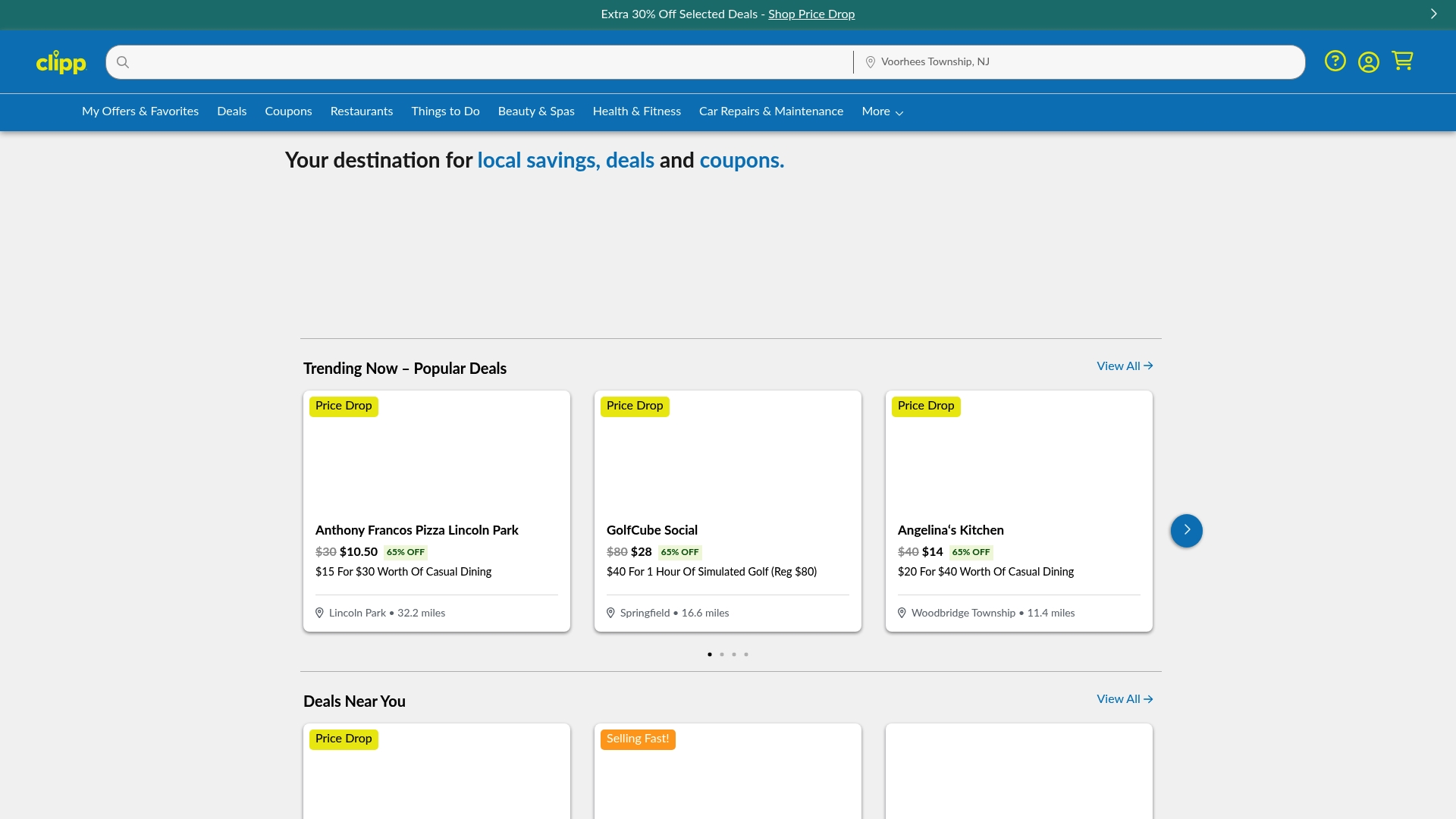
To get started, head to your state's deals page — Texas, Florida, Virginia, Louisiana, Oregon, or browse all states on Clipp — filter by restaurant, and claim a deal for your next meal out. Takes two minutes and the savings show up immediately.
Useful sources and further reading
"Whatever budget you choose for dining out, it's critical to separate it from your grocery money." — Lindsay Plumb, financial counselor, via NPR
- How to eat out without spending a fortune — NPR/TPR series on practical dining savings from personal-finance and nutrition experts.
- Smart Ways to Save Money at Restaurants — Ramsey Solutions' case for a separate dining budget and the to-go-box habit.
- How to eat out for cheap — Fidelity's overview including BLS spending data and BYOB guidance.
- 19 Clever Tips To Cut Costs While Dining Out — Chowhound's rundown of timing, happy hour, and midweek strategies.
- How to get restaurant coupons and save 20–50% dining out — Clipp's primary guide to coupon discovery and stacking.
- Step by step dining discounts: save up to 50% — Clipp's walkthrough for combining discounts in sequence.
- Unlock local savings: top ways to eat, play, and save — Clipp's neighborhood savings playbook for dining and beyond.