

TL;DR:
- Family deals offer bundled discounts and promotions for family dining and activities that help families save money.
- Evaluating deal terms, expiration dates, and true costs ensures families get genuine savings without hidden fees.
Family deals are bundled discounts and promotions designed to help families save money on dining, entertainment, and local activities. Explaining family deals means understanding how these offers work, what formats they take, and how to spot the ones worth your time. Platforms like Clipp connect families with curated local savings across restaurants, activity centers, and more. This article breaks down the most common deal types, how to evaluate them, the real benefits they deliver, and the mistakes that cost families money.
What types of family deals are commonly available?

Family deals come in several well-defined formats. Knowing the structure of each one helps you decide which offers genuine value and which ones just look good on paper.
Meal bundles are the most common format in dining. A restaurant sets a fixed price for a group meal, typically covering two adults and two children. The per-person cost drops significantly compared to ordering individually. Meal bundles and entertainment packages are designed specifically for group enjoyment, making them a practical choice for regular family outings.
Group entertainment tickets work on a similar principle. A theme park, bowling alley, or movie theater sells a family package at a flat rate. The package bundles admission for a set number of people, often adding extras like a drink or snack. This format rewards families who plan ahead and buy together rather than individually at the door.
Activity passes and membership discounts are a third category worth understanding. Museums, zoos, and recreation centers frequently offer annual family memberships that pay for themselves after two or three visits. These are not one-time coupons. They are recurring savings tools that also simplify planning because you stop calculating cost every time you want to go.
- Meal bundles: fixed price for a set group size at a restaurant
- Group tickets: flat-rate admission for families at entertainment venues
- Activity passes: annual or seasonal access at reduced per-visit cost
- Coupon deals: percentage or dollar-off codes redeemable at checkout
- Membership discounts: ongoing savings at gyms, recreation centers, and local services
Pro Tip: Before buying a family activity pass, count how many visits you realistically plan in a year. If two visits cover the membership cost, everything after that is free.
How do you find and evaluate trustworthy family deals?
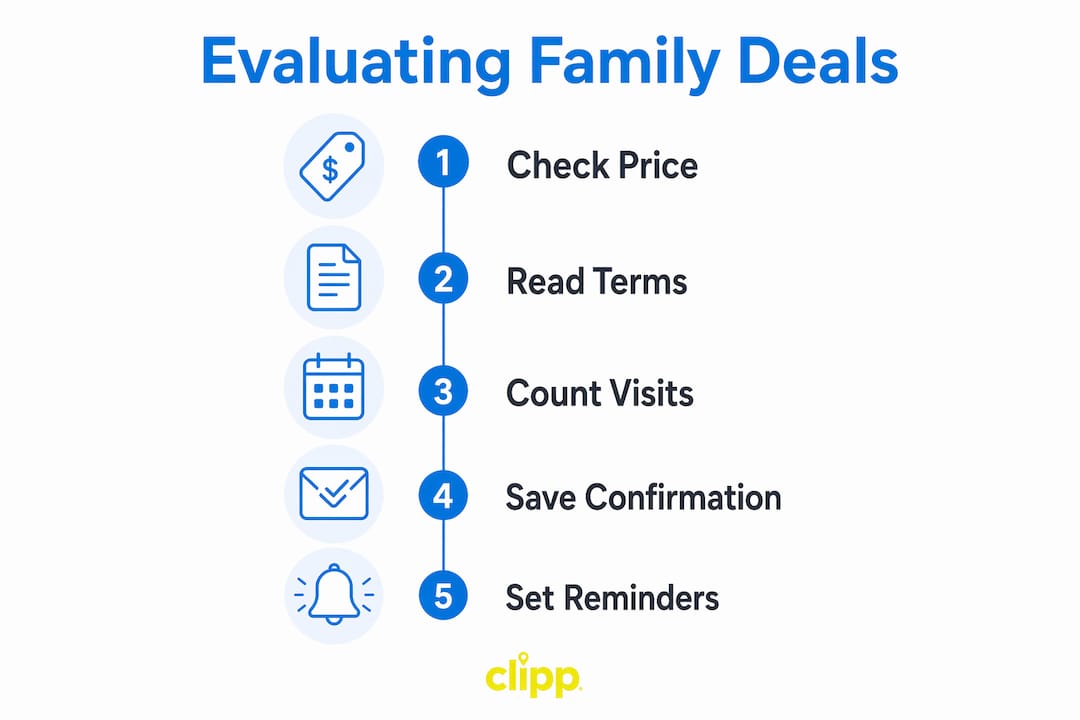
Finding a deal is easy. Finding one that actually saves you money takes a few extra steps. The difference between a real discount and a marketing trick often comes down to reading the fine print.
Follow these steps to evaluate any family deal before you commit:
- Check the expiration date. Many deals expire within 30 to 90 days of purchase. A deal you cannot use in time is money wasted.
- Read the restrictions. Look for blackout dates, minimum spend requirements, and limits on which menu items or services qualify. A restaurant deal that excludes weekends is far less useful for most families.
- Calculate the real savings. Take the original price, subtract the deal price, and factor in any required extras. A $40 family meal deal that requires a $15 minimum drink order is a $55 outing, not a $40 one.
- Verify the source. Use established platforms with real merchant partnerships. Clipp lists local dining and family savings from verified local businesses, which reduces the risk of encountering expired or fraudulent offers.
- Compare to the standard price. Look up the regular menu or ticket price before buying. Some deals inflate the "original price" to make the discount look larger than it is.
The most reliable deals come from platforms that maintain direct relationships with local merchants. Clipp's "Near You" and "Trending Deals" sections surface offers from businesses actively promoting to local families, which means the deals are current and redeemable.
Pro Tip: Screenshot or save your deal confirmation immediately after purchase. Some venues require a printed voucher or a specific app screen at checkout.
What benefits do family deals offer beyond simple savings?
The financial benefit of a family deal is obvious. The less obvious benefits are often more valuable in the long run.
"Family deals provide budget-friendly options that save money while encouraging family time through grouped discounts and shared activities." — Clipp
Budget control is the clearest advantage. When a family meal or outing has a fixed price, you know the cost before you leave the house. That predictability makes it easier to plan a monthly entertainment budget without surprises. Families who use bundled deals consistently report spending less per outing than those who pay individually for each item.
Family deals also reduce the friction of planning. A set package removes the need to negotiate what everyone wants or calculate individual costs at the table. You pick the deal, you go, and the price is already settled. That simplicity has real value for busy households.
Some deals carry additional perks that go beyond price. Educational venues like science museums and nature centers often include guided programs or workshops in their family packages. A family admission ticket to a children's museum might include a craft session that would cost extra if purchased separately. These bundled experiences add depth to an outing without adding to the bill.
The social benefit is real too. Families who regularly use dining and entertainment deals tend to go out more often because the cost barrier is lower. More outings mean more shared experiences, which research consistently links to stronger family relationships and better communication among children and parents.
Common pitfalls when using family deals and how to avoid them
Family deals can backfire when families treat every offer as automatically good. A few recurring mistakes account for most of the money lost on deals that seemed like savings.
- Ignoring hidden fees. Service charges, booking fees, and gratuity requirements can add 15–20% to a deal's stated price. Always check the total cost at checkout before confirming.
- Buying more than you need. A deal for six people is not a bargain if your family has four. Overpaying for unused portions cancels out the discount.
- Assuming all deals are equal. A 50% off coupon at a restaurant you would never normally visit is not a saving. It is a new expense. Only use deals for places and activities you would genuinely choose anyway.
- Missing the terms on group size. Many family deals define "family" as two adults and two children. A family of five may need to pay extra, which changes the math entirely.
- Letting deals expire unused. Buying a deal and forgetting it is one of the most common ways families lose money. Set a calendar reminder the day you purchase.
Defining default and enforcement procedures in any financial agreement prevents disputes. The same principle applies to family deals: read every term before you buy, not after a problem arises.
Pro Tip: Keep a simple notes app list of deals you have purchased, their expiration dates, and any restrictions. Five minutes of organization saves real money.
Key Takeaways
Family deals deliver the most value when you understand their structure, verify their terms, and use them for activities you already planned to enjoy.
| Point | Details |
|---|---|
| Know the deal format | Meal bundles, group tickets, and activity passes each work differently and suit different family needs. |
| Verify before buying | Check expiration dates, restrictions, and true total cost before committing to any offer. |
| Use Clipp for local deals | Clipp connects families with verified local savings on dining, entertainment, and activities. |
| Avoid common mistakes | Hidden fees, unused deals, and wrong group sizes are the top reasons families lose money on discounts. |
| Benefits go beyond price | Fixed-price packages simplify planning, reduce friction, and encourage more frequent family outings. |
Why I think most families underuse the deals right in front of them
Most families I have talked to about this topic share the same pattern. They know deals exist. They have downloaded apps and signed up for email lists. But they rarely use what they find, and when they do, they often pick the wrong ones.
The real problem is not access. It is evaluation. Families skip the 90-second step of reading the terms and then feel burned when a deal does not work as expected. That one bad experience creates skepticism that keeps them from saving money for months afterward.
The fix is simpler than most people expect. Treat every deal like a small purchase decision, not a freebie. Ask yourself: Would I pay this price for this experience if there were no discount? If the answer is yes, the deal is worth it. If the answer is no, the discount is just pulling you toward spending you did not plan.
Clipp's model works well for families precisely because it focuses on local merchants. You are not browsing national chains you could find anywhere. You are finding community-specific savings at the restaurants and activity spots your neighborhood already has. That relevance makes it far more likely you will actually use what you find.
The families who get the most from deal platforms are the ones who check in regularly, not just when they are already planning an outing. Browsing Clipp on a Tuesday morning and spotting a Friday dinner deal is how real savings happen. Waiting until Saturday afternoon and hoping something is available is how you end up paying full price.
— Mehmet
Where Clipp helps families find real local savings
Families who want to put these principles into practice have a direct starting point.
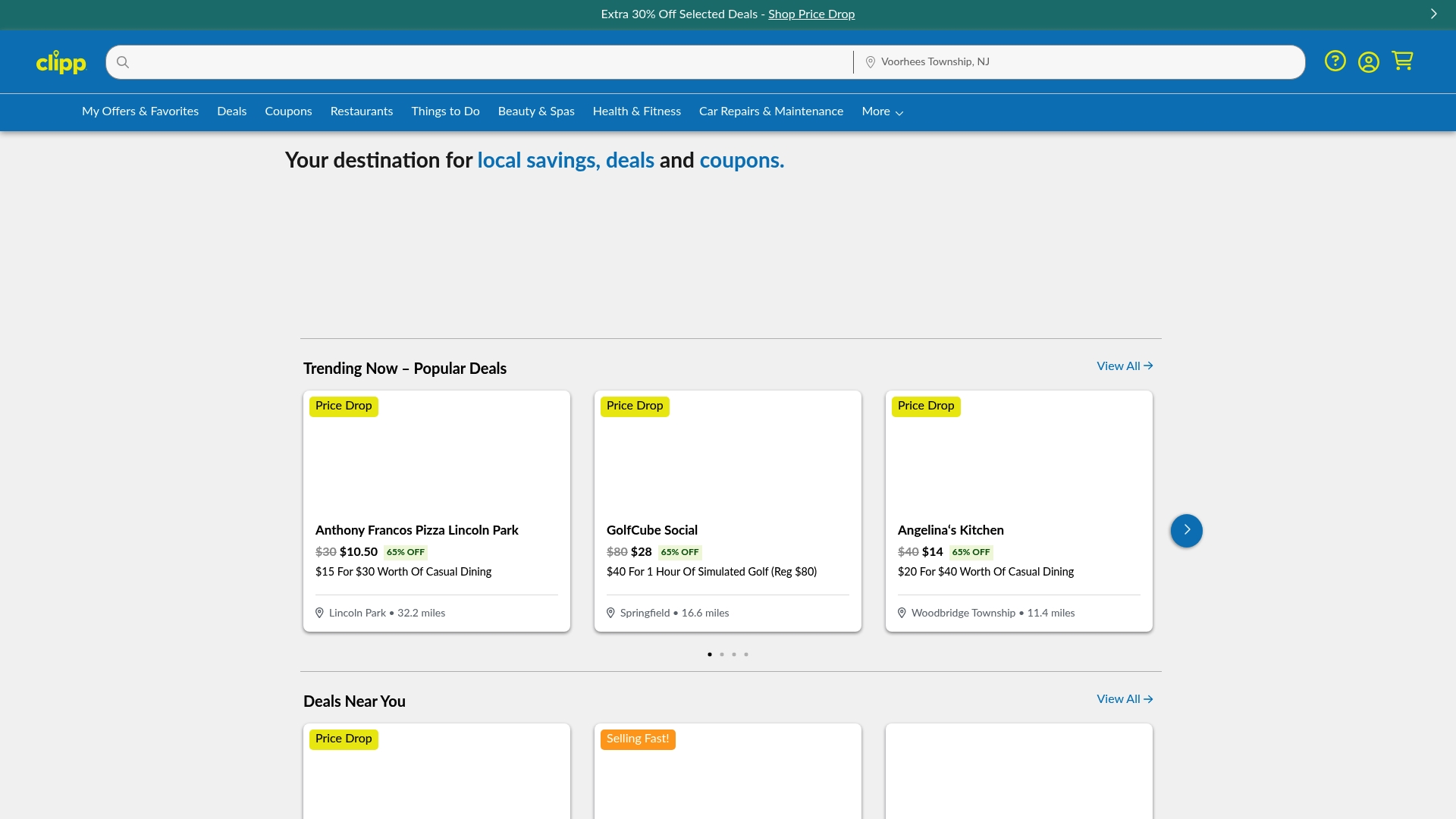
Clipp lists curated deals on dining, entertainment, and local activities across the country, updated regularly with offers from verified local merchants. The platform's "Near You" section surfaces deals relevant to your location, so you are not sorting through national promotions that do not apply. Families can browse local family coupons by category, check expiration dates upfront, and see the full terms before committing. Whether you are planning a weekend dinner or a day out, Clipp gives you a clear picture of what is available and what it actually costs.
FAQ
What are family deals?
Family deals are bundled discounts on dining, entertainment, and local activities priced for groups, typically two adults and two or more children. They reduce the per-person cost compared to individual pricing.
How do I know if a family deal is worth it?
Calculate the total cost including fees, check the expiration date, and confirm the deal applies to your actual group size. Only use deals for places you would visit at full price.
Where is the best place to find family deals near me?
Clipp lists verified local deals on dining and entertainment by location, making it straightforward to find current offers near you.
What is the most common mistake families make with deals?
Buying deals and letting them expire unused is the top mistake. Set a calendar reminder on the day of purchase to avoid losing money on forgotten vouchers.
Do family deals include hidden fees?
Some do. Service charges, booking fees, and minimum spend requirements can add significantly to the stated price. Always check the checkout total before confirming a purchase.