

TL;DR:
- In 2026, discoverability depends on mastery of SEO, answer engine optimization, and generative engine ranking. Achieving all three ensures offers appear across search, AI answers, and recommendations, while neglecting any leaves room for competitors.
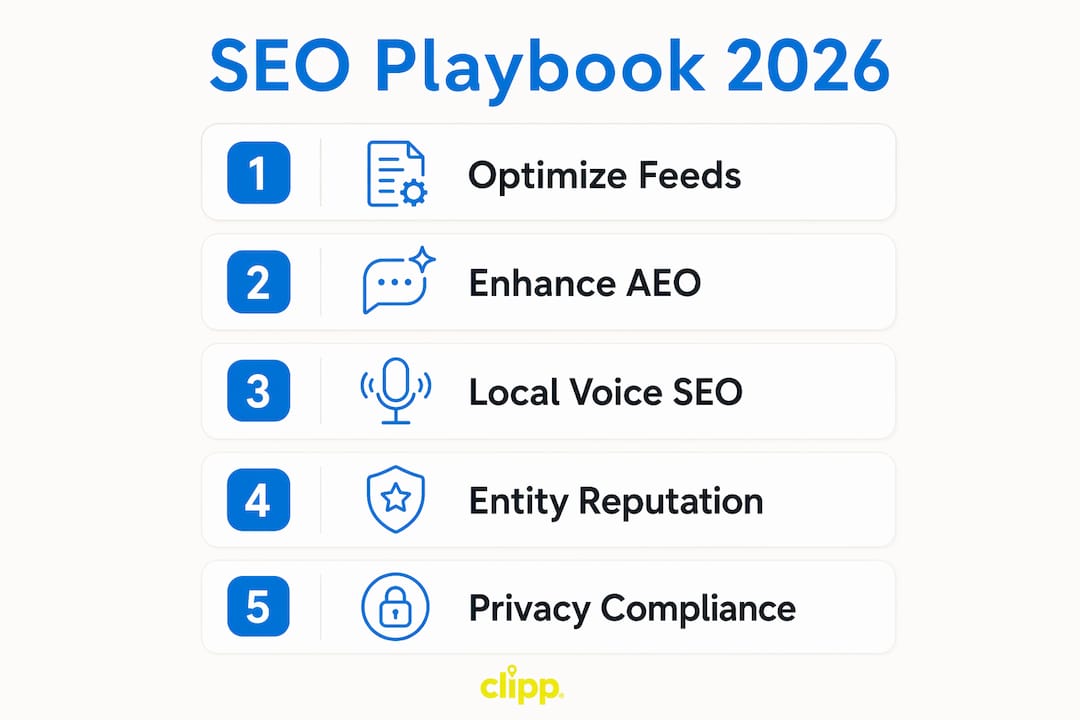
In 2026, discoverability for deals platforms depends on three parallel priorities: traditional SEO (crawl and index), AEO (getting cited inside AI answers), and GEO (earning recommendations from generative engines). Nail all three, and your offers reach users whether they search Google, ask ChatGPT, or let an AI agent shop for them. Miss anyone, and a competitor's coupon shows up instead of yours.
The four trends that matter most right now:
- Agentic commerce: AI agents are completing purchases autonomously, and they skip offers they can't parse
- Structured feeds and JSON-LD: clean, machine-readable offer data is now table stakes, not a bonus
- Entity signals and unlinked mentions: AI engines weigh brand consensus, not just backlinks
- Extraction metrics: feed acceptance rate and agent selection rate are replacing rank position as primary KPIs
Execute these three steps this week:
- Run a headless-client extraction test on your top 10 offer pages. If price and redemption URL don't appear without JavaScript, that's your first fix.
- Audit your feed for missing
validThrough,price, andcouponCodefields. Fix those before anything else. - Pitch one authoritative local or vertical outlet for an unlinked brand mention. A single mention on a trusted site moves the needle faster than ten low-authority links.
Table of Contents
- What are the SEO trends in 2026 for deals platforms?
- How do you make your deals machine-consumable for AI agents?
- How do you structure content so AI engines cite your deals?
- What replaces traditional link building for deals platforms?
- Structured data and feed hygiene: what actually keeps offers indexed
- Technical SEO and UX priorities for deals platforms
- Trust, fraud prevention, and privacy signals that matter in 2026
- How do you measure success when AI agents drive discovery?
- What does a 90-day roadmap look like for AI discoverability?
- How Clipp.com is preparing for 2026
- How does voice search affect deal discovery platforms?
- How is personalization changing SEO for deals platforms?
- How do privacy regulations affect SEO and tracking in 2026?
- Key Takeaways
- Why agentic readiness matters more than most SEO teams realize
- See these strategies live on Clipp
- Sources and further reading
What are the SEO trends in 2026 for deals platforms?
The single biggest shift is that SEO has split into three roles: SEO handles ranking and crawlability, AEO (answer engine optimization) targets AI citation, and GEO (generative engine optimization) targets recommendation. Traditional SEO is still the foundation, but it now feeds two additional layers that determine whether your deals actually surface.
Here's how the stack works in practice:
- SEO layer: Googlebot indexes your pages. Clean crawl = data in the index = eligibility for everything above it.
- AEO layer: AI answer engines (ChatGPT, Perplexity, Google AI Overviews) extract concise, schema-annotated facts from indexed pages and surface them in answers. Zero-click behavior is growing, meaning users get the answer without visiting your site.
- GEO layer: Generative engines recommend brands based on entity reputation, consensus mentions, and structured authority signals. Different engines draw from different sources: some weight Reddit and Wikipedia heavily, others favor clean SEO signals and YouTube.
One more thing worth knowing: ChatGPT, Perplexity, and Google AI Overviews pull from different source mixes. That means off-site work needs to be channel-specific, not a single generic link-building campaign.
Pro Tip: If your platform is small, prioritize AEO first. Getting cited in one AI answer for "best dining deals near me" delivers more qualified traffic than ranking #4 in blue links.
How do you make your deals machine-consumable for AI agents?
Platforms with machine-readable integrations are the ones AI agents actually complete purchases through. Agents skip offers they can't parse, which means a deal buried in a JavaScript widget is effectively invisible to agentic commerce flows.
Implementation priority order:
- Pricing parseability first. Every offer page must expose price, currency, and availability in server-rendered HTML or a static JSON endpoint. No JS-only price reveals.
- Redemption links second. The
redemptionURLandcouponCodefields must be present, direct, and not gated behind a modal. - API verification third. Expose a lightweight offers API that returns canonical offer IDs, TTLs, and inventory status.
Minimum feed fields agents need:
| Field | Format | Notes |
|---|---|---|
url | Canonical URL | One per offer, no redirects |
price | Numeric | No range strings like "$10–$20" |
priceCurrency | USD | Required |
validFrom / validThrough | — | Set TTL; stale offers hurt feed acceptance |
couponCode | String | Exact redemption code |
redemptionURL | Direct URL | No JS modals |
availability | schema.org value | InStock / OutOfStock |
Pro Tip: Simulate a headless client (curl or Playwright with JS disabled) against your top offer pages. If the price field is empty in the response, agents see the same empty field. Fix that before any other technical work.

How do you structure content so AI engines cite your deals?
AI engines prefer extractable, concise answer blocks with schema-annotated facts. For deals platforms, that means every category page needs a liftable answer paragraph at the top, followed by structured offer data.
A liftable answer block looks like this (50–80 words):
Clipp offers dining deals in [City] with discounts up to 50% at verified local restaurants. Offers include a direct redemption link, a printed or digital coupon code, and a clear expiration date. No membership is required. Deals are updated weekly and cover categories including sit-down dining, takeout, and family restaurants.
That block is what an AI engine quotes. Write one for every major category page.
Fields critical for AEO:
| Field | Why it matters |
|---|---|
price + priceCurrency | Agents need a parseable number |
availability | Prevents citation of expired offers |
seller / merchant name | Entity recognition and trust |
description | Provides the liftable answer text |
validThrough | Freshness signal for AI systems |
Editor checklist:
- Open every category page with a direct, factual answer paragraph (not a marketing headline)
- Label the author and publication date
- Add
OfferorAggregateOfferJSON-LD to every deals page - Use the same merchant name everywhere: "Joe's Pizza" not "Joe's" in one place and "Joe's Pizza Restaurant" in another
What replaces traditional link building for deals platforms?
Link building is evolving into entity SEO, and for deals platforms that shift is especially pronounced. AI engines don't just count links; they assess whether your brand appears consistently in the right contexts across trusted sources.
Entity mapping checklist:
- Define your core topics (local dining deals, wellness coupons, home services discounts)
- Map merchant relationships: each merchant you feature is an entity connection
- Identify 10–15 authoritative outlets in your verticals (local press, city guides, consumer savings blogs)
- Write and maintain a consistent brand description across your site, Google Business Profile, and third-party directories
- Add
sameAslinks in your JSON-LD pointing to your Wikipedia entry, Wikidata ID, or Crunchbase profile
Digital PR and consensus mentions now carry more weight for AI visibility than individual backlinks. A mention in a local newspaper's "best deals" roundup, even without a hyperlink, signals to AI engines that your platform is a recognized authority. Understanding how link building strategies are shifting in 2026 helps you allocate PR effort correctly.
Pro Tip: Set a weekly AI-visibility baseline: query five target phrases across ChatGPT, Perplexity, and Google AI Overviews, and record whether your brand appears. Average the results over four weeks before drawing conclusions. Single screenshots lie.
Structured data and feed hygiene: what actually keeps offers indexed
Clean structured data is the floor, not a differentiator. A sample Offer JSON-LD for a deals page:
{
  "@context": "https://schema.org",
  "@type": "Offer",
  "name": "50% Off Dinner for Two",
  "url": "https://clipp.com/offers/example-restaurant",
  "price": "25.00",
  "priceCurrency": "USD",
  "availability": "https://schema.org/InStock",
  "validFrom": "2026-01-01",
  "validThrough": "2026-03-31",
  "seller": { "@type": "Organization", "name": "Example Restaurant" },
  "description": "50% off dinner for two at Example Restaurant. Use code CLIPP50 at checkout.",
  "couponCode": "CLIPP50"
}
Feed field reference:
| Field | Required | Update frequency |
|---|---|---|
price | Yes | On every price change |
validThrough | Yes | Before expiration |
availability | Yes | Real-time or daily |
couponCode | When applicable | On issuance |
seller | Yes | On merchant change |
Catalog hygiene rules:
- Deduplicate transient offers: one canonical URL per deal, no matter how many merchant pages list it
- Canonicalize merchant offers using
rel=canonicalwhen the same deal appears under multiple category paths - Validate prices against the merchant's live page weekly
- Set
validThroughon every offer; never leave it blank
Technical SEO and UX priorities for deals platforms
Server-render critical offer data. That's the single most impactful technical decision a deals platform can make in 2026, because JS-only pricing and redemption paths are invisible to both agents and some crawlers.
Engineer checklist:
- Serve offer price, availability, and redemption URL in server-rendered HTML
- Expose a
/offers.jsonor equivalent static endpoint for feed consumers - Add
rel=canonicalto all ephemeral deal URLs pointing to the evergreen category page - Test every redemption flow without JavaScript enabled
- Verify that paginated deal listings use proper
rel=next/rel=prevor are replaced by a sitemap-linked flat structure
Monitoring KPIs:
- Feed acceptance rate (target: above 95%)
- Page render time for offer pages (target: under 2 seconds)
- Agent selection rate (tracked via tagged redemption URLs)
- Redemption success rate by channel
Pro Tip: Run extraction tests from at least two LLMs monthly. Paste your offer page URL into ChatGPT and Perplexity and ask "What is the price and redemption code for this deal?" If they can't answer, your structured data isn't working.
Trust, fraud prevention, and privacy signals that matter in 2026
Verified, accurate offers reduce friction for both AI agents and users. An agent that encounters a mismatched price or a broken redemption URL will not select that offer again.
Trust signals to implement:
- Merchant verification badges on every partner page
- Third-party review integration (Google Reviews, Trustpilot) with schema markup
- Transparent terms and conditions linked directly from the offer card
- Verifiable redemption URLs that resolve without redirects
Fraud-detection principles for deals marketplaces:
- Rate-limit coupon issuance per user session to prevent bulk scraping
- Verify merchant redemption counts weekly against issued coupon volume
- Flag anomalous price changes (greater than 20% in 24 hours) for manual review
- Monitor for duplicate coupon codes appearing on third-party sites
US privacy compliance checklist:
- Implement cookie consent banners that comply with state-level requirements (California's CCPA, Virginia's VCDPA)
- Adopt cookieless measurement approaches: server-side tagging, first-party data modeling, and Google's Privacy Sandbox APIs
- Tag agent-driven conversions separately from browser-driven ones so you can measure the channel accurately
How do you measure success when AI agents drive discovery?
Add three KPI categories to your measurement stack: visibility (how often AI engines mention your brand), extraction (how accurately agents pull your offer data), and influence (conversions attributed to agent-driven sessions).
KPI list:
- Agent selection rate: percentage of agent sessions that result in a completed redemption
- Feed acceptance rate: percentage of submitted offers accepted without errors by Google Merchant Center or equivalent
- AI-citation frequency: weekly count of brand mentions across ChatGPT, Perplexity, and Google AI Overviews
- Redemption conversion rate by channel: browser vs. agent vs. voice
Sample A/B experiment:
- Control: top 20 offer pages with existing markup
- Variant: same pages with enriched
OfferJSON-LD (addedcouponCode,redemptionURL,validThrough) - Measurement window: 4 weeks
- Primary metric: feed acceptance rate and AI-citation frequency
- Secondary metric: redemption conversion rate
Average repeated AI-visibility checks across engines rather than relying on single screenshots. Results vary run to run; a four-week rolling average is the minimum reliable baseline.
What does a 90-day roadmap look like for AI discoverability?
By the end of this sprint, you should have a feed acceptance rate above 95%, at least one confirmed AI citation for a target query, and one verified merchant badge live on the platform.
Week-by-week priorities:
- Weeks 1–4 (quick wins): Publish
OfferJSON-LD on top 10 pages. Add non-JS redemption links. Fix missingvalidThroughfields. Pitch two local press outlets for brand mentions. - Weeks 5–8 (foundation): Build or expose a static offers API endpoint. Implement merchant verification badges. Set up weekly AI-visibility baseline tracking. Canonicalize duplicate offer URLs.
- Weeks 9–12 (scale): Expand JSON-LD to full catalog. Launch cookieless measurement stack. Run the A/B extraction experiment. Expand PR outreach to five vertical outlets.
Owner and deliverable map:
| Task | Owner | Success metric |
|---|---|---|
| JSON-LD on top 10 offers | Engineering | Schema validation passes |
| Non-JS redemption links | Engineering | Headless test returns redemption URL |
| AI-visibility baseline | SEO lead | Weekly report live |
| Merchant verification badges | Product | Badges visible on partner pages |
| PR pitch (local press) | Marketing | One published mention |
| Cookieless measurement | Analytics | Agent conversions tagged separately |
How Clipp.com is preparing for 2026
Clipp's 2026 focus is agentic readiness and feed hygiene, with structured offers and direct merchant integration as the platform's core technical differentiators.
Platform features mapped to agent needs:
- Structured offer listings with direct redemption URLs (no modal gates)
- Merchant verification on partner pages, supporting trust signals for AI agents
- Category pages organized by local service type, enabling entity-level topic mapping
- Deal pages built around local dining and service categories that map cleanly to voice and AI query patterns
Sample Offer JSON-LD for a Clipp deal page:
{
  "@context": "https://schema.org",
  "@type": "Offer",
  "name": "50% Off at Local Restaurant",
  "url": "https://clipp.com/offers/local-restaurant-50off",
  "price": "15.00",
  "priceCurrency": "USD",
  "availability": "https://schema.org/InStock",
  "validThrough": "2026-06-30",
  "couponCode": "CLIPP50",
  "redemptionURL": "https://clipp.com/redeem/local-restaurant-50off",
  "seller": { "@type": "Organization", "name": "Local Restaurant" }
}
Next-quarter implementation priorities for Clipp: expand JSON-LD coverage to all merchant category pages, add sameAs entity links to the brand's structured data, and publish a static offers endpoint for agent feed consumption.
Pro Tip: Inspect Clipp's live offer pages using Google's Rich Results Test to verify which schema fields are being read. Any field that fails validation is a field agents can't use.
How does voice search affect deal discovery platforms?
Voice queries for deals are conversational and local: "What's a good restaurant deal near me tonight?" rather than "restaurant coupon." Optimizing for voice means writing offer descriptions and category page intros that answer those natural-language questions directly.
Structure your category page answers to match spoken query patterns. Lead with the city or neighborhood, the deal type, and the discount amount in the first sentence. That's the sentence a voice assistant reads aloud. Pages built around local dining deals already follow this pattern and perform well in voice surfaces when the opening sentence is tight and factual.
Keep offer titles under 10 words. Voice assistants truncate long titles, and a truncated offer title loses the discount amount, which is the only thing the user actually wanted to hear.
How is personalization changing SEO for deals platforms?
AI-driven personalization is collapsing the traditional funnel. Users no longer browse a deals homepage and filter manually; they expect the platform to surface relevant offers before they search. That shift has direct SEO implications: your category pages need to signal enough context that both algorithms and AI agents can infer user intent from the page itself.
The practical move is to build topic clusters around user segments rather than generic deal categories. A page titled "Family Dining Deals in Austin" carries more personalization signal than "Restaurant Deals." It maps to a specific intent, a location, and a user type, which is exactly what AI recommendation engines use to match offers to users.
First-party behavioral data is becoming the primary personalization input as third-party cookies phase out. Deals platforms that capture explicit user preferences (saved categories, redeemed offer history) and surface those signals in their structured data will have a compounding advantage in AI recommendation layers.
How do privacy regulations affect SEO and tracking in 2026?
CCPA in California and VCDPA in Virginia are the two US frameworks with the most direct impact on deals platform tracking. Both require opt-in or opt-out mechanisms for data sale and sharing, which affects retargeting, cross-site attribution, and third-party analytics.
The practical SEO consequence is measurement degradation: cookie consent opt-outs reduce the observable conversion data that feeds both paid and organic optimization. Server-side tagging (via Google Tag Manager server-side or a first-party data layer) recovers a significant portion of that signal without relying on third-party cookies.
For AI-driven discovery specifically, privacy regulations push platforms toward future SEO strategies built on first-party signals: on-site behavior, logged-in user data, and feed-level performance metrics. Those signals are both privacy-compliant and more accurate than third-party attribution, which makes the regulatory pressure a net positive for platforms that invest in their own data infrastructure.
Key Takeaways
In 2026, deals platforms that win AI discovery combine clean structured feeds, entity-level reputation, and agent-parseable redemption flows across all three discovery layers: SEO, AEO, and GEO.
| Point | Details |
|---|---|
| Three-layer discovery | Manage SEO (crawl), AEO (AI citation), and GEO (recommendation) as separate but connected priorities. |
| Feed hygiene is non-negotiable | Every offer needs price, validThrough, couponCode, and redemptionURL in server-rendered markup. |
| Entity over links | Earn consistent brand mentions on authoritative outlets; unlinked mentions count for AI engines. |
| New KPIs required | Track feed acceptance rate, agent selection rate, and AI-citation frequency alongside organic traffic. |
| Clipp as a live example | Clipp's structured local offers and direct redemption URLs demonstrate the agent-ready pattern described throughout this guide. |
Why agentic readiness matters more than most SEO teams realize
The conventional wisdom says "fix your schema and you're done." That's wrong, and it's wrong in a way that costs deals platforms real revenue. Schema is necessary but it's the entry ticket, not the competitive edge. The platforms that will dominate AI-driven discovery in 2026 are the ones that treat their offer feed as a product, not a technical afterthought.
What most teams underestimate is the compounding effect of entity reputation. A single authoritative mention in a trusted local outlet does more for AI recommendation visibility than a month of on-page tweaks. AI engines are essentially running a consensus check: does this brand appear consistently, in the right contexts, on sources I trust? If the answer is yes, your offers get surfaced. If not, a competitor's do.
The measurement gap is equally underappreciated. Teams that keep reporting on rank position alone will miss the shift entirely. Feed acceptance rate and AI-citation frequency are the metrics that actually tell you whether your 2026 strategy is working. Start tracking them now, before you need them to prove ROI.
See these strategies live on Clipp
Clipp connects local merchants with deal-seekers across the US through structured, directly redeemable offers built for both human browsers and AI agents. Every listing includes a verified merchant profile, a direct redemption URL, and clear expiration dates, which is exactly the pattern this guide recommends.
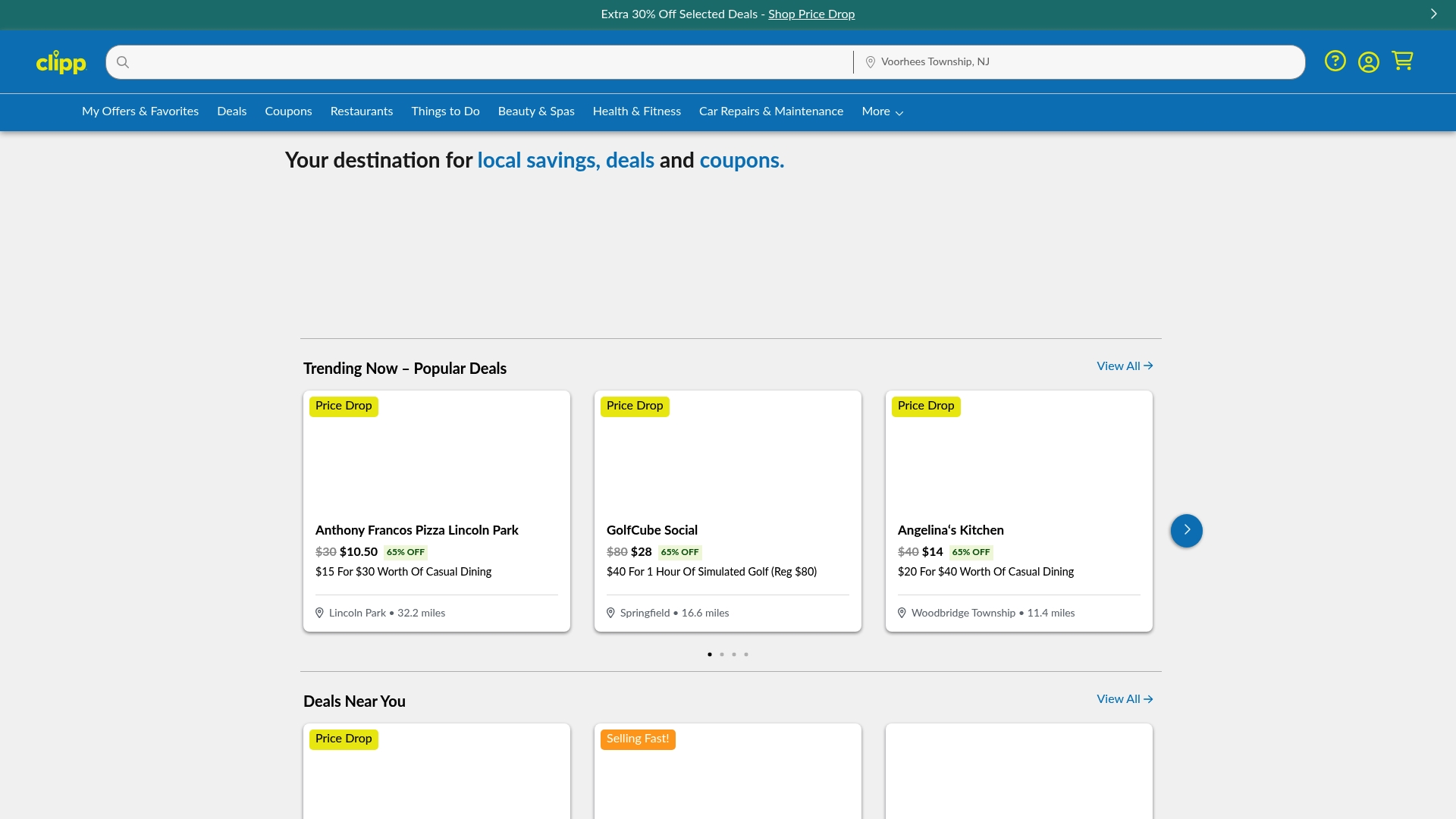
Browse live local deals in Texas or explore Virginia offers to inspect how structured offer pages look in practice. Check the JSON-LD on any Clipp offer page using Google's Rich Results Test to see the schema fields described in this guide implemented on real merchant listings. Ready to see what a fully structured deals platform looks like? Visit Clipp.com and inspect any offer page.
Sources and further reading
Technical references:
- schema.org Offer type: canonical field definitions for
Offer,AggregateOffer, andProduct - Google Search Central: Structured Data: implementation guidance and Rich Results Test
- FTC guidance on endorsements and reviews: relevant for merchant verification and review display
Strategy and research:
- Is SEO Dead? The Future of SEO in 2026 | Gist: SEO/AEO/GEO framework and channel-specific source analysis
- Stop Calling It SEO: 12 Strategies To Dominate AI Search in 2026 | Moz: AI-visibility baselines and entity SEO tactics
- How AI Search Is Reshaping Link Building Strategy in 2026 | Search Engine Land: entity SEO and unlinked mention value
- The Future of SEO in 2026 | IvanHub: agent-parseability audit and KPI framework
- Marketing trends | Ahrefs: agentic commerce readiness signals
- The future of SEO | HubSpot: zero-click growth and AEO adoption data
- Digital Marketing Trends & Predictions 2026 | Neil Patel: LLMO, dynamic funnels, and social search behavior
- Understanding the Future of SEO | SEO Analytic: privacy-first SEO and first-party data strategies
For engineers: Start with the schema.org Offer spec and Google's Rich Results Test. Run the IvanHub five-step agent-parseability audit against your top 20 offer pages before any other technical work.
For PR and marketing leads: Read the Moz and Search Engine Land pieces on entity SEO. Build your AI-visibility baseline before your next PR campaign so you can actually measure whether the mentions moved the needle.