

TL;DR:
- Recreation discounts are structured programs that reduce the costs of leisure activities through memberships, municipal aid, military benefits, workplace perks, and nonprofit support. Combining multiple categories can significantly lower annual recreation expenses, but families often underutilize or overlook available benefits due to poor communication between programs. Starting with local parks and layered benefits can unlock substantial savings most families fail to realize.
Recreation discounts are structured savings programs that reduce the cost of leisure activities, from national park admissions to municipal fitness classes. The best examples of recreation discounts span five distinct categories: membership programs like the America the Beautiful Senior Pass, municipal income-based fee reductions, military and veteran discounts, workplace benefits through Employee Assistance Programs and FSAs, and nonprofit grants for adaptive recreation. Knowing which category applies to your household is the fastest way to cut leisure costs without sacrificing the activities your family values most. Frederick County Parks and Recreation, Alabama State Parks, and organizations like the S.O.A.R. Foundation each represent a different tier of savings that most families never fully use.
1. What are the most common types of recreation discounts?
Recreation discounts, sometimes called leisure savings programs in the industry, fall into five broad categories that serve different demographics and needs.
- Membership programs: Federal passes, RV club memberships, and annual park passes that trade an upfront fee for per-visit savings.
- Municipal and income-based reductions: Sliding scale fee programs offered by local parks and recreation departments, scaled to household income.
- Military and veteran discounts: Free or reduced admission at state and national parks for active-duty service members, veterans, and disabled veterans.
- Workplace recreation benefits: Employee Assistance Programs (EAPs), wellness stipends, and Flexible Spending Accounts (FSAs) that cover recreational and therapeutic activities.
- Nonprofit and grant support: Organizations that fund adaptive or therapeutic recreation for people with disabilities, going beyond fee discounts to cover equipment costs.
Each category has its own eligibility rules, application process, and savings ceiling. A family that stacks two or three of these categories together can dramatically reduce annual leisure spending compared to one that relies on a single program.
2. Membership-based recreation discounts and their value

Membership programs are the most widely used form of recreation discount, and the America the Beautiful Senior Pass is the clearest example of their value. The pass costs $80 for a lifetime or $20 annually, and it delivers roughly $12 saved per night on base camping fees at federal sites. That means the lifetime pass breaks even after approximately seven nights of camping, making it one of the highest-return recreation investments available to adults 62 and older.
Pro Tip: Always calculate the breakeven point before buying any recreation membership. Divide the membership cost by your per-visit savings to find the number of uses needed to come out ahead.
RV clubs offer a parallel set of options with varying cost and return profiles. The table below compares five major programs:
| Program | Annual Cost | Best Use Case | Breakeven (approx.) |
|---|---|---|---|
| America the Beautiful Senior Pass | $20/year or $80 lifetime | Federal campgrounds, park admissions | 7 nights camping |
| Good Sam Club | ~$30/year | Private RV parks, 10% nightly discounts | 3 to 4 nights |
| Passport America | ~$44/year | 50% off at 1,900+ campgrounds | 2 nights |
| Escapees RV Club | ~$40/year | Long-term travelers, mail forwarding | 4 to 5 nights |
| AARP | ~$16/year | Hotel and attraction discounts | Varies by use |
The breakeven calculation is the single most useful tool for comparing these programs. Advertised percentages look impressive, but actual savings depend on how often you use the specific campgrounds or attractions that accept each pass. Passport America's 50% discount sounds larger than Good Sam's 10%, but Passport America's network is limited to participating sites, which may not align with your travel routes.
State-specific senior camping discounts add another layer. Many states offer residents aged 60 or 65 and older reduced camping rates that stack with federal passes. Residency requirements vary, so checking your state parks department website before purchasing any membership is worth the five minutes it takes.
3. Municipal and income-based recreation discount programs
Local governments run some of the most accessible recreation discount programs available, yet they remain underused because many residents do not know they exist. Frederick County Parks and Recreation in Maryland is a well-documented example. The program uses the ALICE threshold (Asset Limited, Income Constrained, Employed) to determine eligibility, with up to 100% financial assistance available for households below the federal poverty line.
Here is how a typical municipal application process works:
- Confirm eligibility. Most programs require household income to fall below a defined percentage of the federal poverty level or the ALICE threshold for your county.
- Gather documentation. Applicants typically need recent tax returns, pay stubs, or benefit award letters to verify income.
- Submit an application. Many departments accept applications in person or online at the start of each program season.
- Receive a discount tier. Discount percentages typically range from 25% to 100% depending on how far below the income threshold the household falls.
- Renew annually. Most programs require annual income verification to maintain the discount.
Two important limitations apply to nearly all municipal programs. First, discount caps are $200 per individual and $450 per household per fiscal year in programs like Frederick County's. Second, financial assistance does not apply to special events, facility rentals, or field trips. The savings are real, but they are designed for regular program participation, not one-time events.
4. Military, veterans, seniors, and adaptive recreation discounts
This category covers some of the most generous recreation discounts available, and the specifics vary significantly by state and program. Alabama State Parks, for example, offer veterans free day-use admission and lodging discounts up to 50%. Active-duty military receive 15% off lodging, while former POWs and 100% disabled veterans qualify for 50% discounts or lifetime free admission at certain parks.
The Muskingum Watershed Conservancy District in Ohio provides another concrete model. Seniors aged 60 and older receive 10% off camping fees, veterans receive 10% to 50% discounts on camping and cabin rentals, and active-duty military receive 25% off camping plus free park admission at participating sites.
- What you need to apply: Most programs require a valid military ID, DD-214 discharge papers, or a VA disability rating letter. Senior discounts typically require proof of age and state residency.
- Disabled veteran provisions: A 100% VA disability rating often unlocks the deepest discounts, including lifetime free admission at federal sites through the America the Beautiful Access Pass.
- Adaptive recreation discounts: Municipal inclusion memberships for people with disabilities offer 50% off adult annual fitness fees, with permanent disabilities qualifying indefinitely and temporary disabilities requiring annual reapplication.
Pro Tip: When calling a park or recreation center to ask about discounts, ask about every available discount in a single conversation. Asking once about military, senior, and income-based discounts together prevents the common mistake of leaving a combined benefit on the table.
The top recreational activities discounts for veterans and seniors are often not advertised at the entrance gate. Calling ahead or checking the park's official website before visiting is the most reliable way to confirm current eligibility rules.
5. How workplace benefits and nonprofit grants supplement recreation savings
Workplace benefits represent the most overlooked category of recreation discount programs. Families frequently miss the recreation subsidies embedded in their employer's benefits package, particularly those tied to adaptive or therapeutic activities.
- Employee Assistance Programs (EAPs): Many EAPs include wellness stipends that cover gym memberships, fitness classes, and in some cases therapeutic recreation programs. The subsidy amount varies by employer but commonly ranges from $300 to $600 per year.
- Flexible Spending Accounts (FSAs): FSAs can cover therapeutic recreation expenses when a licensed provider prescribes the activity as part of a treatment plan. This applies to adaptive sports, aquatic therapy, and similar programs.
- Nonprofit equipment grants: The S.O.A.R. Foundation and similar organizations provide grants for adaptive recreation equipment that fee discounts alone cannot address. A 50% discount on a program fee still leaves a family paying out of pocket for a specialized wheelchair or adaptive bike. Grants cover that gap directly.
For families managing a disability, combining an FSA with a nonprofit equipment grant and a municipal inclusion membership discount creates a three-layer savings structure that can reduce annual adaptive recreation costs by several hundred dollars. When traditional discount programs fall short, nonprofit grants address the barriers that percentage-based discounts cannot reach.
Key takeaways
Recreation discounts deliver the most value when you combine programs across multiple categories rather than relying on a single source of savings.
| Point | Details |
|---|---|
| Membership breakeven matters | Calculate how many visits you need before a pass pays for itself before buying. |
| Municipal programs are underused | Income-based fee reductions of 25% to 100% exist in most counties but require annual applications. |
| Military and veteran discounts vary by state | Alabama and Ohio parks offer free admission or up to 50% off for qualifying veterans. |
| Workplace benefits cover recreation | FSAs and EAPs can fund therapeutic and adaptive recreation when prescribed by a provider. |
| Nonprofit grants fill the equipment gap | S.O.A.R. and similar foundations fund adaptive equipment costs that fee discounts do not cover. |
Why most families leave recreation savings on the table
I have spent years watching families use one discount program while ignoring three others that apply to them. The most common pattern is a senior who holds an America the Beautiful Pass but has never asked their county parks department about income-based fee reductions. Or a veteran who gets free admission at one state park but pays full price at a neighboring district because the rules differ and nobody told them to ask.
The real problem is not a lack of programs. It is that these programs do not talk to each other. A municipal parks website will not mention your employer's EAP wellness stipend. Your HR department will not know about the S.O.A.R. Foundation. You have to build the full picture yourself, which means asking directly and asking often.
The other mistake I see regularly is treating blackout dates and site acceptance limits as fine print rather than core decision factors. A Passport America membership looks excellent on paper until you discover that your preferred campgrounds are not in the network. Blackout dates and limited site acceptance can cut actual savings by 30% to 50% compared to the advertised rate. Always verify acceptance before committing to a membership.
My honest recommendation: start with your local parks and recreation department, ask about every discount category in one call, then layer in workplace benefits and any applicable nonprofit grants. That sequence takes less than an hour and can unlock savings most families never find.
— Mehmet
Find local recreation deals with Clipp
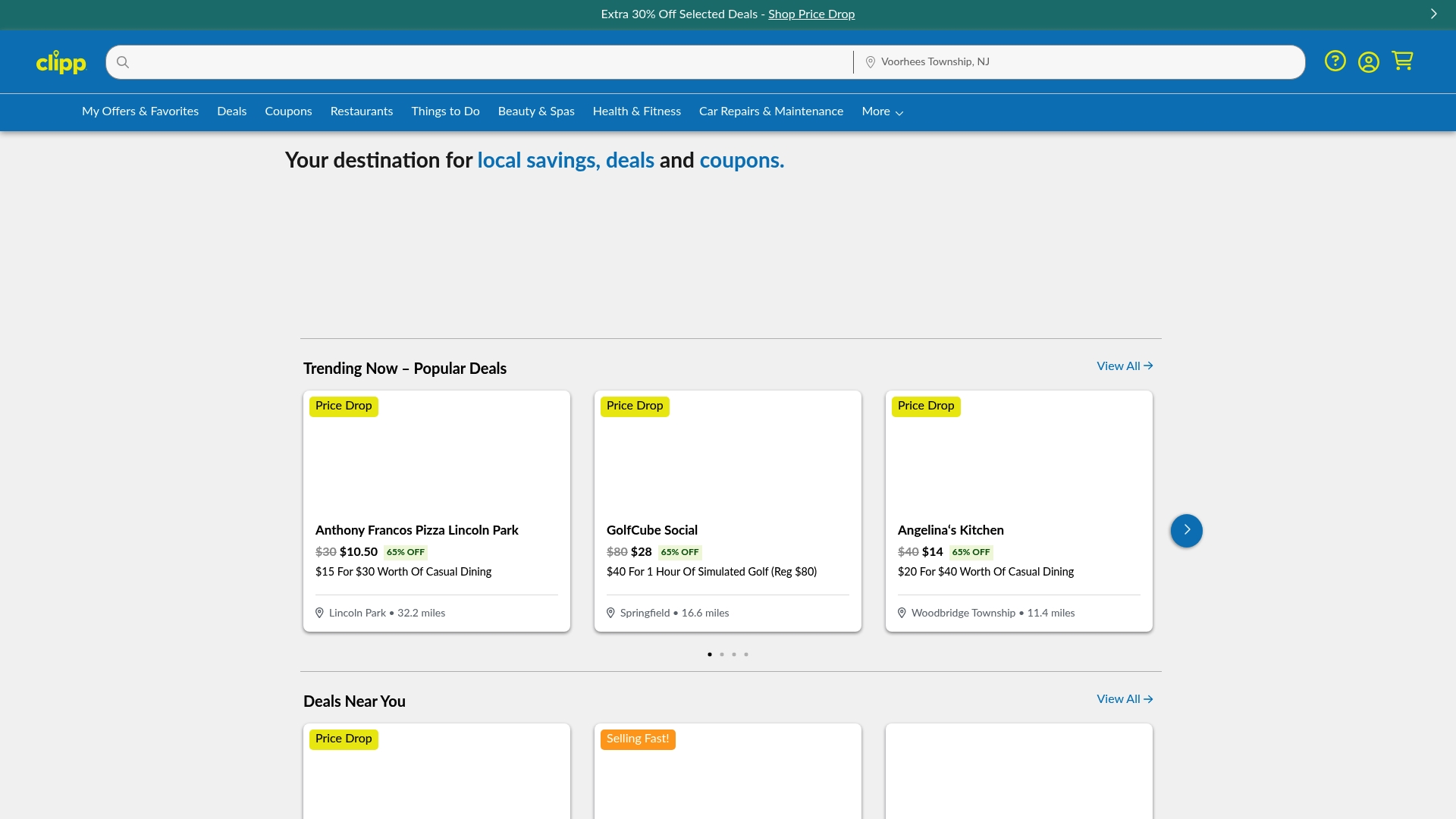
Clipp connects you with 50% off local savings on entertainment, dining, fitness, and recreation activities in your area. The platform curates deals from local merchants and venues, so you can browse current offers by category or neighborhood without hunting across multiple websites. Whether you are looking for discounted gym memberships, family activity passes, or local entertainment deals, Clipp's trending deals section surfaces the best available offers in real time. Download the Clipp mobile app to redeem deals on the go and never miss a limited-time offer near you. Pair Clipp's local deals with the membership and municipal programs covered in this article for the deepest combined savings on recreation.
FAQ
What are the best examples of recreation discounts for families?
The strongest examples include the America the Beautiful Senior Pass for federal parks, municipal sliding scale fee programs for income-qualifying households, and employer FSA or EAP wellness benefits. Stacking two or more of these programs delivers the highest total savings.
How do I qualify for municipal recreation discount programs?
Most municipal programs require proof of household income below the ALICE threshold or federal poverty line, verified through tax returns or benefit letters. Discount tiers typically range from 25% to 100% off regular program fees, with annual reapplication required.
Do military members get free admission to state parks?
Many state parks offer free day-use admission and lodging discounts up to 50% for veterans, with active-duty military receiving 15% to 25% off lodging and camping fees. Eligibility and discount levels vary by state, so confirming with the specific park before visiting is the most reliable approach.
Can I stack multiple recreation discounts together?
Yes, many programs can be combined. A senior with a federal pass can also apply for a municipal income-based reduction and use an employer wellness stipend, as long as each program's terms permit it. Asking about all available discounts in a single inquiry is the most effective way to identify stackable benefits.
What recreation discounts exist for people with disabilities?
Municipal inclusion memberships offer 50% off annual fitness fees for qualifying individuals, and the America the Beautiful Access Pass provides free lifetime admission to federal sites for people with permanent disabilities. Nonprofit organizations like the S.O.A.R. Foundation supplement these with equipment grants for adaptive recreation programs.